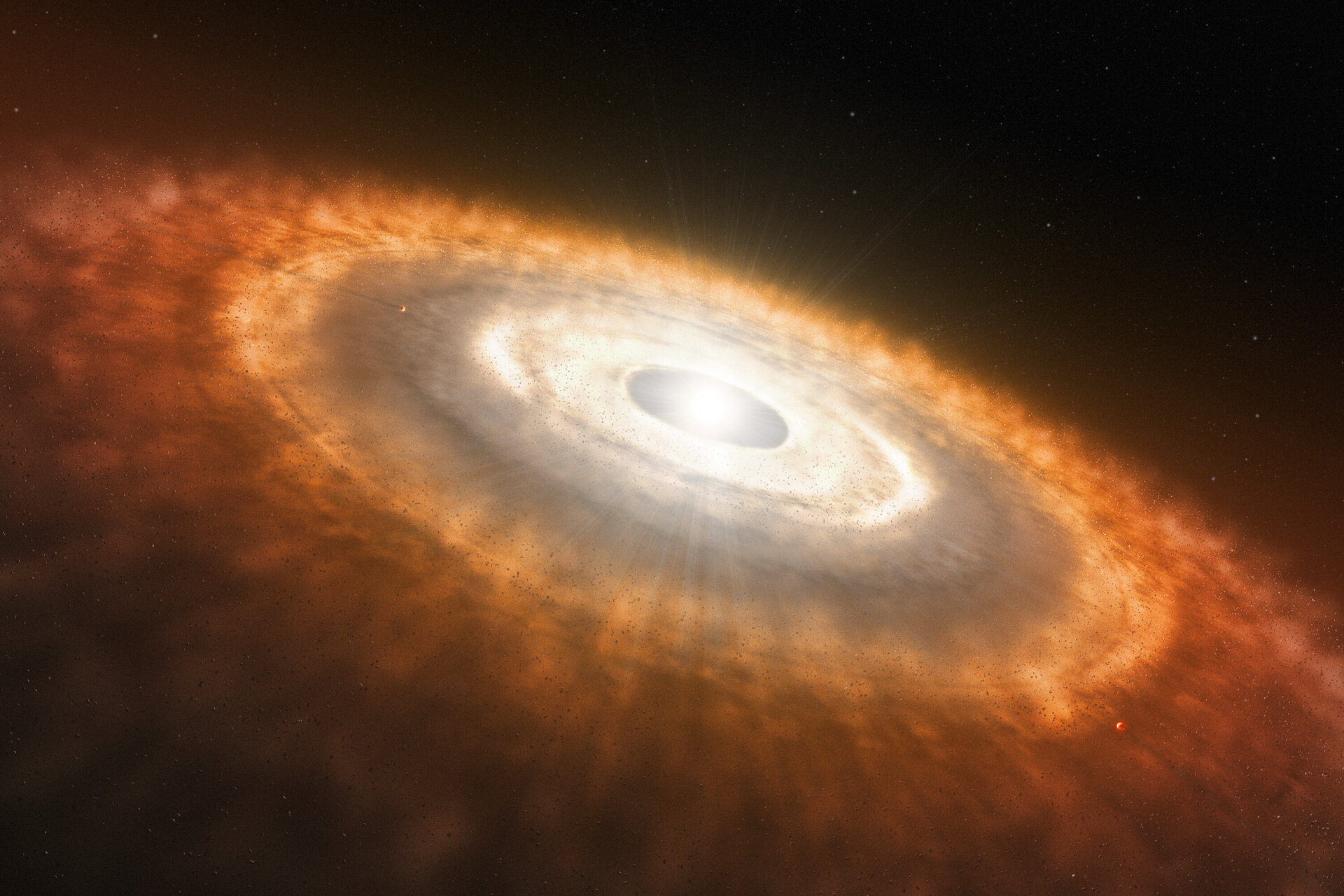
This is an artist’s impression of a young star surrounded by a protoplanetary disc in which planets are forming. An international team of astronomers have used the NASA/ESA/CSA James Webb Space Telescope to provide the first observation of water and other molecules in the inner, rocky-planet-forming regions of a disc in one of the most extreme environments in our galaxy. These results suggest that the conditions for rocky-planet formation, typically found in the discs of low-mass star-forming regions, can also occur in massive-star-forming regions and possibly a broader range of environments.
Because of its location near several massive stars in NGC6357, scientists expect XUE 1 to have been constantly exposed to a high ultraviolet radiation field throughout its life. However, in this extreme environment the team still detected a range of molecules that are the building blocks of rocky planets.
“NASA will hold off sending commands to its Mars fleet for two weeks, from Nov. 11 to 25, while Earth and the Red Planet are on opposite sides of the sun. Called Mars solar conjunction, this phenomenon happens every two years,” NASA said in a statement.
It’s funny that Live Science just announced this three days…given that the time period in which Mars is directly behind the Sun opposite the Earth only lasts from November 11th through November 25th.
The comet has a core of dust, gas and ice surrounded by a bright cloud of gas known as a coma. Sunlight and solar radiation can heat the comet’s core, sometimes causing violent outbursts like the ones observed in July and Oct.
Herman said the comet’s temporary horns are thought to originate from these icy eruptions. The comet’s structure may be shaping how the spewed clouds of gas and ice appear from Earth, creating the appearance of horns to ground-based telescopes.
ESA image. Gateway is planned to be much smaller and more cramped than ISS (about 1/6 the size).
NASA and its international partners see Gateway as a key platform to support the agency’s Artemis moon program and to build the technology required for future deep-space missions. Although the first elements of the small space station are expected to launch before the Artemis 3 mission lifts off in 2025 or 2026, NASA previously said that those astronauts will not use Gateway to “make that mission have a higher probability of success.”
While it’s a good idea to see some planning for this, I think maybe NASA should focus on getting Artemis 1 to work properly before they go on about Artemis 3 and 4.
Taking advantage of Gateway’s orbit far away from Earth’s protective magnetic field, three instruments will study risks due to radiation from the sun and from cosmic rays. Scientists hope this knowledge can help inform future long-term missions to the moon and Mars.
Since Gateway will orbit the Moon and not the Earth, the biggest problem will be preventing astronauts (and instruments!) from getting fried by solar radiation. Scientists need to come up with materials to shield people on Gateway and the Moon, or else we’re going nowhere…
One main reason for landing at the Moon’s South Pole is that the presence of water would help us build permanent settlements…
This region on the moon is an attractive place for humans to build a lasting presence due to the fact that water ice is located underfoot. Future moon-dwellers can potentially tap into that water for consumption, or even to create rocket propellant, instead of depending on water shipped from Earth.
Another reason has now been found…iron, manganese, aluminum, titanium…and “surprisingly” sulfur. Why should they be surprised? It’s already been established that the Moon has ice, and sulfur forms every time hydrocarbon and sulfates combine. Plus sulfur obviously results from volcanic activity, and it’s likely the Moon was volcanic when it first formed. And sulfur is also produced through nuclear fusion – i.e., the Sun.
So what can we do with this knowledge?
Having a more complete chemical composition of the lunar south pole area means future travelers to — and possible inhabitants of — the region can also plan for what else they don’t need to bring from Earth. In particular, some scientists have suggested moon-dwellers could use sulfur in bits of infrastructure such as building materials, solar cells and batteries.
Hmmm…I think more studies are needed first…define “bits,” for example.
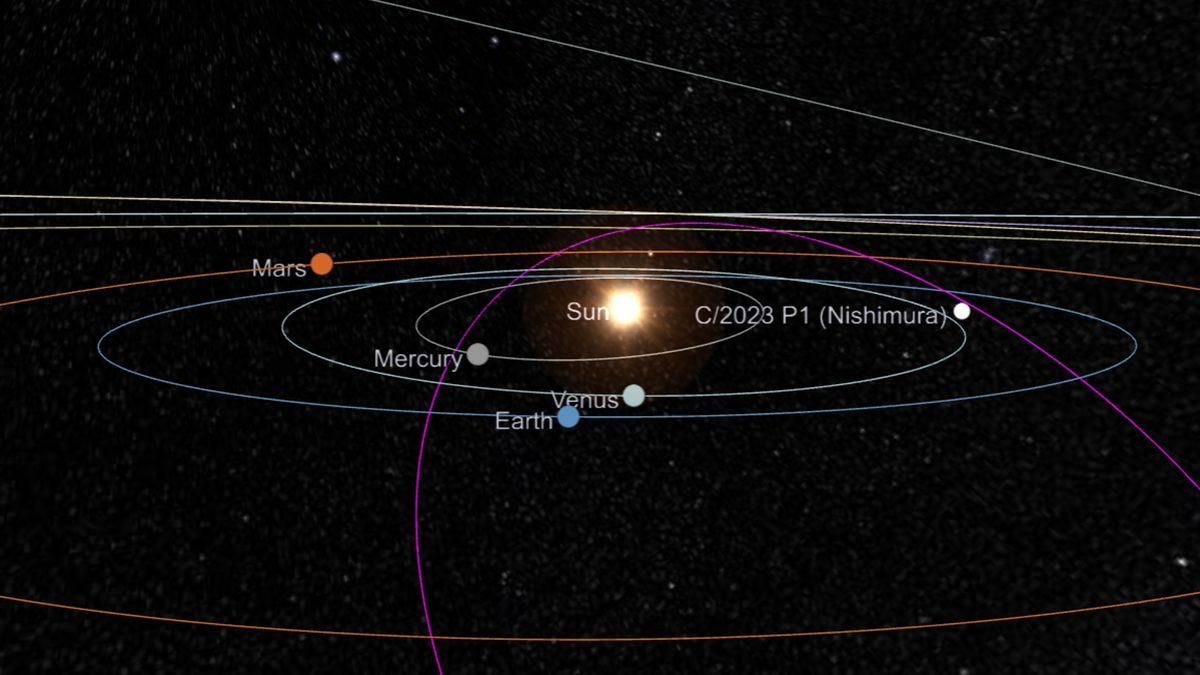
Comet Nishimura’s orbit means that this is likely its first and final trip through the inner solar system. It is possible that the comet originated outside our star system, which would make it the third known interstellar object ever detected, following ‘Oumuamua — which some astronomers speculatively suggested was an alien spacecraft — and Comet 2I/Borisov.
Discovered just two weeks ago by an amateur Japanese astronomer (after whom the comet is now named), the comet Nishimura will approach Earth at its closest on September 13th. But it will be at its brightest about five days later as it approaches the Sun.
Its fate?
Astronomers don’t know when the possible interstellar interloper will depart the solar system. However, it is also possible that the intense force of the comet’s solar slingshot will rip its solid nucleus apart, according to NASA.
Also, its nucleus gives off a “green glow,” which is the result of sunlight breaking apart dicarbon, or diatomic carbon. So getcher geek on, chemical lab rats!
A NASA mission has observed a supermassive black hole pointing its highly energetic jet straight toward Earth. Don’t panic just yet, though. As fearsome as this cosmic event is, it’s located at a very safe distance of about 400 million light-years away.
The two planets are in circles that kind of look like, er….let’s just call the whole thing a cosmic donut (the outer “halo” is the protoplanetary disc of gas and dust from which planets eventually coalesce).
We already know that more than one object can share the same orbit; Jupiter has a collection of 120,000 asteroids following its same path around the Sun, for example. Earth has one, too. But although it’s theoretically possible, astronomers have never discovered two whole planets sharing the same orbit around a star before.
Hmm…the language here is a bit misleading. The two objects are technically not both “planets.”
The article comments later on that the object in the dotted line circle is “a cloud of debris about twice the mass of our Moon trailing a bit behind the innermost gas giant” in one of its LaGrange points (where “Trojan” asteroids follow gas giants such as Jupiter and Saturn). So it’s way too early to say that “two” planets formed in the same orbit.
Still, this is the first time that astronomers have spotted two such objects this close to one another in the same orbit. Who knows if both will remain viable (the debris cloud could become partly or mostly absorbed by the gas giant with the rest either being expelled or thrust into separate orbits).
So why is this called a “cosmic unicorn”?
Apparently because although such Trojans “are allowed to exist by theory, but no one has ever detected them.”
Um. OK.
So, like, totally NOT at all like this? Kind of a bummer, really…
“If we want to develop the Moon as an outpost, a gateway to deep space, then we need to carry out many more explorations to see what sort of habitat would we be able to build there with the locally-available material and how will we carry supplies to our people there,” Mr Annadurai says.
Chandrayaan-1 was India’s first successful Moon launch in 2008 — it deliberately crashed in order to measure the amount of water at the South Pole.
Chandrayaan-2 was only partly successful, as it did put an orbiter around the Moon, but the rover crashed. (The orbiter is still there, sending back information on a regular basis.)
Now, Chandrayaan-3 aims to finally land a rover and do some research exploring.
Let’s hope they can get it to land safely this time…
1. I know it to be certain that the wording of this prompt is a bit odd. Is this meant to mean “know to be true”?
2. I know it to be absolutely certain that there are many things about which I am far from certain.
3. I also know it to be absolutely certain that at least one of the things I know to be certain will annoy at least one person who reads this.
4. I also also know it to be absolutely certain that at least one of the things to know to be certain will amuse at least one person.
5. One of these things I know to be absolutely certain may even irritate and amuse the same person (👈 maybe even this one right here).
6. I even know it to be absolutely certain that writing a list of ten things that are absolutely certain takes a considerably longer time than I had initially anticipated.
7. Just to be sure I irritate someone, it is absolutely certain that the world is a warmer place than it was when I was a kid 40 years ago.
8. The fact that June 2023 was the hottest month on record is absolutely certain.