My short story “Two Strikes Against” was selected as the Winner in the inaugural Next Generation Short Story Awards! (Official list to be available next week.) UPDATED: Link here https://shortstoryawards.com/winners.php?year=2024
Basically it’s a story about a Japanese baseball player on Mars, with a twist. It got rejected a couple of years ago by several scifi magazines, so I figured why not try the sports category.
Especially since there was no scifi category.
Just grateful and thankful for the award. I hope you all get a chance to read the story!
(FWIW “Marsball” is mentioned by characters in an early chapter of Bringer of Light. In fact, I was going to call the story that. Very glad that I didn’t in the end!)
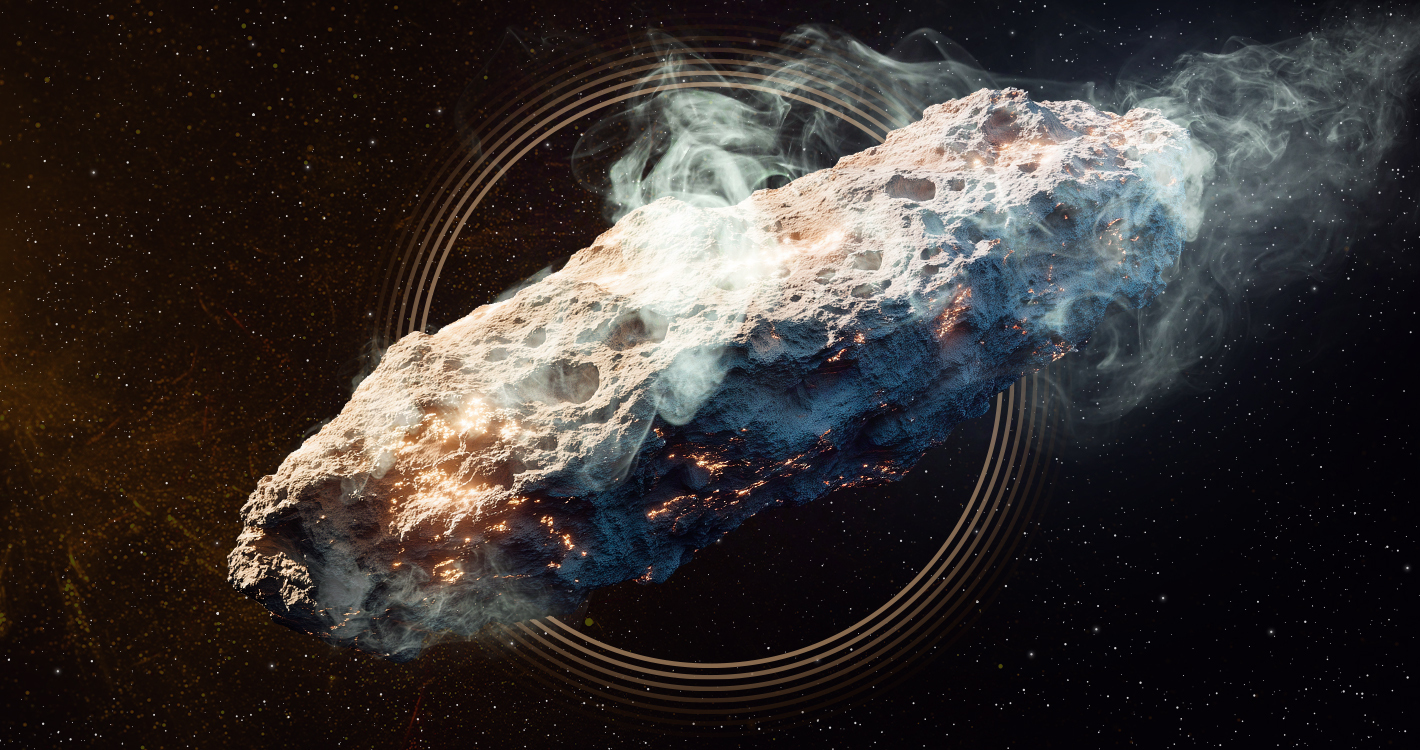
Discovered on July 1 by the NASA-funded ATLAS telescopes in Chile, 3I/ATLAS is only the third confirmed interstellar object known to have passed through our cosmic neighborhood, following 1I/‘Oumuamua in 2017 and comet 2I/Borisov in 2019. Its trajectory shows that it originated from beyond our solar system and will eventually travel back into interstellar space.
Of course, Avi Loeb has already claimed (once again) that an interstellar comet is an “alien probe.”
And naturally, other astrophysicists immediately refuted him. Again.
It’s fast. REAL fast. So fast that even as it entered the solar system it was traveling the distance from the Earth to the Sun in only a month, and then it began to pick up even more speed (from the Sun’s gravity, NOT from “jets out the back” or whatever else unscientific SF fans say online).
Of course, we can assume that the aliens’ spaceship will detach from it precisely during its approach to Mars, or during its passage through perihelion when we cannot see it. In this case, it will have to slow down by more than 20 km/s.
And even so, this will not help the aliens much, because the trajectory will remain retrograde relative to the direction of the planets’ rotation around the Sun. So, if the aliens who flew to us billions of years ago have a plan that is a little more complicated than becoming kamikaze pilots, they will have to slow down again, spending a lot of energy on it. And the aliens still need to get that energy from somewhere.
So, most likely, we should not expect any extraterrestrial visitors at the end of the year. And we will not be able to admire the interstellar comet itself. By the time it emerges from behind the Sun, its brightness will already be approximately 11 stellar magnitudes, meaning it will be inaccessible even to small amateur instruments, let alone the naked eye.
It’s been several months since I last posted…too much work and no play!
Until this past Sunday. Whew.
After a morning lecture about ancient Japanese myths and “deliberately forgotten” kings (maybe), I was grateful to be able to take a quick power nap…
…so that the family could go up a nearby mountain and watch the Geminid meteor shower. (By “mountain,” I mean about 640m/2100ft.)
After a brief lecture/quiz by a staff member at our local culture center, we stayed outside, lying flat on the ground, for over an hour. And, yes, it was cold, despite the sleeping bag and thermal underwear. I saw three shooting stars. Not nearly as many as I’d hoped.
After we got home and took evening baths, the kids went out on our second-floor balcony and found out that the night view was even better at home than on top of a mountain! At least they knew what to look for, thanks to the culture center event.
And by “meteor,” I mean the size of grains of rice. Look to the eastern sky, just a bit to the northwest of Orion, to find the Twins (Castor and Pollux in Greco-Roman mythology).
For more on the origins of the Geminids, check out the JAXA mission to Phaeton, the parent body asteroid. It’s DESTINY!
In two separate papers published Monday in the Astrophysical Journal Letters, astronomers zeroed in on the TRAPPIST-1 system, which consists of seven rocky planets that orbit a single star. Both studies outlined initial results from observations by NASA’s James Webb Space Telescope, suggesting that one planet in particular, known as TRAPPIST-1e, may have a nitrogen-rich atmosphere like Earth’s, though follow-up studies are needed to confirm the discovery.
Trappist 1e is in the “Goldilocks zone” in orbit around its star (i.e., not too cold, not too hot, just right). However, the Webb telescope can’t determine whether its atmosphere has any carbon dioxide, hydrogen, or oxygen, only nitrogen. Yet nitrogen is a clear sign that life is possible, because without nitrogen, DNA and other proteins are not possible. Of course, it could be simply a whole lot of microbes. Or even just ammonia.
Closer to home, the Mars rover Perseverance has found evidence of life in the distant past. Maybe. It found evidence that certain rock features may have happened because of microbes.
May.
That’s how science works, folks. A whole lot of maybes.
This group comprises millions of individuals who are deeply interested in our space programme
The name “Enterprise” is tied in with the system on which the Nation’s economic structure is built.
Use of the name would provide a substantial human interest appeal to the rollout ceremonies scheduled for this month in California, where the aeronautical industry is of vital importance.
It is really too bad that the shuttle looked nothing at all like the Enterprise (Constitution class).
And an odd coincidence that the original name chosen by NASA was…
I wear glasses. I have worn glasses since I was in elementary school 2nd grade — the “aviator” style made of cheap plastic that I frequently broke during recess kickball games and then had to tape together so I could wear them.
I have never figured out how to keep my glasses clean in the subsequent four+ decades of my life.
But I seriously doubt this is “newsworthy.” Cringeworthy, maybe.
Nineteen years ago, my wife and I went to Hiroshima by high-speed ferry boat, on our way back from visiting her parents in Kyushu. Her father’s family comes from Hiroshima (although her father was actually born in Dairen/Dalian (大連), China) and her uncle and his family still live about an hour’s drive north of the city.
(Update from 2020: We visited Hiroshima with the kids for the first time last January, for New year’s 2023.)
Adam’s Stepsons takes the core questions of Blade Runner and distills them into a tight, character-driven drama. It lacks the sweeping visuals of Villeneuve or the noir cityscape of Scott — but it delivers something arguably more intimate:
A quiet horror — and quiet triumph — in the collapse of identity, where the artificial doesn’t just mimic life…
It replaces it.
Over the weekend (my first with no student work to grade — finally! — since April), I decided to ask our “old” friend ChatGPT if it could analyze my sci-fi novella Adam’s Stepsons. Really, I was just curious what it would say.
It said…a LOT.
It correctly interpreted the title (something that many readers apparently didn’t get). It correctly identified the main themes as part of a “post-humanism” sub-genre of science fiction. And once I gave it three short excerpts (from the near the end of the story), it gave a frighteningly accurate thematic and symbolic analysis of the entire novella…just from three short excerpts of a total of about six pages.
I won’t copy all it gave me (you all can go try on your own and see what it says!). But let me share what the program thought were key themes:







 M Thomas Apple Author Page