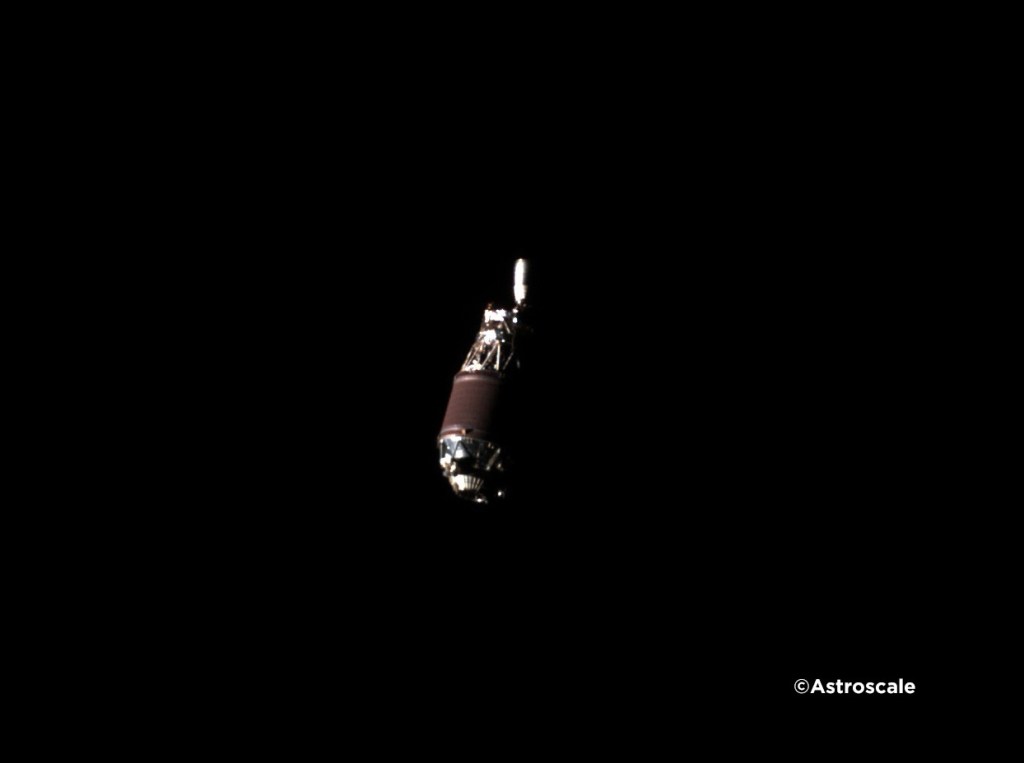
Japanese space company Astroscale Holdings Inc has unveiled what it calls the world’s first publicly released close-up image taken of space debris, hailing it as progress toward understanding the challenges posed by trash orbiting Earth.
There are many words that could be used to describe WASP-76b — hellish, scorching, turbulent, chaotic, and even violent. This is a planet outside the solar system that sits so close to its star it gets hot enough to vaporize lead. So, as you can imagine, until now, “glorious” wasn’t one of those words.
This planet (located in the constellation Pisces) seems to have a rainbow effect of concentric rings…despite being so hot that iron falls from the sky.
This time I figured out how to import the slides directly into mmHmm, and I managed to update my MacOS to Sonoma, which allowed me to use my USB mic (yay). But I also called Ceres a “moon” at some point (it’s not a Moon but a dwarf planet in the asteroid belt near Mars). Oops. Not enough time to edit that bit out or record it again, so just word to the wise! Always fact-check videos, folks. Enjoy!
The asteroids in question are Iris (124 miles / 200 km in diameter) and Massalia (84 miles / 135 km). Both are in the asteroid belt between Mars and Jupiter. Iris is about the size of the US state of Maryland, while Massalia is roughly the size of Connecticut.
Note that the same observatory also found water on the Moon, about a “12-ounce bottle” worth. Not nearly enough for a settlement, but where there’s surface water (albeit trapped in soil on the surface), there’s likely to be more underneath.
So, astronomers need to know both mass and diameter to determine whether a planet is truly similar enough to ours to host some form of Earth-like life. If the planet has a low mass and a large radius, it is likely like a so-called mini-Neptune with a gassy atmosphere and little rock. If it has a higher mass but a smaller radius, it’s probably a rocky planet like ours.
The possibility that TOI-715 b is rocky “would be exciting because that supports it being more of a habitable planet versus some sort of other world,” says Moran.
TOI-715 orbits a red dwarf star around 137 light years away, so we won’t be getting there any time soon. But after finding this planet last year, astronomers also are trying to confirm the existence of another smaller, closer to Earth-sized planet in the habitable zone (i.e., in an orbit that permits liquid water necessary for life to evolve).
And the name of the possibly new “sibling” planet?
A robotic spacecraft made history Thursday becoming the first privately built craft to touch down on the lunar surface, as well as the first American vehicle to accomplish the feat in more than 50 years.
The moment we’ve all been waiting for is nearly here!
Bringer of Light is finally set to be released on March 15, 2024! (Click the link to see a book synopsis and two brief excerpts; Smashwords also has an excerpt from the beginning chapters.)
Stop by Draft2Digital to see links to your favorite bookstore online!
UPDATE: I have some difficulty convincing D2D to distribute to Amazon. Therefore, I have decided to publish Bringer of Light directly on Amazon. Stop by here to order for Kindle (released March 15th). Paperback and hard cover are also in the works.
A study published this weekend in the journal Monthly Notices of the Royal Astronomical Societyproposes that the oldest star in the Milky Way is a faint white dwarf that is about 10.7 billion years old and shining roughly 90 light years away from Earth.
OK, so my post about a big ole spider got the most likes of any post in ten years of blogging about science.
I have so not got the zeitgeist of the 2024 blogosphere lol – anyway, thanks, all, for the “likes”! Although one person used AI to write a very meaningless comment about arachnophobia. What’s the point, man?
By the way, back to science and space stuff. I forgot to post about the Europa Clipper project back in October.
So here you go. (It’s too late to add a message, but the project obviously is going to take some time arriving there, and you can supposedly hear US Poet Laureate Ada Limón read her poem online, although I’ve had trouble with the audio lately:
“Arching under the night sky inky with black expansiveness, we point to the planets we know, we
pin quick wishes on stars. From earth, we read the sky as if it is an unerring book of the universe, expert and evident.
Still, there are mysteries below our sky: the whale song, the songbird singing its call in the bough of a wind-shaken tree.
We are creatures of constant awe, curious at beauty, at leaf and blossom, at grief and pleasure, sun and shadow.
And it is not darkness that unites us, not the cold distance of space, but the offering of water, each drop of rain,
each rivulet, each pulse, each vein. O second moon, we, too, are made of water, of vast and beckoning seas.
We, too, are made of wonders, of great and ordinary loves, of small invisible worlds, of a need to call out through the dark.”