To explore new ways to control this fundamental force of nature, scientists from the City College of New York (CCNY) trapped light inside a magnetic metamaterial and made the material itself 10 times more magnetic in the process.
Next up, magnetic lasers and lots and lots of more magnetic memory savings.
(Note that Popular Mechanics links the phrase “magneto-optical technologies” to an article claiming that the US has somehow managed to reverse-engineer alien technology from crashed UFOs…Um…OK…)
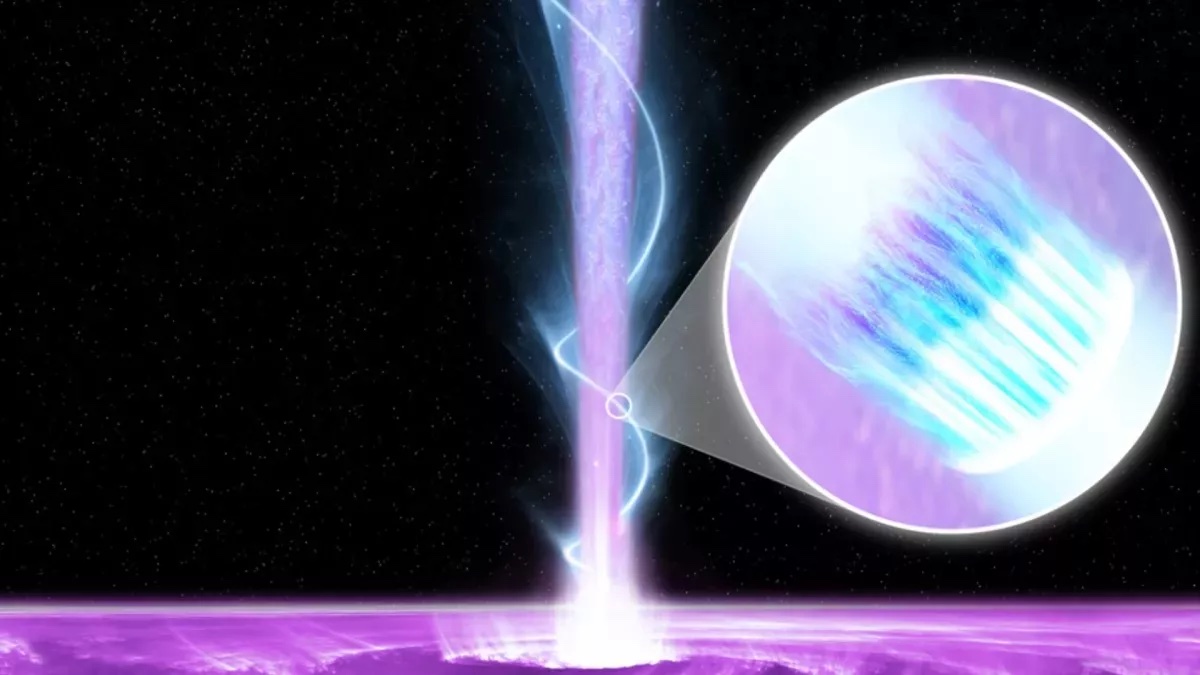
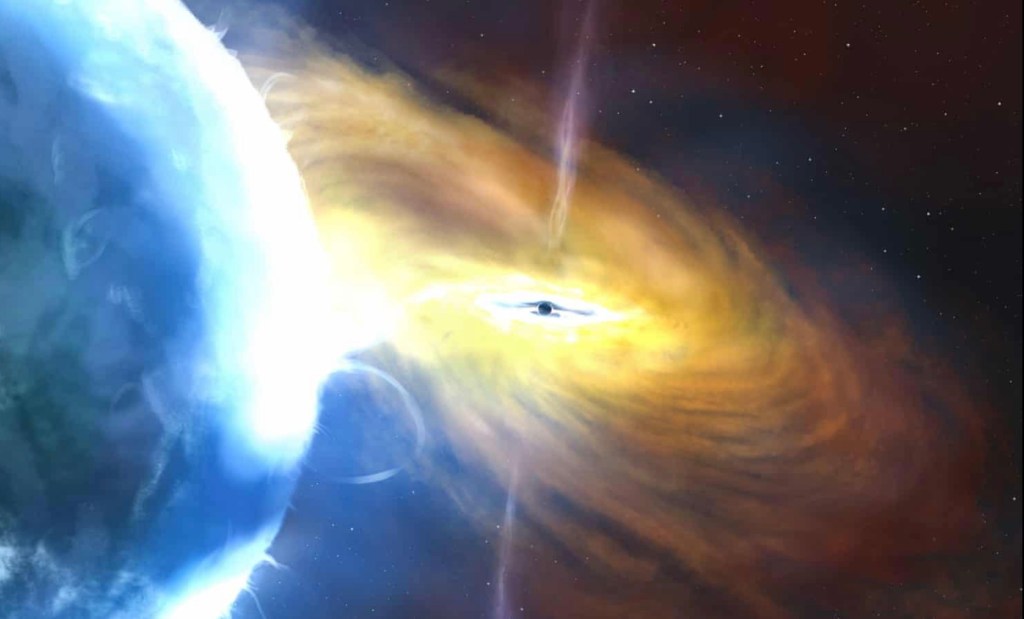
A NASA mission has observed a supermassive black hole pointing its highly energetic jet straight toward Earth. Don’t panic just yet, though. As fearsome as this cosmic event is, it’s located at a very safe distance of about 400 million light-years away.
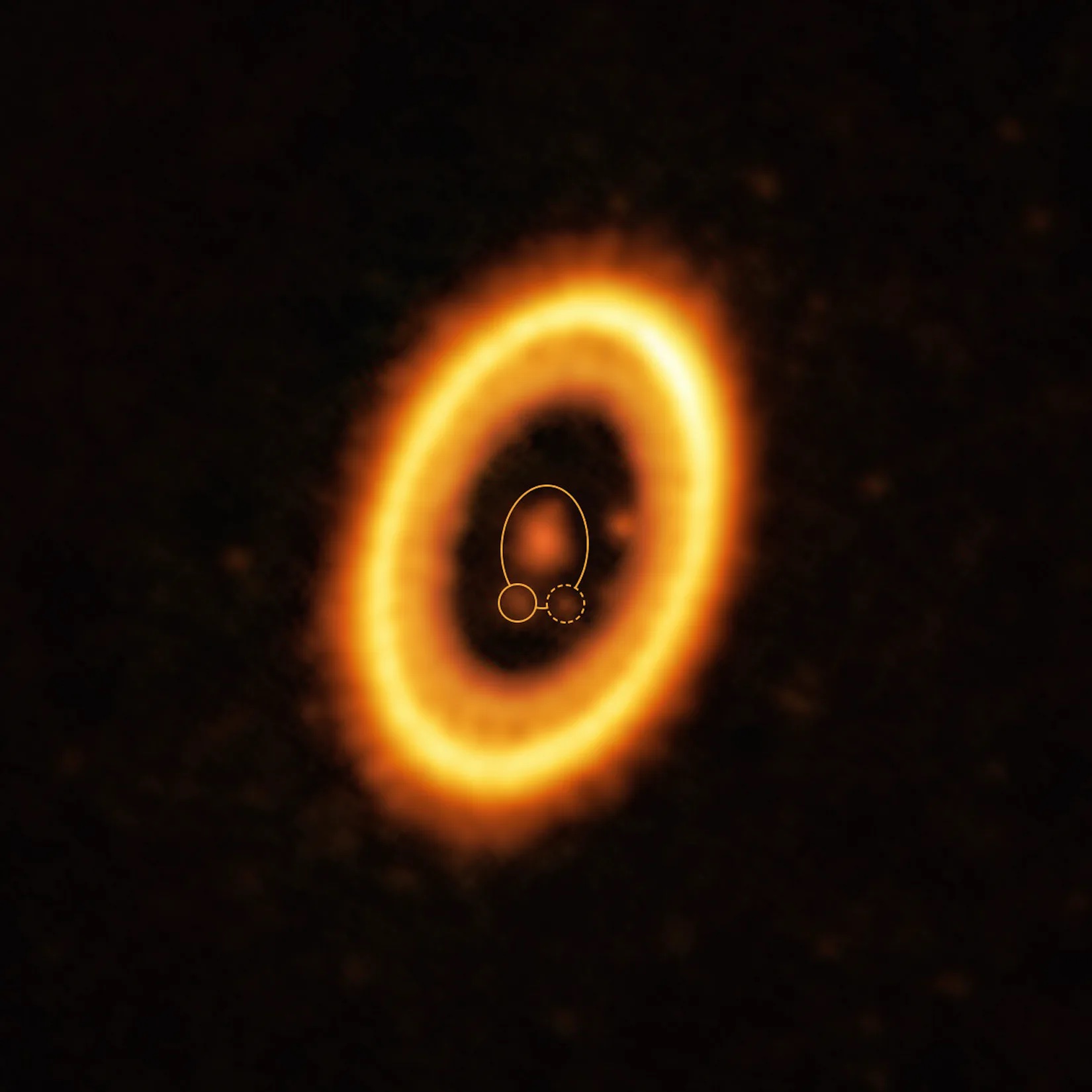
The two planets are in circles that kind of look like, er….let’s just call the whole thing a cosmic donut (the outer “halo” is the protoplanetary disc of gas and dust from which planets eventually coalesce).
We already know that more than one object can share the same orbit; Jupiter has a collection of 120,000 asteroids following its same path around the Sun, for example. Earth has one, too. But although it’s theoretically possible, astronomers have never discovered two whole planets sharing the same orbit around a star before.
Hmm…the language here is a bit misleading. The two objects are technically not both “planets.”
The article comments later on that the object in the dotted line circle is “a cloud of debris about twice the mass of our Moon trailing a bit behind the innermost gas giant” in one of its LaGrange points (where “Trojan” asteroids follow gas giants such as Jupiter and Saturn). So it’s way too early to say that “two” planets formed in the same orbit.
Still, this is the first time that astronomers have spotted two such objects this close to one another in the same orbit. Who knows if both will remain viable (the debris cloud could become partly or mostly absorbed by the gas giant with the rest either being expelled or thrust into separate orbits).
So why is this called a “cosmic unicorn”?
Apparently because although such Trojans “are allowed to exist by theory, but no one has ever detected them.”
Um. OK.
So, like, totally NOT at all like this? Kind of a bummer, really…
Or, how I learned to stop worrying and love the bomb…
“During the adaptation, Stanley ran into a wall: it was impossible to make a successful film about the end of mankind since nobody, himself included, would want to see it. The answer was satire…”
Dr. Strangelove itself was an adaptation of a novel. So I wonder how adapting an adaptation to the stage will work.
How many new lines will they allow? Peter Sellers basically ad libbed everything and Kubrick rewrote the script to match the ad libs.
Probably including this one:
(Btw I hadn’t realized the film won a Hugo Award…along with many other awards…which goes to show how little we actually need Hollywood studios to get great stories in the end…)
Manhattanhenge, a portmanteau of “Manhattan” and “Stonehenge,” is a twice-a-year solar event when the sunset lines up directly with the city’s grid, casting golden rays down city streets. Several of the stones in Stonehenge, the prehistoric monument in Wiltshire, England, experience perfect alignment with the sun during the summer and winter solstices, which is why the event takes its name from the rock formation.
A Japanese telescope positioned on top of Mauna Kea, a dormant volcano on the Big Island of Hawaii, captured video of an eerie flying spiral in the night sky on Jan. 18.
In the video, a small bright spot appears and slowly gets brighter and starts to dissipate into a spiral before getting small again and disappearing.
In fact, it was the remains of a discarded Falcon 9 booster from the launch of a SpaceX satellite. And it isn’t the first time this has happened. Japanese TV talked about this, too (since it was a Japanese astronomy, at the Subaru Telescope, that first recorded it).
So, an Identified Flying Object!
Yay, more metallic junk.
(Thanks to Glen Hill for bringing this article to my attention.)
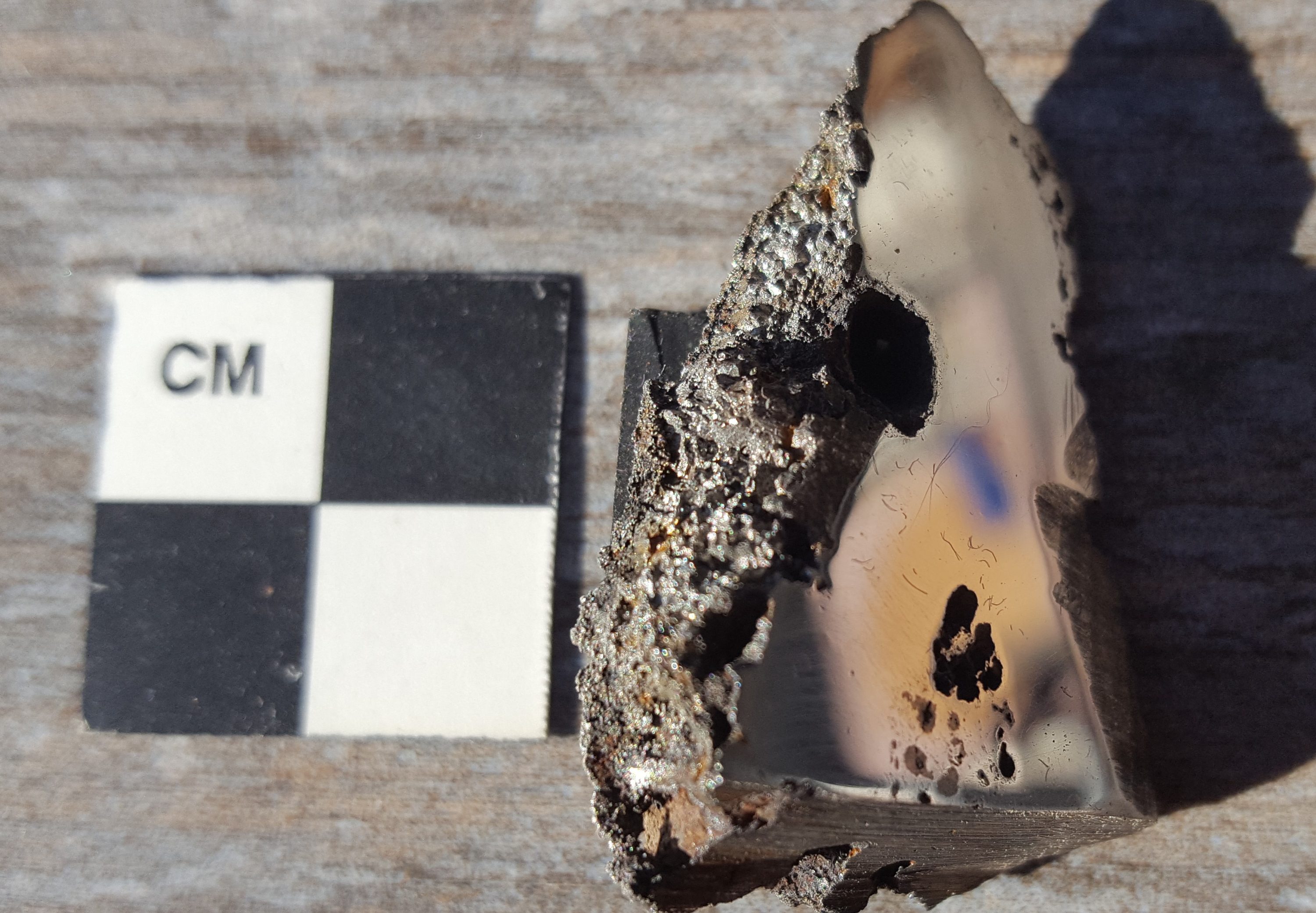
Canadian researchers said the rock was found in rural Somalia two years ago, but locals believe it is much older.
They call the stone Nightfall, and say it is documented in poems, songs and dances that stretch back five generations. It is used today to sharpen knives.
The “new” rock is apparently a meteorite that fell to Earth at least 100 years ago (or more, depending on how you define a “generation”). The two newly-identified minerals are being called “elaliite” (after El Ali, Somalia) and “elkinstantonite” (after NASA planetary evolutionary expert Lindy Elkins-Tanton).
And there’s still one more as-yet-unidentified mineral in the 70-gram rock fragment at the U of Alberta (the original is about 15 tons, and is reported to be the 9th largest such meteorite to have survived entering the Earth’s atmosphere). These three minerals evidently do not exist naturally on Earth. Makes you wonder how many other such minerals are still floating around in space.
And of course, how they might be used to make incredibly strong yet flexible spacecraft materials. (FWIW NASA was already talking about “new” materials such as carbon nanotubes and self-healing piezoelectronic “skins” some twenty years ago…)
Now, maybe it’s just me, but I have a feeling that a 15-ton rock falling into the desert would have raised all sorts of hell. At least locally. Nothing like a 143,000 ton rock, of course. Is there really no record of this thing falling out of the sky? Maybe it’s time to talk to non-European communities and to take their oral legends a bit more seriously.










 M Thomas Apple Author Page