In my dream, I was in the living room of the house in Berne. My parents told me that Chris had died in 1997. I started getting angry, then shouted. I was shouting, “Don’t you understand, I don’t have a family any more.” I was shouting and carrying on so much, that I began to froth at the mouth as if I had rabies. I could not control my emotions, nor my body, and I started shaking violently.
I woke up with the sunlight streaming through my balcony window, and birds and crickets outside in rice fields.
Who needs psychologists when all you need is a few good nightmares.
If you open an early American historical ledger, you will witness a quiet, bureaucratic violence.
On the yellowed pages of parish registers, military rolls, and census tracts, the names of ordinary people undergo a strange, unsettling metamorphosis. A proud Scottish surname is flattened by an English soldier’s hurried quill. A French-Canadian patronym is chopped and mangled to fit the tongue of an Anglo-American land agent. A German-Dutch identity is phoneticized into oblivion by colonial tax collectors.
If you look into your own family history and encounter a sudden, bizarre shift in the spelling of an ancestor’s name, you aren’t looking at a simple clerical mistake.
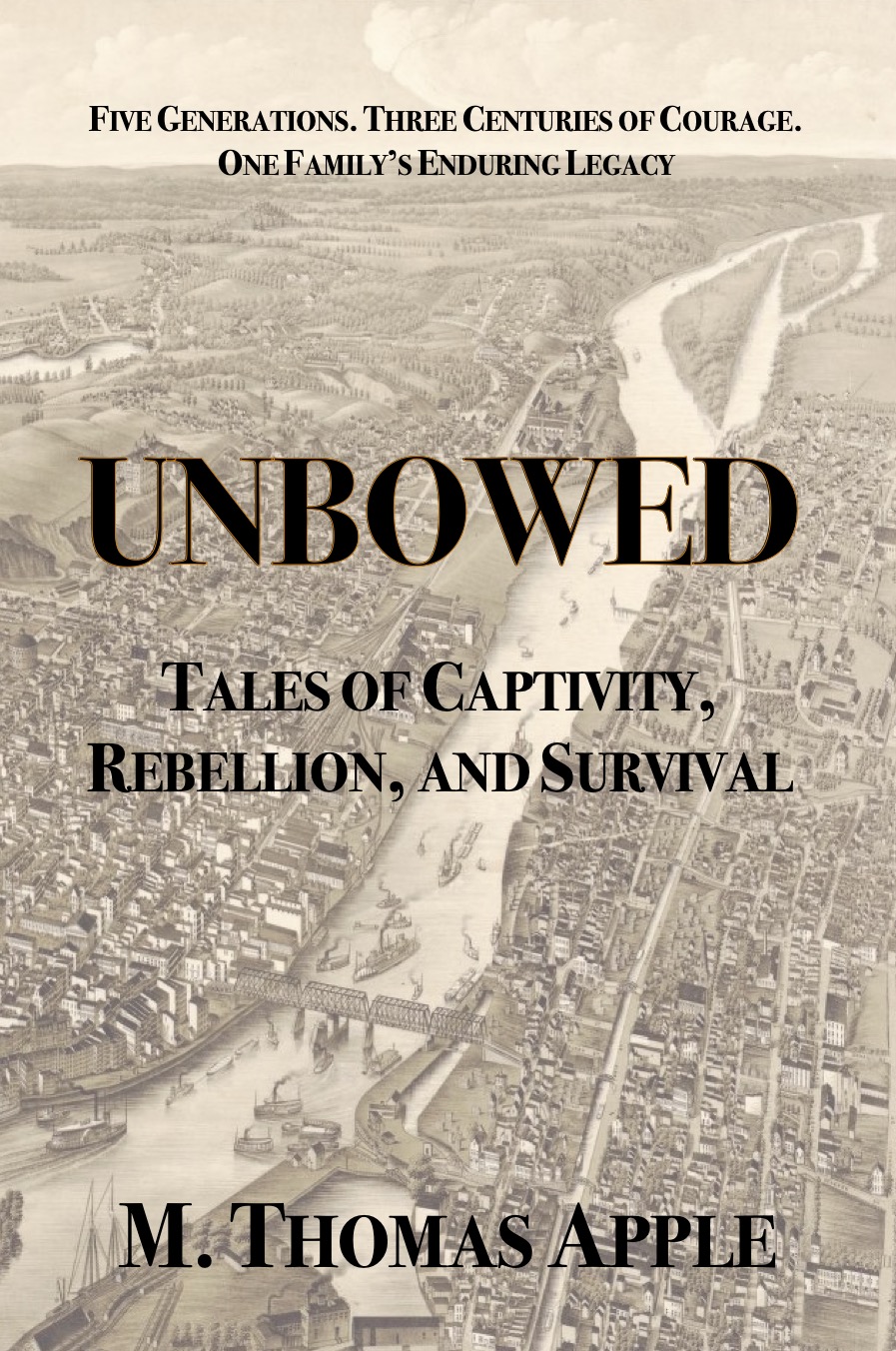
Spanning nearly three centuries of displacement, warfare, and resilience, Unbowed tracks a grand historical mosaic across five distinct cultural lines. It features ordinary people caught in the violent machinery of changing empires:
Part I: A captive Scottish soldier from the English Civil War surviving a harrowing winter crossing as an indentured asset to a rigid Puritan iron works, his family is later tested by the paranoia of the Salem Witch Trials.
Part II: A family fractured by a sudden, brutal wilderness raid in Saratoga, navigating French captivity and cultural adoption inside Mohawk longhouses.
Part III: A Palatine German community torn right down the middle by the fierce, neighbor-versus-neighbor civil conflicts of the Revolutionary War.
Part IV: A bilingual French-Canadian veteran fights for his place on a shifting border, navigating the psychological scars of Civil War combat in la survivance of Cohoes and Troy.
Part V: An immigrant Irish drayman and his literate son fighting to protect their family from a deadly, volatile ballot-box riot in a gritty, industrializing America.
At its core, this volume is about the universal war over identity. In an expanding nation, institutional erasure didn’t always arrive with a bayonet—often, it arrived with an inkwell.
Consider the real historical journey of the German name Bohnenstiehl, filtered through a Dutch-speaking Albany minister before being reformed by English officials into Bonesteel. Or an Anglo-Irish Bushell, phoneticized into Barsell or Bouschel simply because local clerks had never heard it before.
Our ancestors did not survive by remaining rigid. They allowed their names to be rewritten so that their bloodlines could continue to write themselves. They traded the spelling of their past to purchase their future.
Whether your own roots trace back to the colonial frontier or you simply love a sweeping, high-stakes historical epic, Unbowed is a tribute to the unbroken chain of ordinary people who refused to bend.
Over the next few weeks, I’ll be sharing exclusive behind-the-scenes glimpses into the real archival discoveries that inspired these stories right here on the blog.
Thank you for reading, exploring, and reclaiming these voices with me.
All we are, is passages, avenues through which other people travel. We are each others’ byways, highways, continuously passing through each others’ lives. Passengers, drivers, hitchhikers all.
I wear glasses. I have worn glasses since I was in elementary school 2nd grade — the “aviator” style made of cheap plastic that I frequently broke during recess kickball games and then had to tape together so I could wear them.
I have never figured out how to keep my glasses clean in the subsequent four+ decades of my life.
But I seriously doubt this is “newsworthy.” Cringeworthy, maybe.
According to Thorne, who served as a consultant on the science of Interstellar, quantum mechanics could hypothetically explain a way to time travel via wormhole. So far, it’s a thought experiment that leads to the conclusion that you’d lose information along the way—not very practical.
First off, I’m incredibly annoyed at the way WordPress has screwed up the “quotation” function. It seems they are more focused on encouraging bloggers to use AI to write.
Uh. I don’t need AI. I blog. The end. WTH is the point of using AI to write my thoughts? It’s already being trained to USE my blog in the first place! Idiots.
OK. Second, the Popular Mechanics article I’m linking to is entitled “Interstellar travel is possible if we break into a higher dimension, scientists say.”
Only, that is NOT what scientists say. It’s still a thought experiment!
Haven’t posted anything in about five or six weeks. Sorry!
I was going to initially post something about the Boeing crew that got stranded on the ISS, but NASA kept delaying their decision to use SpaceX. It was a given that they’d have no choice.
Boeing, quite obviously, cannot be trusted to spend millions of taxpayer’s dollars and make a proper spacecraft.
Anyway, I’ll start posting something more interesting soon.
In the meantime, here’s a Star Trek TOS selfie by Catwoman. I mean Lee Meriwether. (S3:14, That Which Survives)