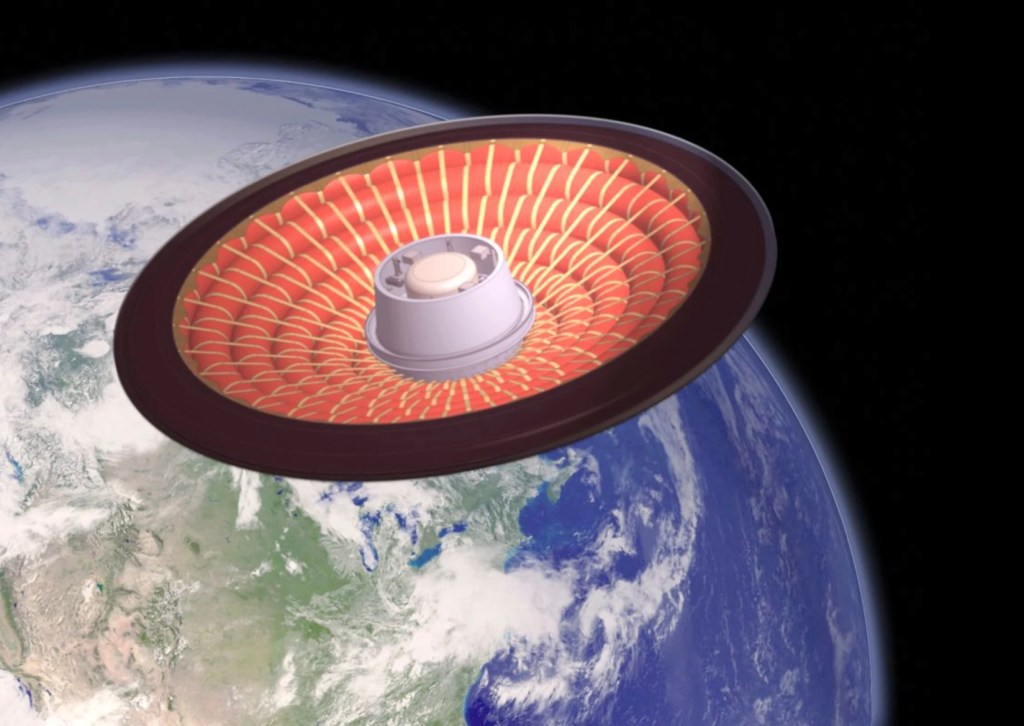
Also, see this one (pay wall, Washington Post) about NASA and DARPA working on one to reach Mars much faster to reduce astronauts’ exposure to radiation.
I still think “durp” every time I see that acronym 😝
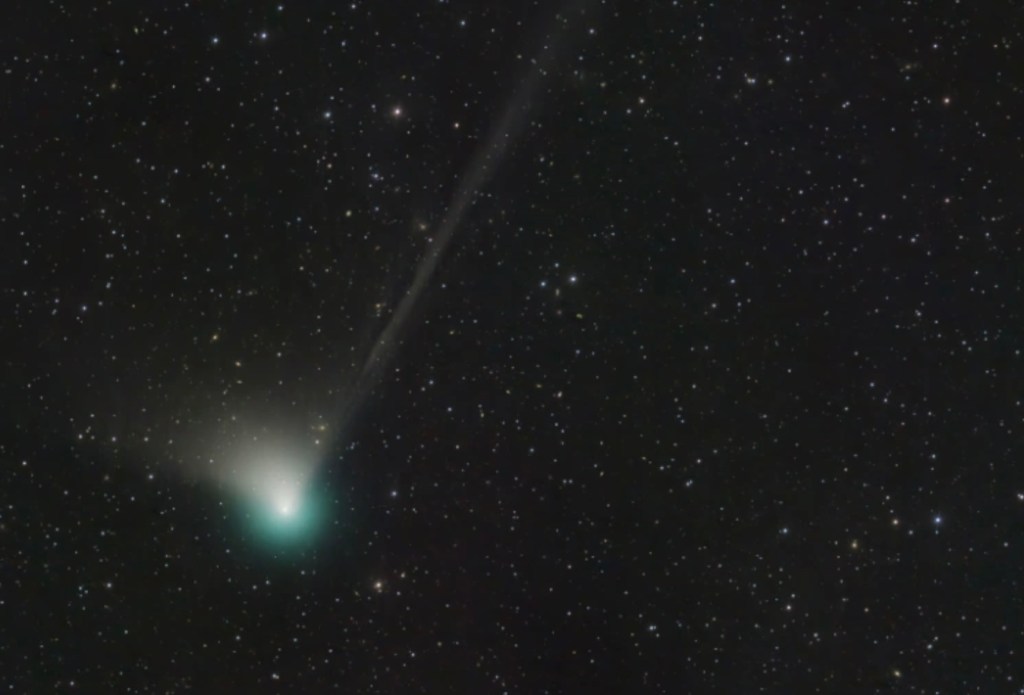
A comet from the outer solar system is set to buzz Earth on Wednesday and skywatchers have a chance to glimpse the celestial object as it journeys through our cosmic neighborhood for the first time in 50,000 years.
If by “Wednesday” you mean “Wednesday in North America. There is no “on Wednesday” worldwide, thanks.
Observers in the Northern Hemisphere should look northeast just after the Moon sets and before dawn. You should be able to see it with a good pair of binoculars.
The last time Comet C/2022 E3 (ZTF) made a visit, Homo sapiens still had Neanderthal neighbors, so this is your one and only! ☄️
Though definitions sometimes differ, cislunar space generally refers to the space between Earth and the moon, including the moon’s surface and orbit. Any nation or entity that aims to establish a presence on the moon, or has ambitions to explore deeper into the solar system, has a vested interest in operating in cislunar space, either with communication and navigation satellites or outposts that serve as way stations between Earth and the moon.
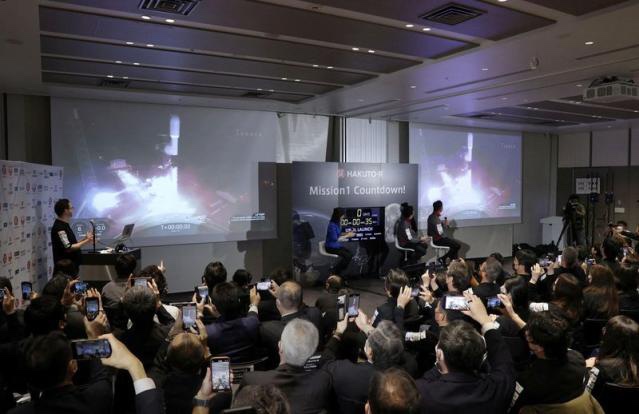
A Japanese start-up (I.e., a small private company)…
using a SpaceX rocket (I.e., a private company owned by the world’s wealthiest pri…er, person)…
sends up a small craft made in Germany… 🇩🇪
along with the Rashid rover (made by the UAE)…
and “a two-wheeled, baseball-sized device from Japan’s JAXA space agency”…
and somehow this is cooperation between the US and Japan versus China and Russia?
I’m not seeing it. The project may have used a NASA launchpad, but the people are charge (and the ones paying for it) are not part of any national government.
And I have a feeling this is the wave of the future. More and more private companies will get involved in space projects as they realize that they can thus ignore politics and aim at profits.
I, for one, welcome our future corporate overlords…
Half of a dilithium crystal? (It’s a new type of crystal called “Chang’esite” (after the ancient Chinese moon goddess).
I should be posting another chapter from Bringer of Light, but I don’t feel like writing that right now, what with a humongoid typhoon slowing churning its way here.
First of all, stop calling it “the golden asteroid.” That’s confusing people (the headline of the article linked below even uses the phrase “gold mine.” Come on, lazy journalists.)
If 16 Psyche is worth mining, when could such operations proceed? Citigroup thinks that space mining, including from the moon and asteroids, will be a $100 billion-per-year business by 2040. Launch costs will continue to decrease and experience in operating in space will continue to expand until such a business makes economic sense.
Well, how heavy do you think the materials to make buildings and ships in outer space are?
If we’re serious about putting people on the Moon and Mars, then it makes much more sense to set up robotic mining factories and assemble everything in space.
All this needs is a little incentive…like a new space race…
The samples were extremely hydrophobic, and repelled water as if it were the most disgusting thing ever invented. Researchers labored to get the lunar soil to gradually soak up water. They also added a nutrient solution.
I love the “illustrative diagram” note for people who might complain this is not scientifically accurate due to scale.
…if you are lucky enough to live Western Europe, parts of northwestern Africa, and some of the Americans…
As for why the Moon appears red…
“You’ll actually be seeing every sunrise and every sunset occurring around the Earth at once. All of that light will be projected on to the Moon.” (Dr Gregory Brown, Royal Observatory
And if you happened to be standing on the Moon at the time, you’d see a blood ring encircling the Earth in front of you (ah, assuming you were not on the other side of the Moon).
Come on. Somebody has got to figure out how to get a picture of that.
“Perhaps most intriguing among the documents are the several dozen Defense Intelligence Reference Documents (DIRDs), which discuss the viability of various “advanced technolog[ies].” This collection includes reports on “traversable wormholes, stargates, and negative energy,” “high-frequency gravitational wave communications,” “warp drive, dark energy, and the manipulation of extra dimensions,” and many other topics that will sound familiar to fans of science fiction.”