M Thomas Apple Author Page

Science fiction, actual science, history, and personal ranting about life, the universe, and everything

Phosphorus on Enceladus boosts chances for life?

July 2, 2023
MThomas

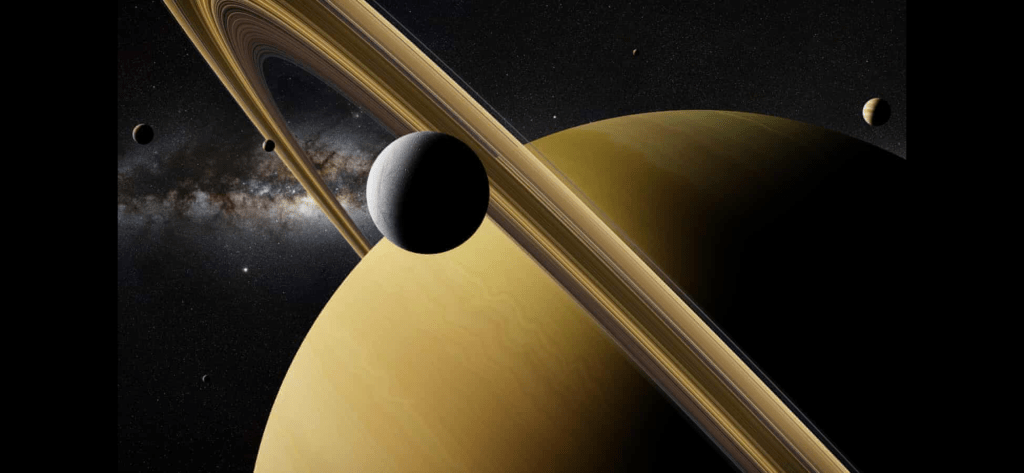
According to legend, the ancient giant Enceladus vents sulfur from his tomb. According to data, Saturn’s tiny moon Enceladus vents more than that.

https://www.astronomy.com/science/phosphate-find-on-enceladus-boosts-chances-for-life/

Scientists have suspected for a long time that this tiny moon of Saturn may be the best place in our solar system to look for life.

Now they have confirmed evidence of all six crucial elements necessary for life to exist (life as we know it, anyway): carbon (C), hydrogen (H), nitrogen (N), oxygen (O), phosphorus (P), and sulphur (S). If present as a phosphate, essential for DNA and RNA to exist, the discovery of phosphorus on the 310-mile-wide Enceladus may indicate life of sort sort, perhaps at a microscopic level beneath the icy surface.

One guess is that the oceans of Enceladus have at least 100 times more phosphorus than the Earth’s oceans. That would make for quite the carbonated fizzy pop. Methane has already been seen coming out out of various “ice geysers” (a.k.a. cryovolcanoes). Since methane results from rotten organic material, there logically should be something alive out there.

Now we just have to get back out there and figure out a way to find them.

And another post to which I forgot to add a title…

June 30, 2023
MThomas

In a few billion years, our aging Sun will run out of hydrogen fuel in its core and begin to swell, eventually engulfing Mercury, Venus, and probably Earth itself. Known as the red giant phase, this is a normal step in a mid-sized star’s life cycle, when it swells to hundreds of times its usual size. There are plenty of red giants in the night sky, but astronomers have never caught one in the act of swallowing its planets — until now.

https://www.astronomy.com/science/star-seen-swallowing-its-planet-whole/

Pack your stuff, folks…

The photo is an artist’s depiction btw. The article describes how the astronomer discovered that star was eating its own planet.

Plume of water seen on Saturn’s moon

May 31, 2023
MThomas

The record-breaking plume reached nearly 6,000 miles into space – covering the distance between Ireland and Japan – and poured water into the void at an estimated rate of 300 litres a second.

https://www.theguardian.com/science/2023/may/30/astronomers-see-6000-mile-water-vapour-plume-blasting-from-saturn-moon

Note that the water jetted out into space nearly 40 times longer than the actual size of the moon (about 500 in diameter, or as the Gurdian puts it “500-mile-wide” for those who forgot the meaning of “diameter).

Enceladus is probably the best bet for life elsewhere in the solar system due to its water — and while whipping around Saturn once per day, which is likely the reason for underwater volcanos and other vents that may provide the proper chemistry for life.

Also the perfect place to trick an inexperienced asteroid hunter crew…

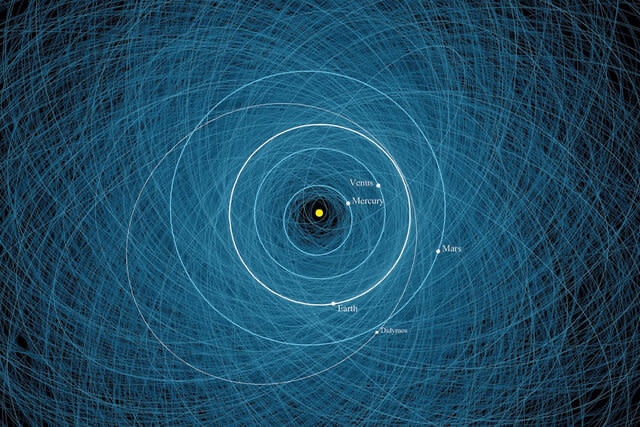
Cancel your asteroid insurance – for the next thousand years

May 22, 2023
MThomas

Does anybody remember Spirographs?

Of all the asteroids they modeled, the one with the largest risk of impact was a kilometer-wide asteroid known as 1994 PC1. Over the next thousand years, the probability that 1994 PC1 will cross within the orbit of the Moon is a paltry 0.00151%, hardly worth worrying about.

https://www.yahoo.com/entertainment/cancel-asteroid-insurance-earth-declared-150002866.html

Thanks to Glen Hill over at Engagin’ Science (formerly Scientia, which apparently was far too Latin- and science-esque for search engines to handle) for bringing this (not-so Earth-shattering) info to my attention.

Sorry, folks. Hollywood was once again wrong (sigh).

😂

JUICE it ESA!

April 14, 2023
MThomas

Led by the European Space Agency (ESA), the mission will orbit the largest planet in the solar system and explore its icy moons, which scientists think could support living organisms.

JUICE will explore three possible ocean-bearing moons – Europa, Ganymede and Callisto. Under their icy surfaces are thought to be huge oceans of water – a crucial ingredient for life as we know it.

https://www.aljazeera.com/news/2023/4/13/explaining-juice-mission-to-jupiter-and-its-moons

The “Jupiter Icy Moons Explorer” is the first time an ESA-headed project will visit another moon.

If it launches successfully, of course.

Lift off in less than seven hours from French Guiana!

Great job by Alzajeera, although “Earth is about 4.1 times the size of Europa and is believed to have a young and active surface that may vent water vapour to space via plumes and geysers.” is a bit misleading (Europa, not Earth, is believed to have…)

Copy editor!

🤞 🚀 🇬🇫

UPDATE

The launch was successful, and the 90 m2 solar array also deployed successfully.

Now we just have to sit and wait until 2031!

The strangeness of Mercury’s huge core

March 30, 2023
MThomas

Mercury is a planet that just doesn’t make sense. It’s incredibly small yet hosts a relatively massive core. Mercury is so strange that astronomers have not been able to explain its properties with simulations of the solar system’s formation. But now, researchers have found an important clue, and Mercury’s weirdness appears to be the fault of the giant planets.

https://www.space.com/mercury-weird-because-of-jupiter-outer-planets

Basically, Mercury is nearly as dense as the Earth despite being less than 6% the size. This is due to the gas giants in our solar system yanking material (“planetesimals” and protoplanets) and ejecting it from the solar system, leaving Mercury with very little material left to form itself.

But there are plenty of questions still…

Titan and its subsurface ocean has tides

February 24, 2023
MThomas

It is this subsurface ocean, or rather its interaction with the ice shell that covers it, that a team of researchers led by the Catholic University of Louvain (UCLouvain) in Belgium hope to better understand. More specifically, they wish to understand how the ocean’s depth and the pressure exerted by the icy shell on the underground water body influence the formation of tidal motions and currents inside of it. 

https://www.space.com/saturn-moon-titan-ocean-tides-icy-crust-study

When I first heard of “Attack on Titan,” I was disappointed to learn that it didn’t take place actually on Titan. (The title in English is a mistranslation. It should be “Attack of the Titans” or “The Titans Attack” or even “Attacking Titans,” depending.) In any case, it’s a disgusting manga/anime with nothing to do with the icy moon of Saturn. Except for the name. And even that’s a misuse (they should have used “giant” as the storyline is very loosely based on Ymir and the frost giants of Scandinavian myth).

Anyway. It’s a fascinating moon the size of the planet Mercury with a liquid ocean and (mostly) nitrogen atmosphere, making it a candidate for extraterrestrial life. Here’s a cool view of it: https://solarsystem.nasa.gov/moons/saturn-moons/titan/overview/

Shooting star over the English Channel

February 15, 2023
MThomas

Courtesy of @dlxinorbit – via @Marco_Langbroek

The agency earlier said the object was expected to “safely strike” the earth’s atmosphere near to the French city of Rouen.

https://www.bbc.com/news/uk-64621721

“Near to”? OK.

Anyway, “SAR2667” provided some cross-cultural entertainment for people living in England, France, Belgium, and the Netherlands. Lots of photos and videos online.

Interesting note from ESA: they were able to detect it and notify everyone exactly where and when it would disintegrate.

Since there are more than 30,000 of these things that orbit the Sun relatively close to Earth’s orbit, it’s a good thing we’re getting better at detecting them. Maybe we’d better up the ante on deflecting them

“Green comet” buzzing Earth “Wednesday”

February 1, 2023
MThomas

A comet from the outer solar system is set to buzz Earth on Wednesday and skywatchers have a chance to glimpse the celestial object as it journeys through our cosmic neighborhood for the first time in 50,000 years.

https://www.nbcnews.com/science/space/green-comet-approach-flyby-earth-rcna65202

If by “Wednesday” you mean “Wednesday in North America. There is no “on Wednesday” worldwide, thanks.

Observers in the Northern Hemisphere should look northeast just after the Moon sets and before dawn. You should be able to see it with a good pair of binoculars.

The last time Comet C/2022 E3 (ZTF) made a visit, Homo sapiens still had Neanderthal neighbors, so this is your one and only! ☄️

“Don’t worry,” they said, “the size of a truck,” they said…

January 26, 2023
MThomas

An asteroid is on its way to Earth, but don’t worry – the end is here Not here. The asteroid, named 2023 BU, is about the size of a van and is expected to miss our planet during Thursday’s flyby. However, according to a NASA scientist, it will be “one of the closest approaches of a known near-Earth object ever recorded.”

https://newsbeezer.com/germanyeng/a-truck-sized-asteroid-will-come-extraordinarily-close-to-earth-tomorrow/

This thing is coming closer than even some satellites, but it’s still small enough for most of it to burn up in the atmosphere.

Most of it.

Yikes.

Blog at WordPress.com.
The Silmaril Chick

Writing Fanfiction in the worlds of Tolkien and Beyond!

Our Awesome Universe

Learning more about our place in the universe...

TechWordly

Best Tech Gadgets Advise

Weird Science Marvel Comics

Marvel Comics Reviews, Previews and News

Universe discoveries

Writing blogs is miracle I am a writer blogger and my site mission is to give information on maximum information to audiences

Robby Robin's Journey

Reflections of an inquiring retiree ...

Stylish Home Solutions

Simple ideas to make every room feel stylish and welcoming

Fox Reviews Rock

Rock & Metal Reviews That Hit Hard

My little corner of the world

Short stories | Reflections | Poetry

Dimmajoblog

Read. Reflect. Grow