A robotic spacecraft made history Thursday becoming the first privately built craft to touch down on the lunar surface, as well as the first American vehicle to accomplish the feat in more than 50 years.
Mimas, the smallest and innermost of Saturn‘s major moons, is believed to generate the right amount of heat to support a subsurface ocean of liquid water
But it demonstrates the fact that water may in fact be common in space, opening the possibility of finding life on celestial bodies with older (much older) water sources.
(FYI: Mimas orbits Saturn once every 22 hours, and is affected by tidal forces from Saturn that appear to have melted part of its icy surface.)
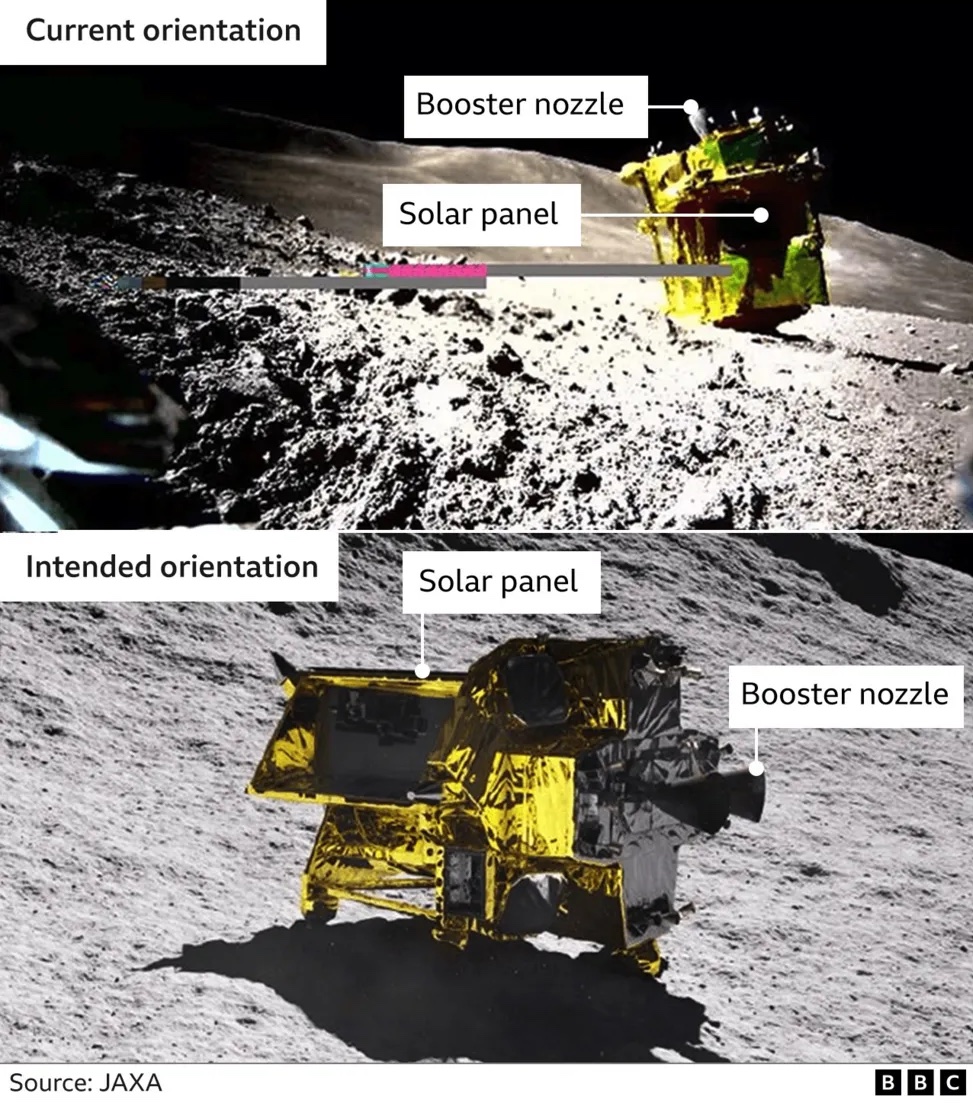
The craft is at a very awkward angle. A picture, captured by the small baseball-sized robot called Sora-Q – which was ejected from Slim moments before touchdown – showed the lander face-down on the lunar surface.
That left its solar panels facing away from the sunlight and unable to generate power. The decision was taken to put the lander into sleep mode – and conserve what power remained – less than three hours after it landed.
That tactic appears to have worked. A change in the direction of the sunlight has now “awoken” the craft.
As previously reported, JAXA did achieve its goal of a “precision landing” — as some put it, a “pinpoint” touchdown within 100 meters of the intended target — within 55 meters, although if all had gone as planned, it would have been within 10 meters.
That’s far, far closer than previous Moon landings.
Too bad SLIM is essentially standing on its nose. But at least this is a beginning. Japan has now become the fifth country (US, USSR, China, India) to successfully “soft land” an object on the Moon.
And the robots it brought with it are pretty amazing. And tiny.
Or SLIM, if you want to actually write acronyms properly (snark).
Also, it’s JAXA, not Jaxa. And NASA and ESA, not Nasa and Esa. But I digress.
Anyways, kudos but too bad yet another space mission failed. At this point I’m wondering how on Earth NASA managed to land people on the Moon so successfully in the 1960s and 1970s without killing half of them in the process. We can barely manage to get a tiny robot rover the size of a marble to land (see the link above for the picture of the “hopper” and “shape shifting” ball…curious about the “shape shifting” bit…)
“We continue receiving valuable data,” the company said in a statement, “and providing spaceflight operations for components and software relating to our next lunar lander mission, Griffin.”
Well, yeah, great. But the Peregrine lander still is a failure. Propulsion leak. Solar panels that didn’t open in time.
And NASA is counting on these privately operated products to get people back to the Moon? And they’ve delayed the Artemis again by another year?
When I was in school, we were all talking about people on Mars, living in permanent communities in the 2020s. And we can’t even get a tiny Moon lander to work right.
Sigh. And after BBC posted “Vulcan rocket” I so had my hopes up. (“The Vulcan rocket,” not “Vulcan rocket,” Spock 🖖)
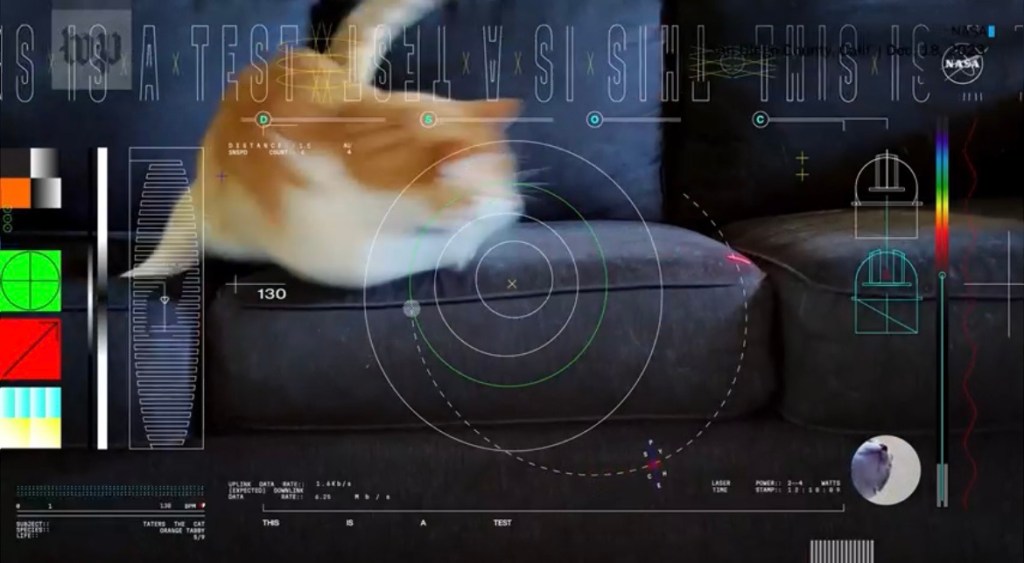
Taters the cat chases a laser pointer in a video sent to Earth from Psyche
Aiming the laser at the spacecraft so the transceiver knows where to point back is the most difficult part, Wright said. And because Earth and the spacecraft are both moving, the lasers must point to where the destination will be in a few minutes. “The beam’s so narrow, it can’t just point to Earth. It needs to know exactly where on Earth,” Wright said. “Trying to hit a dime from a mile away while you’re moving at 17,000 miles an hour — that’s the challenge.”
So NASA has been working on this idea for a while now. The invisible laser beam that carried this video file came from the Psyche probe, on its way to the asteroid belt between Mars and Jupiter.
Psyche is 19 million miles away right now. The laser beam took 108 seconds to reach Earth.
Mars and Earth are on average 140 million miles apart and can be up to 250 million miles apart depending on the timing of their respective orbits.
I don’t think lasers are the answer here. A good start, maybe, but you can do the math. Having to wait between 10 to 20 minutes, or more, for a one-way transmission (double that for an exchange of messages) would not be ideal for a human settlement in an emergency.
Star Trek style instant interstellar communication is still just scifi. Unless there’s still something out there we haven’t found yet, even quantum communication will take time…
But at least NASA has finally realized that non-science people like cat videos.
This is an artist’s impression of a young star surrounded by a protoplanetary disc in which planets are forming. An international team of astronomers have used the NASA/ESA/CSA James Webb Space Telescope to provide the first observation of water and other molecules in the inner, rocky-planet-forming regions of a disc in one of the most extreme environments in our galaxy. These results suggest that the conditions for rocky-planet formation, typically found in the discs of low-mass star-forming regions, can also occur in massive-star-forming regions and possibly a broader range of environments.
Because of its location near several massive stars in NGC6357, scientists expect XUE 1 to have been constantly exposed to a high ultraviolet radiation field throughout its life. However, in this extreme environment the team still detected a range of molecules that are the building blocks of rocky planets.
“NASA will hold off sending commands to its Mars fleet for two weeks, from Nov. 11 to 25, while Earth and the Red Planet are on opposite sides of the sun. Called Mars solar conjunction, this phenomenon happens every two years,” NASA said in a statement.
It’s funny that Live Science just announced this three days…given that the time period in which Mars is directly behind the Sun opposite the Earth only lasts from November 11th through November 25th.
From the beginning of the Golgo 13 story, 「剥がれた鍍金」(hagareta tokin, “The peeled away metal plating”).
Despite the fact that the manga Golgo 13 is about as conservative as you can get (openly misogynistic and racist at times, as well), I’ve been a fan since before coming to Japan in 1999. I hadn’t realized that the original anime movie that I saw back in Boston was based on what became the manga with the most printed volumes in the world in July 2021. This year marks its 50th anniversary, and the stories are being reproduced in larger format, grouped according to physical region.
The group of stories based in Japan came out a short while ago (I already got copies of stories based in France and the Middle East, and a book based in Italy is due soon). Interestingly, one of the stories is reproduced from December 2001 — four months after JAXA successfully launched the H-IIA rocket following a previous failure (hence, the “peeled metal plating” title).







 M Thomas Apple Author Page