From the beginning of the Golgo 13 story, 「剥がれた鍍金」(hagareta tokin, “The peeled away metal plating”).
Despite the fact that the manga Golgo 13 is about as conservative as you can get (openly misogynistic and racist at times, as well), I’ve been a fan since before coming to Japan in 1999. I hadn’t realized that the original anime movie that I saw back in Boston was based on what became the manga with the most printed volumes in the world in July 2021. This year marks its 50th anniversary, and the stories are being reproduced in larger format, grouped according to physical region.
The group of stories based in Japan came out a short while ago (I already got copies of stories based in France and the Middle East, and a book based in Italy is due soon). Interestingly, one of the stories is reproduced from December 2001 — four months after JAXA successfully launched the H-IIA rocket following a previous failure (hence, the “peeled metal plating” title).
Carbon accounted for almost five percent of the sample’s total weight, and was present in both organic and mineral form, while the water was locked inside the crystal structure of clay minerals, he said.
Scientists believe the reason Earth has oceans, lakes and rivers is because it was hit with water-carrying asteroids 4 to 4.5 billion years ago, making it a habitable planet.
We have ample evidence now that all water on Earth was brought during the “Late Heavy Bombardment” period (4~4.5 billion years ago). Imagine how many rocks it took to get enough water (estimates anywhere between 20 and 200 million years of asteroid after asteroid slamming into the Earth).
And the only reason life exists on Earth is that there is enough iron and nickel in the Earth’s core to generate a magnetic field to prevent solar radiation from ripping off the atmosphere. Which is likely what happened to Mars.
(Alright, alright, technically electrical currents running through the liquid iron outer core as well as in the crust and ionosphere also contribute to the magnetic field. Go check out this horribly complicated explanation if you like.)
Note that this is the third time to get asteroid dust to examine. JAXA has managed to do this twice now. But Hayabusa-2 only got about 5 grams. The OSIRIS-REx project got about 250 grams (1/2 lb). Lots more = lots more to save for future researchers who will have developed even more sophisticated analysis methods.
Now lets get some PEOPLE on those things and start mining and living in space, already!
ESA image. Gateway is planned to be much smaller and more cramped than ISS (about 1/6 the size).
NASA and its international partners see Gateway as a key platform to support the agency’s Artemis moon program and to build the technology required for future deep-space missions. Although the first elements of the small space station are expected to launch before the Artemis 3 mission lifts off in 2025 or 2026, NASA previously said that those astronauts will not use Gateway to “make that mission have a higher probability of success.”
While it’s a good idea to see some planning for this, I think maybe NASA should focus on getting Artemis 1 to work properly before they go on about Artemis 3 and 4.
Taking advantage of Gateway’s orbit far away from Earth’s protective magnetic field, three instruments will study risks due to radiation from the sun and from cosmic rays. Scientists hope this knowledge can help inform future long-term missions to the moon and Mars.
Since Gateway will orbit the Moon and not the Earth, the biggest problem will be preventing astronauts (and instruments!) from getting fried by solar radiation. Scientists need to come up with materials to shield people on Gateway and the Moon, or else we’re going nowhere…
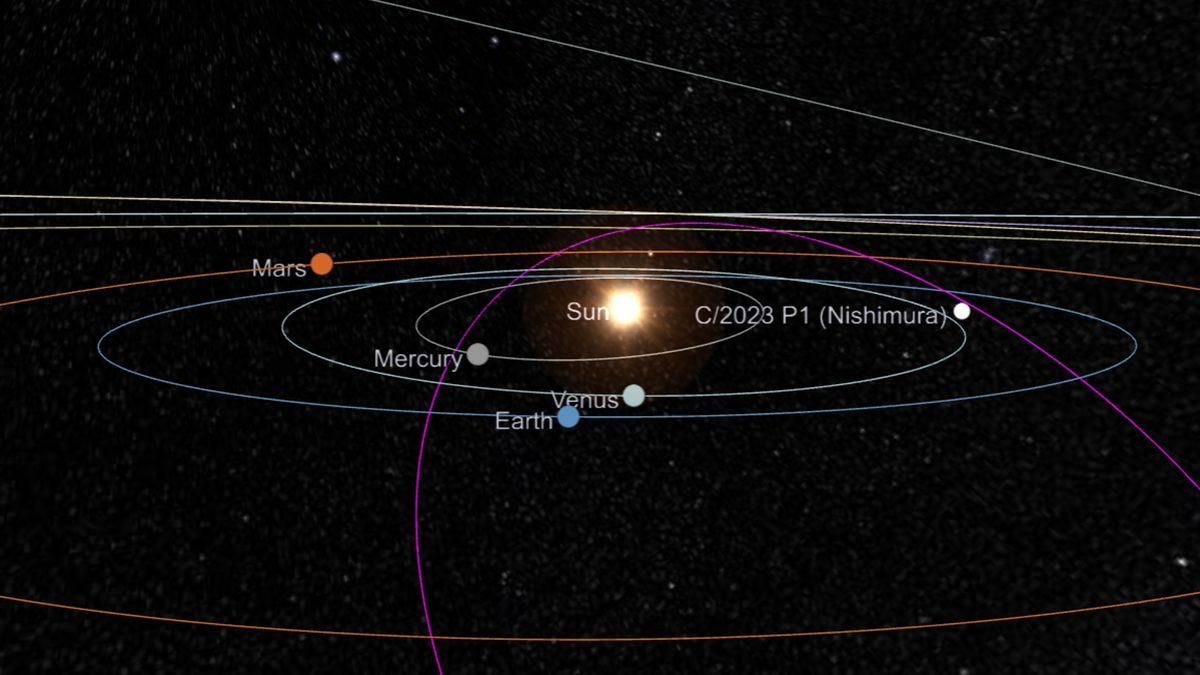
Comet Nishimura’s orbit means that this is likely its first and final trip through the inner solar system. It is possible that the comet originated outside our star system, which would make it the third known interstellar object ever detected, following ‘Oumuamua — which some astronomers speculatively suggested was an alien spacecraft — and Comet 2I/Borisov.
Discovered just two weeks ago by an amateur Japanese astronomer (after whom the comet is now named), the comet Nishimura will approach Earth at its closest on September 13th. But it will be at its brightest about five days later as it approaches the Sun.
Its fate?
Astronomers don’t know when the possible interstellar interloper will depart the solar system. However, it is also possible that the intense force of the comet’s solar slingshot will rip its solid nucleus apart, according to NASA.
Also, its nucleus gives off a “green glow,” which is the result of sunlight breaking apart dicarbon, or diatomic carbon. So getcher geek on, chemical lab rats!
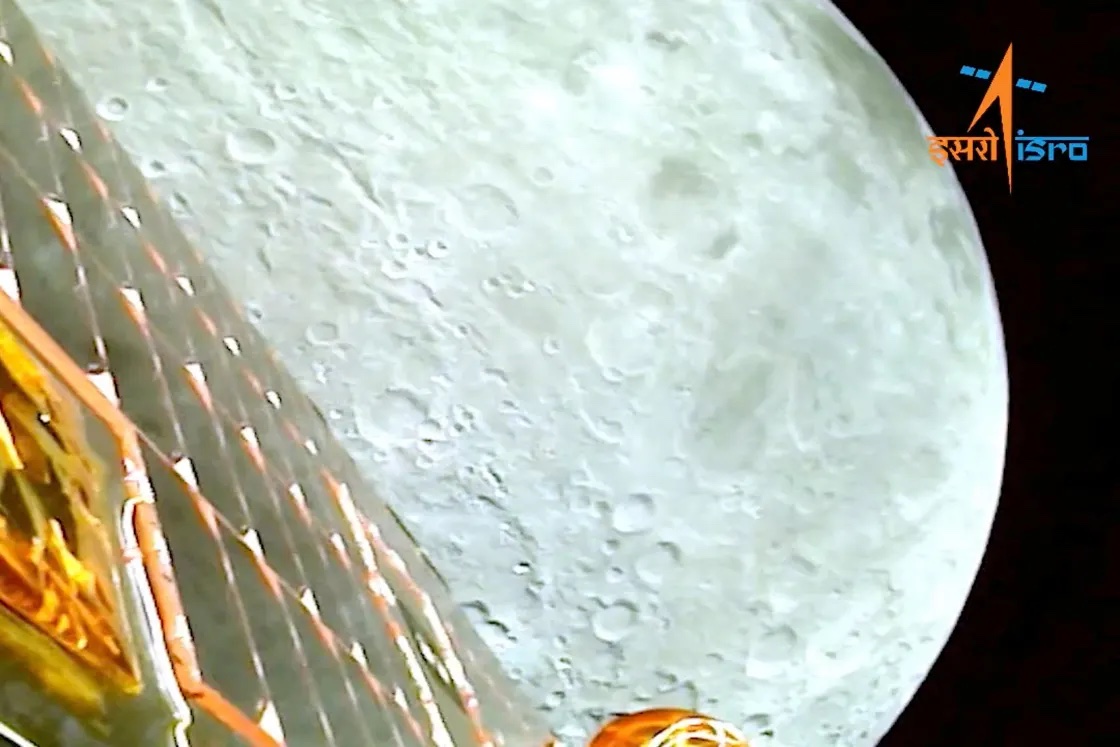
Taken just prior to landing…the “image” shown of it actually landing was not real but a simulation.
India and Russia had been locked in a race to the lunar south pole. The Luna-25 spacecraft that crashed was the first moon-landing spacecraft launched by Russia’s space agency in almost five decades. Roscosmos officials said Sunday they lost contact with the lander after it fired its engines in preparation for a descent to the surface.
It wasn’t much of a “race,” tbh. India had been planning this for years, while Russia randomly launched a craft that had virtually no chance of succeeding.
Congratulations, ISRO! You should have some company over the next couple of years. Here’s hoping that international cooperation and not competition will lead humanity to permanent settlements on the Moon. Mars, and beyond…
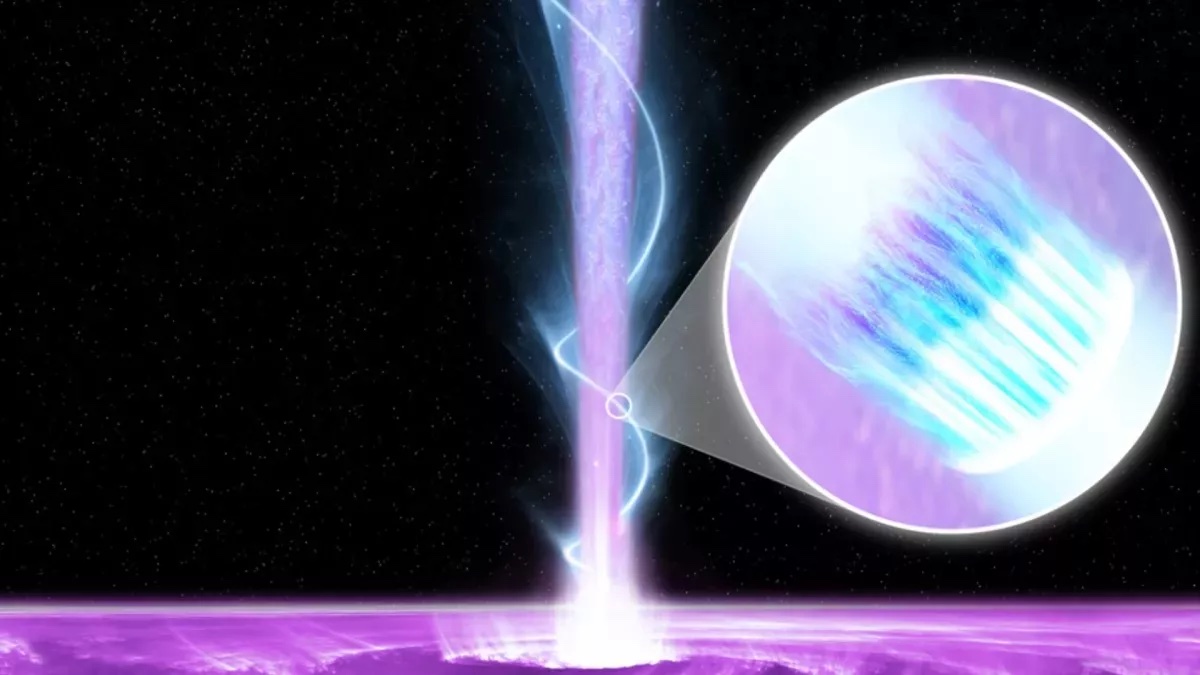
A NASA mission has observed a supermassive black hole pointing its highly energetic jet straight toward Earth. Don’t panic just yet, though. As fearsome as this cosmic event is, it’s located at a very safe distance of about 400 million light-years away.
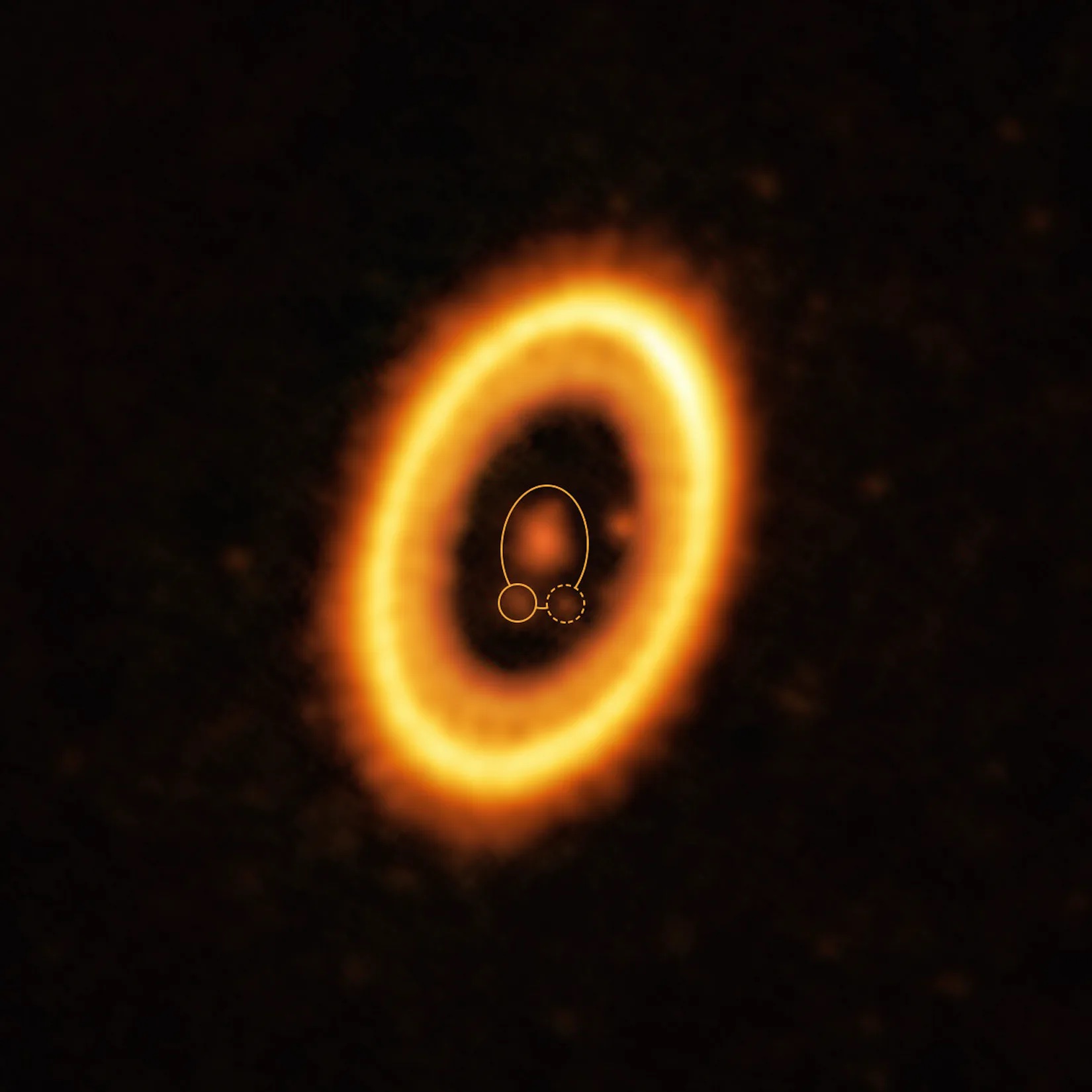
The two planets are in circles that kind of look like, er….let’s just call the whole thing a cosmic donut (the outer “halo” is the protoplanetary disc of gas and dust from which planets eventually coalesce).
We already know that more than one object can share the same orbit; Jupiter has a collection of 120,000 asteroids following its same path around the Sun, for example. Earth has one, too. But although it’s theoretically possible, astronomers have never discovered two whole planets sharing the same orbit around a star before.
Hmm…the language here is a bit misleading. The two objects are technically not both “planets.”
The article comments later on that the object in the dotted line circle is “a cloud of debris about twice the mass of our Moon trailing a bit behind the innermost gas giant” in one of its LaGrange points (where “Trojan” asteroids follow gas giants such as Jupiter and Saturn). So it’s way too early to say that “two” planets formed in the same orbit.
Still, this is the first time that astronomers have spotted two such objects this close to one another in the same orbit. Who knows if both will remain viable (the debris cloud could become partly or mostly absorbed by the gas giant with the rest either being expelled or thrust into separate orbits).
So why is this called a “cosmic unicorn”?
Apparently because although such Trojans “are allowed to exist by theory, but no one has ever detected them.”
Um. OK.
So, like, totally NOT at all like this? Kind of a bummer, really…
The bankruptcy filing by Richard Branson’s Virgin Orbit Holdings Inc (VORB.O) has dealt a blow to Japan’s hopes of building a domestic space industry, with plans for a Kyushu-based spaceport designed to attract tourism on hold for lack of funding.
Still, it’s jarring to see TV news about JAXA and NASA doing “joint” explorations of Mars, and then see a constant failure of JAXA to do anything based in Japan.
Something is seriously wrong with this space agency. And I suspect it has nothing to do with the scientists or astronauts.
With just over a minute to go before liftoff, a California aerospace startup opted to stand down from launching the world’s first 3D-printed rocket on its inaugural test flight.
At least unlike the spectacular self-destruction of JAXA’s H3 this past Tuesday (Monday, Japan time), the team testing the California rocket wisely decided that it’s not a bright idea to stick a billion dollar satellite on an untested rocket. Repeatedly.
I’m beginning to feel that using 3D printed parts may not be the way to go with rocket engines…