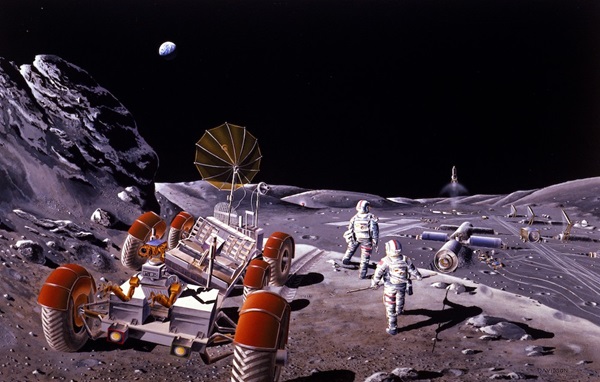
A permanent Moon colony? But I doubt babies will be born here any time soon…
“Today, all activity in space is tethered to the Earth. But I predict that in around 30 years people will start living in space – and soon after, the first off-Earth baby will be born.”
Hmm, maybe. I’d be a little wary of making predictions about space travel. We were supposed to be building a base on Mars by now (according to predictions made when I was in high school).
I think we should probably figure out how to get people not to be completely fried by solar radiation before we start making babies in space (which *I* predict will inevitably require genetic manipulation and lead to a new human race at some point…and no, not in “around 30 years”!).
As the training progressed, the participants changed the way they used the device, which resulted in new finger coordination patterns. This was recorded in their hand movements as well as in their brains.
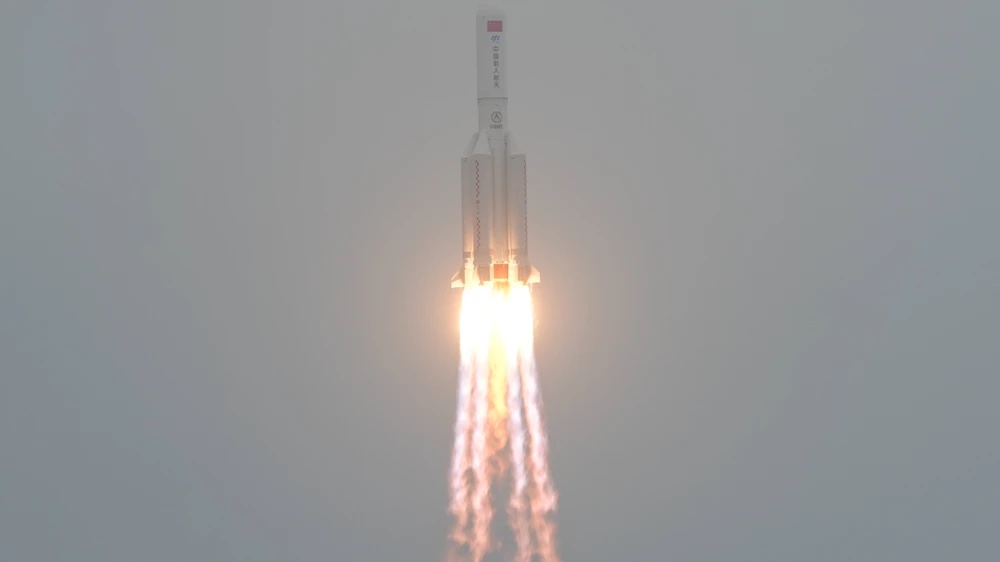
“When they did that design, they should have stopped and thought, ‘you know, that’s going to leave a big chunk of debris in orbit, we should change the design of the engine’,” McDowell says. “But they didn’t. This is real negligence.”
Four years ago, China’s first space station landed in the Pacific Ocean between Australia and Chile, after an uncontrolled reentry. China didn’t care.
Last year, pieces from a Long March 5B rocket landed in Cote d’Ivoire. They damaged buildings in two villages. China didn’t care.
This launch of the same rocket design could land anywhere from New York to New Zealand, covering a wide range of habitation. China doesn’t care.
On the other hand, once somebody in their government reads about the criticism by the scientific community, they’ll petulantly whine that this often happened in the 1960s, so that makes it OK for them to ignore rocket safety designs known for the past 30 years.
Maybe it’s technology they haven’t yet stolen from other countries.
As the self-acknowledged center of the known universe, the Middle Kingdom only cares what others think of it. Like a spoiled child that thinks it knows everything but fears it does not, China only reacts to its own mistakes by lashing out at others and disclaiming responsibility.
If you want to be respected as a superpower, you need to learn how to respect other countries and stop dumping your trash on them. Respect is not given, it is earned. China has done little to earn any respect by the scientific community.
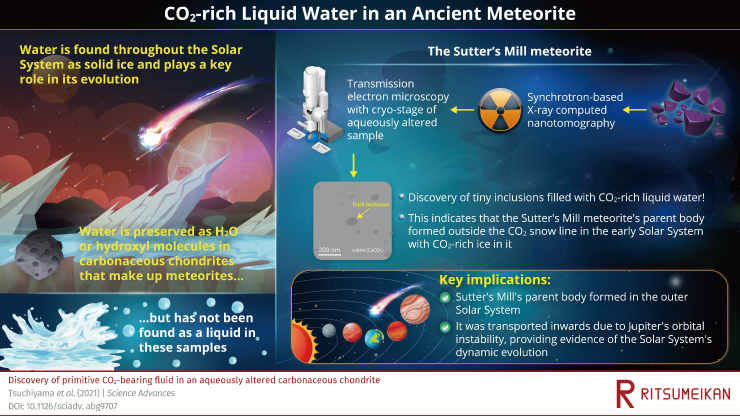
“This assumption is consistent with recent theoretical studies of the solar system’s evolution that suggest that asteroids rich in small, volatile molecules like water and carbon dioxide formed beyond Jupiter’s orbit before being transported to areas closer to the sun.”
However, it does show the need for STEM students and researchers in Japan to improve their English. For every study like this published in English there are many more only published in Japanese. Lots of interesting research going on in Japan that people *outside* Japan need to know about!
Apologies to readers for the weird mix-up in chapter numbering. I’ve been (slowly, painfully slowly) writing Bringer of Light on Scrivener…which I forgot to update on my desktop PC, which led to some sort of weird misnumbering of chapters in two different versions of the file.
Anyway, I have begun to finish up the story but now I’m going back and doing some editing while continuing to finish the first book of the series off. I’ll be adding more details (especially about technology) while trying to keep the technobabble out and getting more focused on character interaction and development.
It’s a process, after all! Hope you’re enjoying it.
See here for a list of chapters so far (draft form).
Using blobs of skin cells from frog embryos, scientists have grown creatures unlike anything else on Earth, a new study reports. These microscopic “living machines” can swim, sweep up debris and heal themselves after a gash.
…but seriously, this is neat. One source of the X-Rays is the Sun (it also bounces off of Jupiter and Saturn). But there may be yet another source…perhaps the rings of Uranus or the planet itself.
And no, it’s not really pink. That’s just a Chandra X-ray image.
The possibilities…the tether doesn’t actually have to touch the ground. Basically, you put up a satellite with two tethers (one for things going up, one for things going down) and then have a rocket sent up and attach to the tether.
The tether would then push the payload the rest of the way into outer space (as the article points out, space begins at 62 miles above sea level, but 98% of the weight of rockets is used to break away from the Earth’s gravity to that point).
Now, this article was published on April 1st, so I’m really hoping it’s not a prank…
(Also, wordpress looks REALLY BAD today for some reason. Wth? This “block” style is clunky AF and looks more like Netscape ca. 1996)







 M Thomas Apple Author Page