Now that I’ve got the manuscript completed, it’s time to search for typos!
Yup. Found some already. Oops.
I figure to rearrange and combine some of the later chapters as well. Look for a publication online in late March!
It’s taken nearly 9 years. Hm. Only 11 years fewer than Adam’s Stepsons.
Fortunately, I have outlined book two and started writing the opening chapters already. Hopefully it won’t take another 9 years to see the continuation of the Bringer of Light story!
Or SLIM, if you want to actually write acronyms properly (snark).
Also, it’s JAXA, not Jaxa. And NASA and ESA, not Nasa and Esa. But I digress.
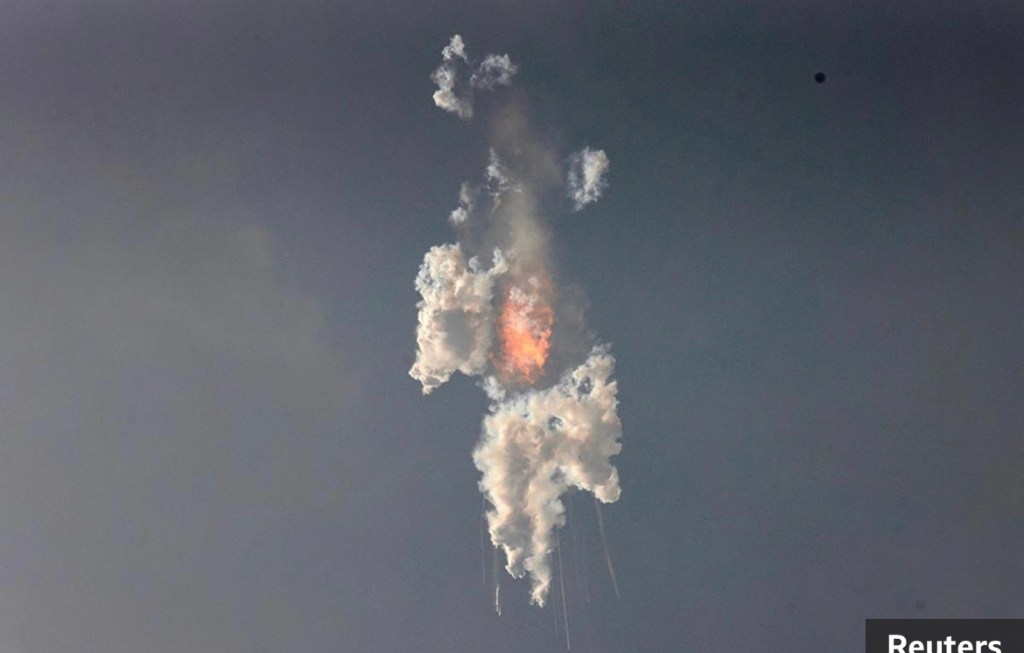
Anyways, kudos but too bad yet another space mission failed. At this point I’m wondering how on Earth NASA managed to land people on the Moon so successfully in the 1960s and 1970s without killing half of them in the process. We can barely manage to get a tiny robot rover the size of a marble to land (see the link above for the picture of the “hopper” and “shape shifting” ball…curious about the “shape shifting” bit…)
“We continue receiving valuable data,” the company said in a statement, “and providing spaceflight operations for components and software relating to our next lunar lander mission, Griffin.”
Well, yeah, great. But the Peregrine lander still is a failure. Propulsion leak. Solar panels that didn’t open in time.
And NASA is counting on these privately operated products to get people back to the Moon? And they’ve delayed the Artemis again by another year?
When I was in school, we were all talking about people on Mars, living in permanent communities in the 2020s. And we can’t even get a tiny Moon lander to work right.
Sigh. And after BBC posted “Vulcan rocket” I so had my hopes up. (“The Vulcan rocket,” not “Vulcan rocket,” Spock 🖖)
Way back in 2015, my good friend Rami Z Cohen came to me with an idea for a story. He had written two or three scenes about a group of asteroid hunters who stumbled upon something bizarre. The idea of mining asteroids was news at the time (and still is, although probably too expensive right now and not a worthwhile investment until we actually get some people in space who need metals without relying on NASA/ESA/JAXA/ISRO/etc).
So Rami and I began to email ideas back and forth for a few weeks, then we started to flesh out his characters and plot. I wrote a synopsis and outline and we hashed out the background.
ESA image. Gateway is planned to be much smaller and more cramped than ISS (about 1/6 the size).
NASA and its international partners see Gateway as a key platform to support the agency’s Artemis moon program and to build the technology required for future deep-space missions. Although the first elements of the small space station are expected to launch before the Artemis 3 mission lifts off in 2025 or 2026, NASA previously said that those astronauts will not use Gateway to “make that mission have a higher probability of success.”
While it’s a good idea to see some planning for this, I think maybe NASA should focus on getting Artemis 1 to work properly before they go on about Artemis 3 and 4.
Taking advantage of Gateway’s orbit far away from Earth’s protective magnetic field, three instruments will study risks due to radiation from the sun and from cosmic rays. Scientists hope this knowledge can help inform future long-term missions to the moon and Mars.
Since Gateway will orbit the Moon and not the Earth, the biggest problem will be preventing astronauts (and instruments!) from getting fried by solar radiation. Scientists need to come up with materials to shield people on Gateway and the Moon, or else we’re going nowhere…
One main reason for landing at the Moon’s South Pole is that the presence of water would help us build permanent settlements…
This region on the moon is an attractive place for humans to build a lasting presence due to the fact that water ice is located underfoot. Future moon-dwellers can potentially tap into that water for consumption, or even to create rocket propellant, instead of depending on water shipped from Earth.
Another reason has now been found…iron, manganese, aluminum, titanium…and “surprisingly” sulfur. Why should they be surprised? It’s already been established that the Moon has ice, and sulfur forms every time hydrocarbon and sulfates combine. Plus sulfur obviously results from volcanic activity, and it’s likely the Moon was volcanic when it first formed. And sulfur is also produced through nuclear fusion – i.e., the Sun.
So what can we do with this knowledge?
Having a more complete chemical composition of the lunar south pole area means future travelers to — and possible inhabitants of — the region can also plan for what else they don’t need to bring from Earth. In particular, some scientists have suggested moon-dwellers could use sulfur in bits of infrastructure such as building materials, solar cells and batteries.
Hmmm…I think more studies are needed first…define “bits,” for example.
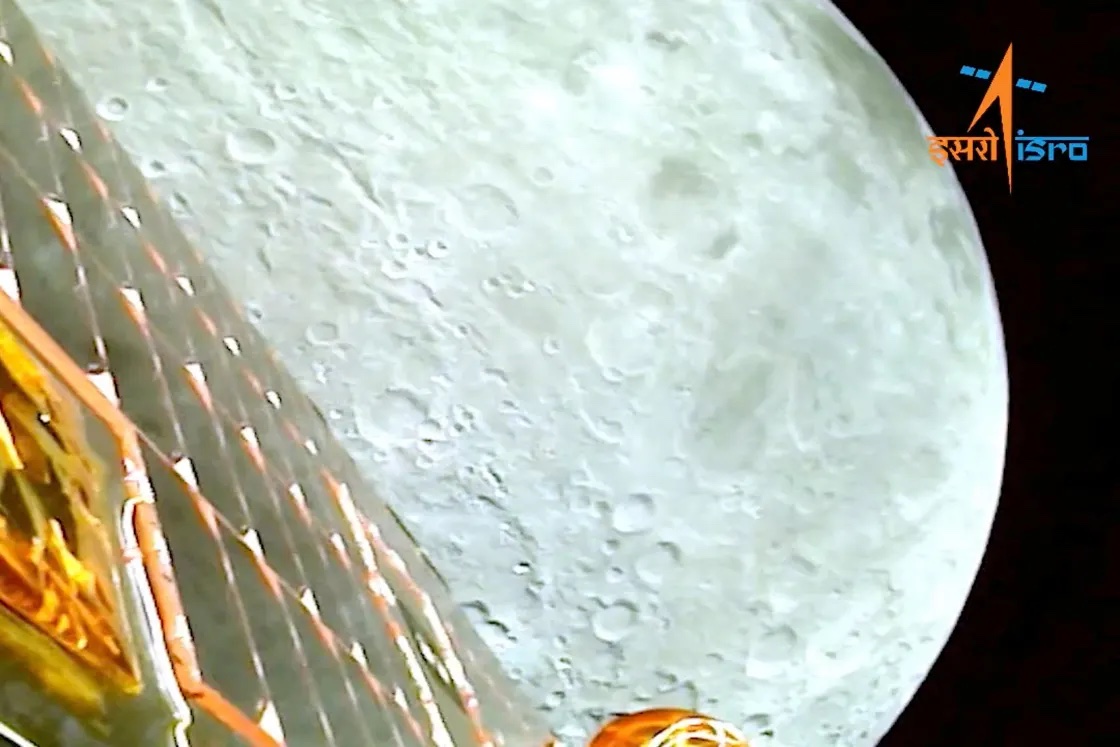
Taken just prior to landing…the “image” shown of it actually landing was not real but a simulation.
India and Russia had been locked in a race to the lunar south pole. The Luna-25 spacecraft that crashed was the first moon-landing spacecraft launched by Russia’s space agency in almost five decades. Roscosmos officials said Sunday they lost contact with the lander after it fired its engines in preparation for a descent to the surface.
It wasn’t much of a “race,” tbh. India had been planning this for years, while Russia randomly launched a craft that had virtually no chance of succeeding.
Congratulations, ISRO! You should have some company over the next couple of years. Here’s hoping that international cooperation and not competition will lead humanity to permanent settlements on the Moon. Mars, and beyond…
“If we want to develop the Moon as an outpost, a gateway to deep space, then we need to carry out many more explorations to see what sort of habitat would we be able to build there with the locally-available material and how will we carry supplies to our people there,” Mr Annadurai says.
Chandrayaan-1 was India’s first successful Moon launch in 2008 — it deliberately crashed in order to measure the amount of water at the South Pole.
Chandrayaan-2 was only partly successful, as it did put an orbiter around the Moon, but the rover crashed. (The orbiter is still there, sending back information on a regular basis.)
Now, Chandrayaan-3 aims to finally land a rover and do some research exploring.
Let’s hope they can get it to land safely this time…
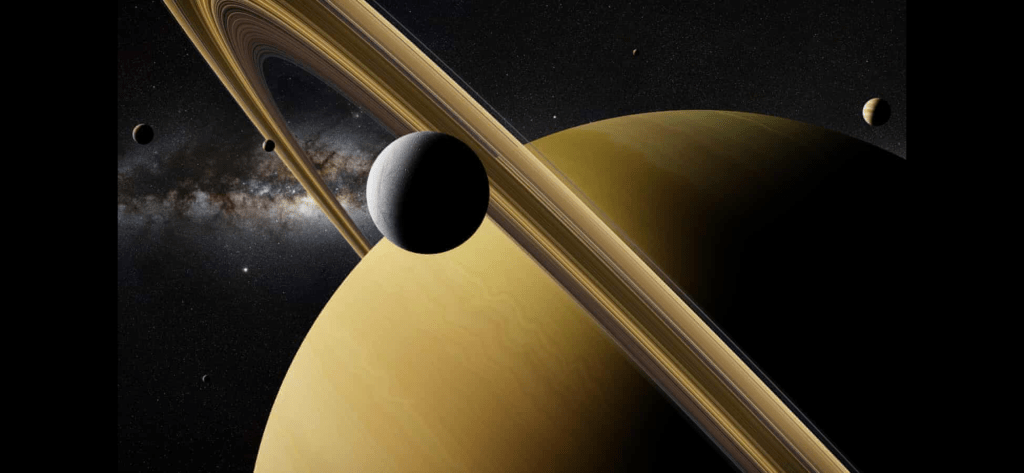
The record-breaking plume reached nearly 6,000 miles into space – covering the distance between Ireland and Japan – and poured water into the void at an estimated rate of 300 litres a second.
Note that the water jetted out into space nearly 40 times longer than the actual size of the moon (about 500 in diameter, or as the Gurdian puts it “500-mile-wide” for those who forgot the meaning of “diameter).
Enceladus is probably the best bet for life elsewhere in the solar system due to its water — and while whipping around Saturn once per day, which is likely the reason for underwater volcanos and other vents that may provide the proper chemistry for life.
…Ispace engineers observed that the estimated remaining propellant was “at the lower threshold and shortly afterward the descent speed rapidly increased.”




 M Thomas Apple Author Page