A robotic spacecraft made history Thursday becoming the first privately built craft to touch down on the lunar surface, as well as the first American vehicle to accomplish the feat in more than 50 years.
Mimas, the smallest and innermost of Saturn‘s major moons, is believed to generate the right amount of heat to support a subsurface ocean of liquid water
But it demonstrates the fact that water may in fact be common in space, opening the possibility of finding life on celestial bodies with older (much older) water sources.
(FYI: Mimas orbits Saturn once every 22 hours, and is affected by tidal forces from Saturn that appear to have melted part of its icy surface.)
OK, so my post about a big ole spider got the most likes of any post in ten years of blogging about science.
I have so not got the zeitgeist of the 2024 blogosphere lol – anyway, thanks, all, for the “likes”! Although one person used AI to write a very meaningless comment about arachnophobia. What’s the point, man?
By the way, back to science and space stuff. I forgot to post about the Europa Clipper project back in October.
So here you go. (It’s too late to add a message, but the project obviously is going to take some time arriving there, and you can supposedly hear US Poet Laureate Ada Limón read her poem online, although I’ve had trouble with the audio lately:
“Arching under the night sky inky with black expansiveness, we point to the planets we know, we
pin quick wishes on stars. From earth, we read the sky as if it is an unerring book of the universe, expert and evident.
Still, there are mysteries below our sky: the whale song, the songbird singing its call in the bough of a wind-shaken tree.
We are creatures of constant awe, curious at beauty, at leaf and blossom, at grief and pleasure, sun and shadow.
And it is not darkness that unites us, not the cold distance of space, but the offering of water, each drop of rain,
each rivulet, each pulse, each vein. O second moon, we, too, are made of water, of vast and beckoning seas.
We, too, are made of wonders, of great and ordinary loves, of small invisible worlds, of a need to call out through the dark.”
Or SLIM, if you want to actually write acronyms properly (snark).
Also, it’s JAXA, not Jaxa. And NASA and ESA, not Nasa and Esa. But I digress.
Anyways, kudos but too bad yet another space mission failed. At this point I’m wondering how on Earth NASA managed to land people on the Moon so successfully in the 1960s and 1970s without killing half of them in the process. We can barely manage to get a tiny robot rover the size of a marble to land (see the link above for the picture of the “hopper” and “shape shifting” ball…curious about the “shape shifting” bit…)
“We continue receiving valuable data,” the company said in a statement, “and providing spaceflight operations for components and software relating to our next lunar lander mission, Griffin.”
Well, yeah, great. But the Peregrine lander still is a failure. Propulsion leak. Solar panels that didn’t open in time.
And NASA is counting on these privately operated products to get people back to the Moon? And they’ve delayed the Artemis again by another year?
When I was in school, we were all talking about people on Mars, living in permanent communities in the 2020s. And we can’t even get a tiny Moon lander to work right.
Sigh. And after BBC posted “Vulcan rocket” I so had my hopes up. (“The Vulcan rocket,” not “Vulcan rocket,” Spock 🖖)
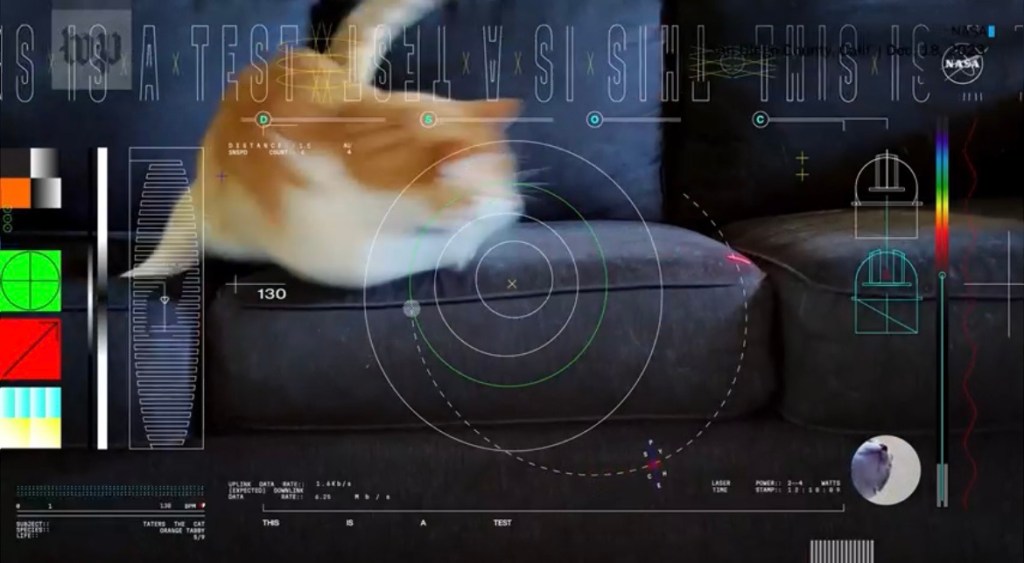
Taters the cat chases a laser pointer in a video sent to Earth from Psyche
Aiming the laser at the spacecraft so the transceiver knows where to point back is the most difficult part, Wright said. And because Earth and the spacecraft are both moving, the lasers must point to where the destination will be in a few minutes. “The beam’s so narrow, it can’t just point to Earth. It needs to know exactly where on Earth,” Wright said. “Trying to hit a dime from a mile away while you’re moving at 17,000 miles an hour — that’s the challenge.”
So NASA has been working on this idea for a while now. The invisible laser beam that carried this video file came from the Psyche probe, on its way to the asteroid belt between Mars and Jupiter.
Psyche is 19 million miles away right now. The laser beam took 108 seconds to reach Earth.
Mars and Earth are on average 140 million miles apart and can be up to 250 million miles apart depending on the timing of their respective orbits.
I don’t think lasers are the answer here. A good start, maybe, but you can do the math. Having to wait between 10 to 20 minutes, or more, for a one-way transmission (double that for an exchange of messages) would not be ideal for a human settlement in an emergency.
Star Trek style instant interstellar communication is still just scifi. Unless there’s still something out there we haven’t found yet, even quantum communication will take time…
But at least NASA has finally realized that non-science people like cat videos.
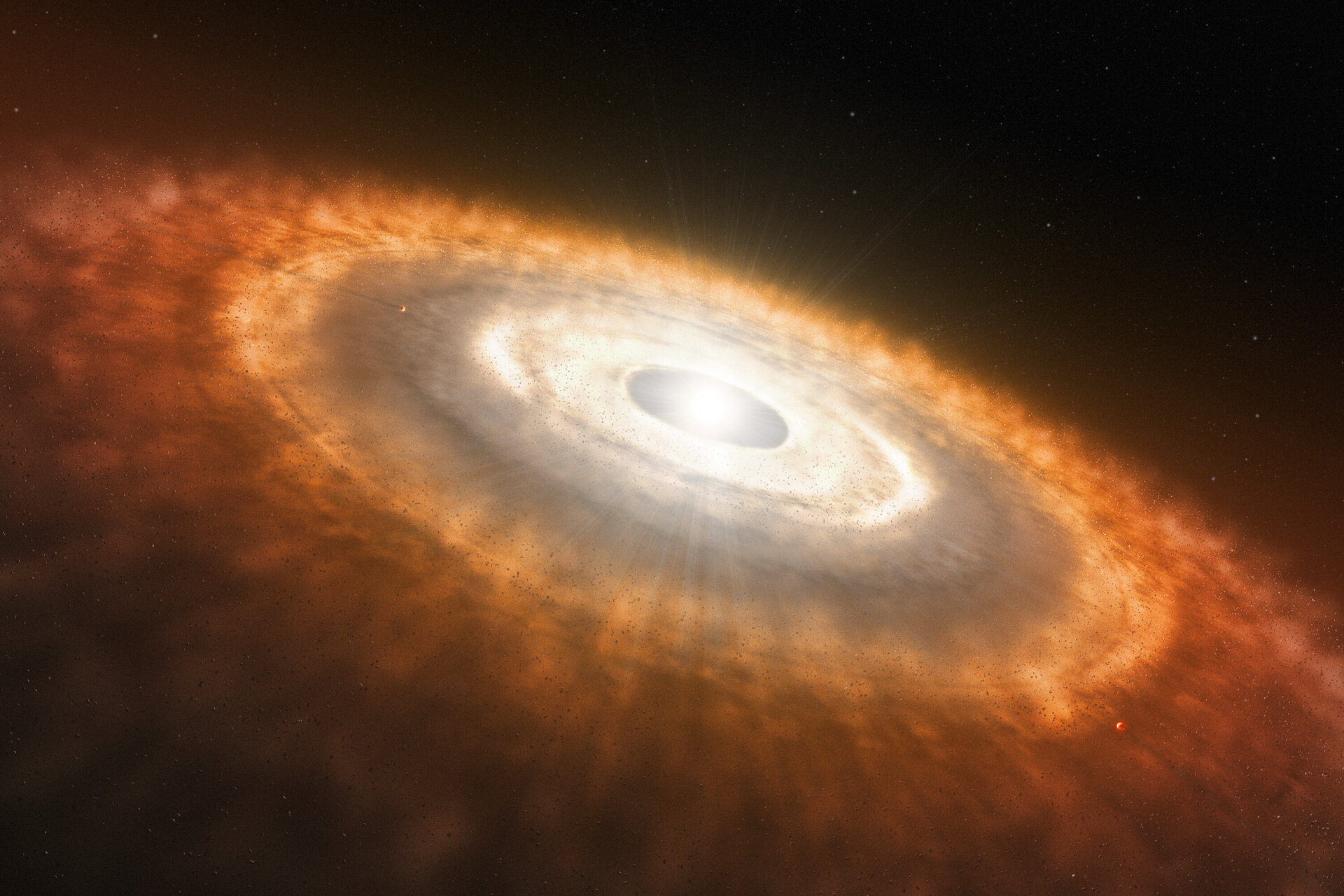
This is an artist’s impression of a young star surrounded by a protoplanetary disc in which planets are forming. An international team of astronomers have used the NASA/ESA/CSA James Webb Space Telescope to provide the first observation of water and other molecules in the inner, rocky-planet-forming regions of a disc in one of the most extreme environments in our galaxy. These results suggest that the conditions for rocky-planet formation, typically found in the discs of low-mass star-forming regions, can also occur in massive-star-forming regions and possibly a broader range of environments.
Because of its location near several massive stars in NGC6357, scientists expect XUE 1 to have been constantly exposed to a high ultraviolet radiation field throughout its life. However, in this extreme environment the team still detected a range of molecules that are the building blocks of rocky planets.
“NASA will hold off sending commands to its Mars fleet for two weeks, from Nov. 11 to 25, while Earth and the Red Planet are on opposite sides of the sun. Called Mars solar conjunction, this phenomenon happens every two years,” NASA said in a statement.
It’s funny that Live Science just announced this three days…given that the time period in which Mars is directly behind the Sun opposite the Earth only lasts from November 11th through November 25th.
The comet has a core of dust, gas and ice surrounded by a bright cloud of gas known as a coma. Sunlight and solar radiation can heat the comet’s core, sometimes causing violent outbursts like the ones observed in July and Oct.
Herman said the comet’s temporary horns are thought to originate from these icy eruptions. The comet’s structure may be shaping how the spewed clouds of gas and ice appear from Earth, creating the appearance of horns to ground-based telescopes.