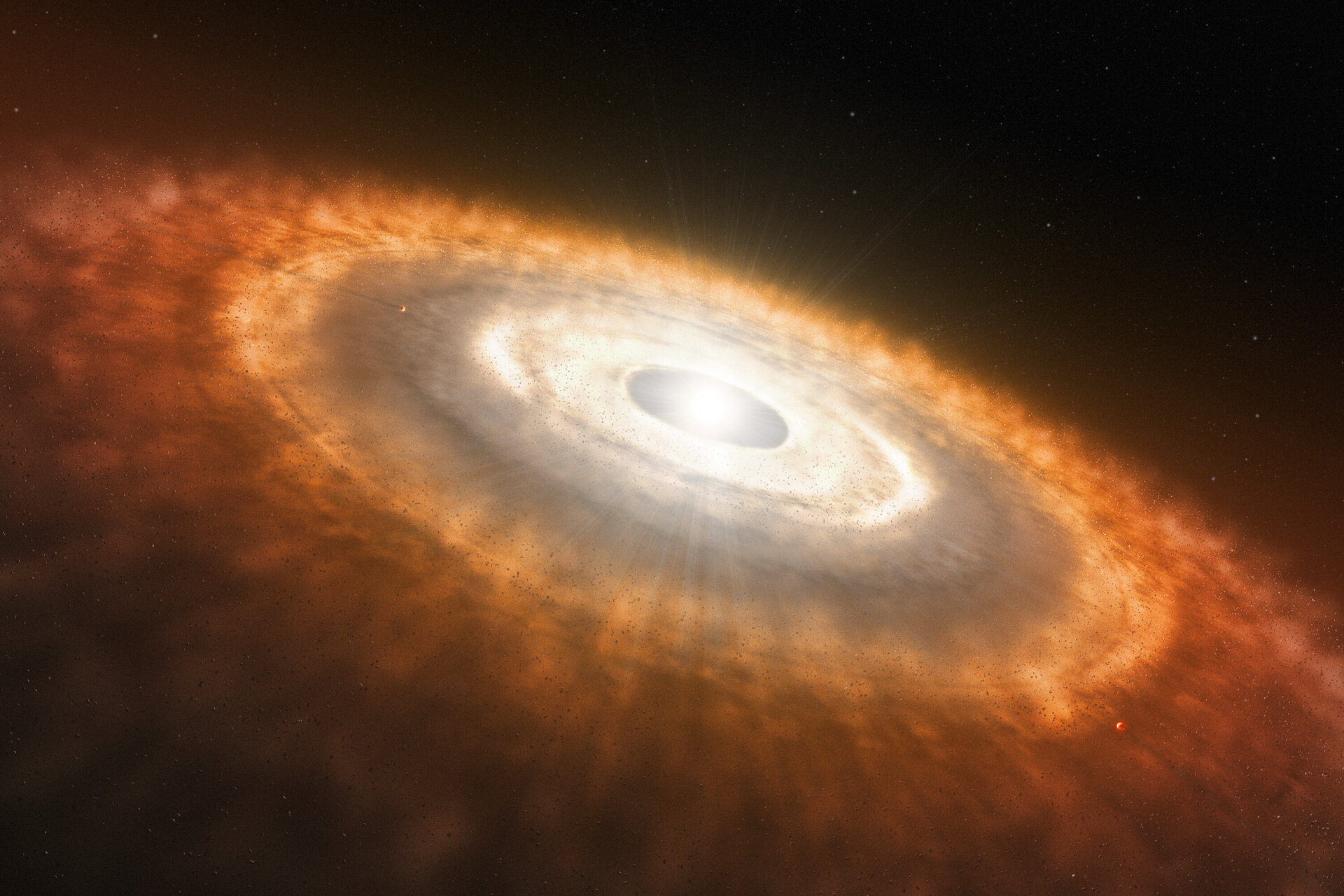
This is an artist’s impression of a young star surrounded by a protoplanetary disc in which planets are forming. An international team of astronomers have used the NASA/ESA/CSA James Webb Space Telescope to provide the first observation of water and other molecules in the inner, rocky-planet-forming regions of a disc in one of the most extreme environments in our galaxy. These results suggest that the conditions for rocky-planet formation, typically found in the discs of low-mass star-forming regions, can also occur in massive-star-forming regions and possibly a broader range of environments.
Because of its location near several massive stars in NGC6357, scientists expect XUE 1 to have been constantly exposed to a high ultraviolet radiation field throughout its life. However, in this extreme environment the team still detected a range of molecules that are the building blocks of rocky planets.
Things just got busy at work and at home. And influenza really is strong this year, as predicted (I found out long ago that teenagers – especially guys – completely ignore suggestions regarding ways of avoiding illness due to an unwavering belief in their invulnerability).
I’ll try to make it up to you over the next couple of days.
In the meantime, here’s an Apple IIe showing the matrix (“all I see is blond…brunette…”).
Both Russian and Ukrainian forces are integrating traditional weapons with AI, satellite imaging and communications, as well as smart and loitering munitions, according to a May report from the Special Competitive Studies Project, a non-partisan U.S. panel of experts. The battlefield is now a patchwork of deep trenches and bunkers where troops have been “forced to go underground or huddle in cellars to survive,” the report said.
I found it interesting that many people online were commenting about Iain M Bank’s take on AI (for an in-depth analysis of his Culture series check this out on Blood Knife) and how he “predicted” all this.
Uh. You know, I’m not sure whether Banks wrote much about integrating traditional weapons with AI (since I haven’t read his series). But I do know that PK Dick wrote a short story called “Second Variety” about trench warfare and AI robots making more versions of themselves and taking over the world.
All artificial intelligence, all robots and Chatbots and everything else electronically-programmed by a human being, will inevitably have human bias.
Even women prefer women’s voices to men’s when it comes to customer service.
On the other hand, women are also historically relegated to work with lower pay, lower status, kept out of positions of power — subject to the “male gaze.”
Now, we have AI that can be treated as sex objects. Even “married.”
So it is all “sinister,” as BBC asks?
Creepy, maybe. Sad, perhaps. Entirely predictable, definitely.
As we continue to lead more and more isolated individual lives, cut off from human contact and left unable to socialize, the rise of the “AI companion” seems inevitable…
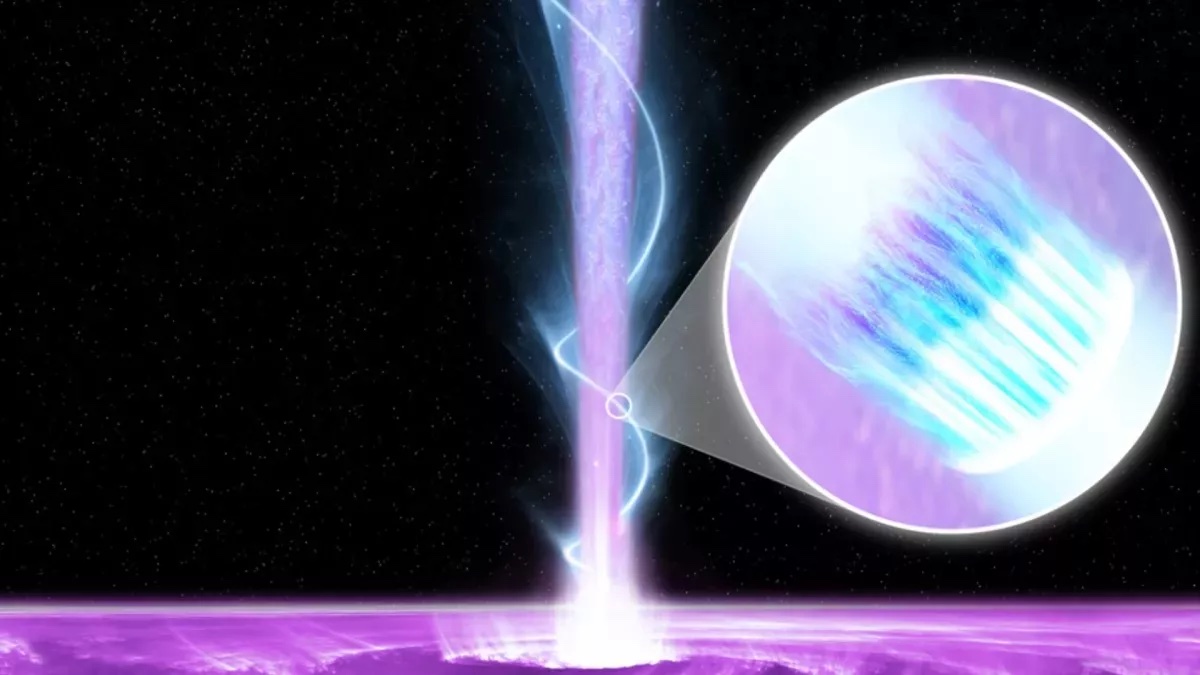
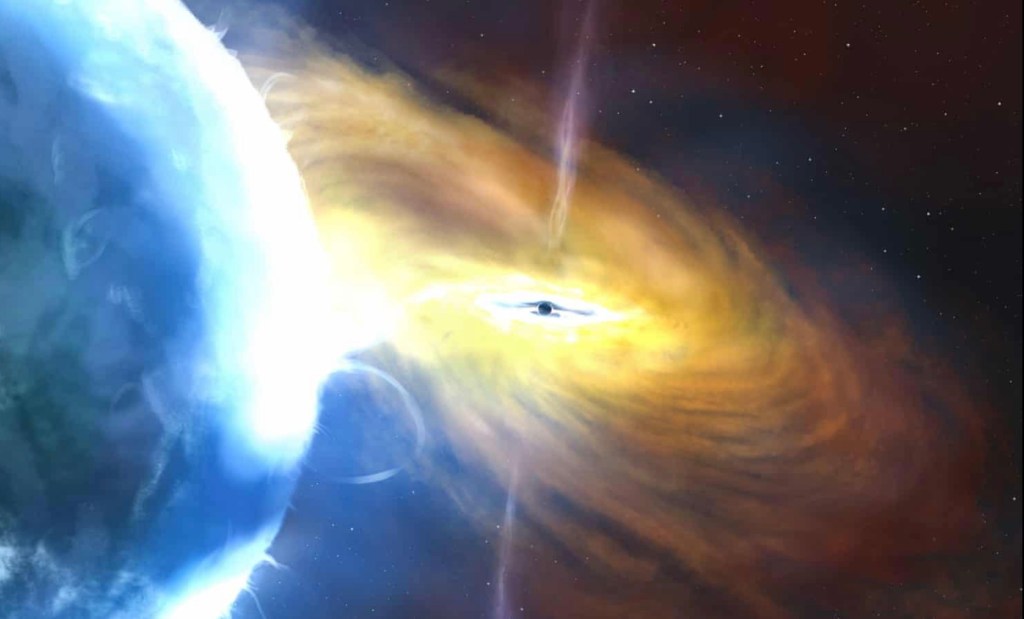
A NASA mission has observed a supermassive black hole pointing its highly energetic jet straight toward Earth. Don’t panic just yet, though. As fearsome as this cosmic event is, it’s located at a very safe distance of about 400 million light-years away.
Superconductors are materials that allow electrical current to flow with no resistance, a property that would revolutionize power grids where energy is lost in transmission as well as advance fields such as computing chips, where electrical resistance acts as a speed limit.
The hallmark of science is replicability. I.e., can two independent teams of researchers, using similar means, methods, and materials in completely different settings, replicate the findings of the original team?
So…
Researchers from at least three Chinese universities have in recent days said they produced versions of LK-99 with varying results. One team from the Huazhong University of Science and Technology posted a video purporting to show the material levitating over a magnet, which is important because true superconductors can float over a magnet in any orientation, without spinning like a compass.
But…
…another team, from Qufu Normal University, said they did not observe zero resistance, one of required characteristics of a superconductor. A third, from the Southeast University in the eastern Chinese city of Nanjing, said they measured zero resistance, but only at a temperature of 110 Kelvin (-163 degree Celsius).
And…
The possible bad news for LK-99 is that the superconducting field is full of materials that hold promise at first but fall apart under scrutiny. Researchers even have a handy name for them — unidentified superconducting objects.
A.k.a “USOs.” As the linked article points out, plenty of smart, hardworking researchers have claimed to have found a “superconductor,” but then their claims simply fall apart under scrutiny.
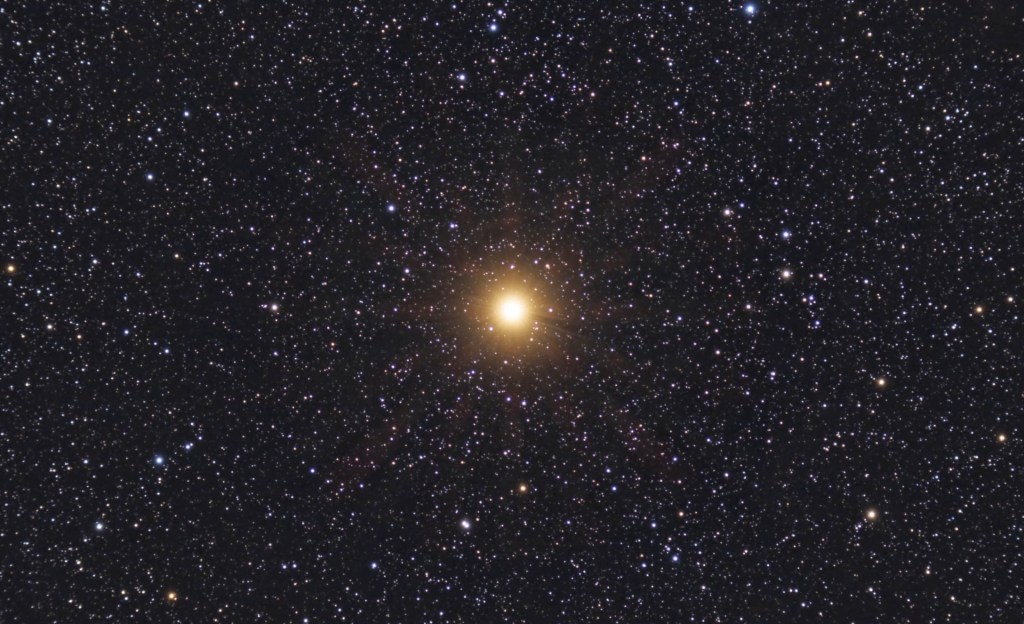
Betelgeuse, the closest red giant to Earth, has long been understood to move between brighter and dimmer in 400-day cycles. But from late 2019 to early 2020, it underwent what astrophysicists called “the great dimming”, as a dust cloud obscured our view of the star.
Now, it is glowing at 150% of its normal brightness, and is cycling between brighter and dimmer at 200-day intervals – twice as fast as usual…It is currently the seventh brightest star in the night sky – up three places from its usual tenth brightest.
Betelgeuse is the closet red giant Star to our solar system, one of the shoulders of the Greek constellation of Orion.
The cultural information in the linked article was actually more interesting than the phenomenon observed. For instance, the fact that an Aboriginal people in Australia saw it long before the Greeks did was something I didn’t know.
And that the Greek name comes originally from the Arabic “bat al-jawzāʾ” meaning “giant’s shoulder.”
And all three cultures saw the star as connected with fire held by a giant hunter of some sort.
And so have ancient Babylonians, Egyptians, and probably everyone else, too. We just can’t help personifying even the stars.
The kicker?
When it does eventually explode, it could – over the course of a week – grow so bright that it will be visible during daylight, and cast shadows at night.
Now that’s something I’d like to be around to see. Hmm. If only I could manage to live for another 10- to 100,000 years…
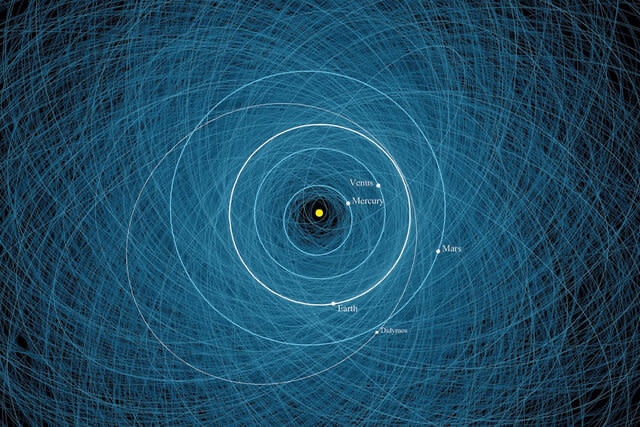
Of all the asteroids they modeled, the one with the largest risk of impact was a kilometer-wide asteroid known as 1994 PC1. Over the next thousand years, the probability that 1994 PC1 will cross within the orbit of the Moon is a paltry 0.00151%, hardly worth worrying about.
Thanks to Glen Hill over at Engagin’ Science (formerly Scientia, which apparently was far too Latin- and science-esque for search engines to handle) for bringing this (not-so Earth-shattering) info to my attention.
Sorry, folks. Hollywood was once again wrong (sigh).