Today I talked to virtually no one for the first time in quite a while. It’s almost like meditation. Reminds me of what L said when we were out drinking Friday night (as usual). She and G were talking about scuba diving, about how being underwater hearing only your own breath and hardly being able to see anything unless it’s right in front of you gives you a feeling of being alone in the universe, a feeling of vulnerability and isolation, of insignificance. I commented, “That’s just like meditation.” No reaction.
I don’t need to go scuba diving in the Philippines to experience such a feeling.
For all these technological “advances,” we are no better than the ancients. We are still prisoners to our emotions — or to the biological impulses of electricity and hormones whose results we deem emotive.
I’ve always been a night owl, always found it easier to concentrate when other brain waves were sleeping and not interfering with mine.
Now, though, I often find the most relaxing time of day is dinner time — because I get to cook for my family!
I never would have said that even five years ago. But the pandemic especially has given me a chance to try out all sorts of recipes, modifying, adding, subtracting as I go. It’s like a chemical experiment 🧪 for our digestive systems!
I can’t wait to get home from work, start up a little Cannonball Adderly, Bill Evans, or Dizzy Gillespie and fire up the grill/wok/air heater and roll up my sleeves.
Of course, I still enjoy the late late hours of a tipple 🥃 and a three-hour YouTube on the rise and fall of the Akkadian Empire (history nerd here). Not enough hours in the day!
In that case, you should keep a diary, his advisor suggested. Write every day.
OK, he said.
And bring me a story or two to look at.
OK.
October
These aren’t stories, his advisor informed. These are more like diary entries.
How should I write a story, then? he asked.
Write what you know. Base your stories on people and things around you.
OK.
And bring me another story or two.
OK.
November
The narration isn’t believable, his advisor imparted.
Why? he asked.
It’s too difficult for the reader to identify with the characters. Nobody has a family with nine children.
What should I do?
Go read Sherwood Anderson’s Winesburg, Ohio.
OK.
And bring me a couple more stories.
OK.
December
I don’t get any sense of through-story, his advisor complained.
What do you mean? he asked.
The stories aren’t connected. They’re all different.
Well, what should I do?
Try an internal perspective. Go read James Joyce’s Portrait of the Artist as a Young Man.
OK.
And bring me another story.
OK.
January
This is too abstract, his advisor mused.
What do you mean? he asked.
This isn’t a true plot. The symbolism is too obscure.
It’s a translation of something I wrote for a German class.
You don’t want to be Kafka.
I don’t?
You need real life stories, with real people and real problems.
What should I do?
Go read Raymond Carver’s “Cathedral.”
OK.
And…
Bring you another story?
Two.
February
I think I see the problem, his advisor intuited.
What is it? he asked.
I think you need to experience more life before you can be an effective writer.
What do you mean?
You need to go out into the world and work different jobs, meet different people, move around a bit.
My thesis is due in two months.
So it is. Make sure you give your draft to me next month.
OK.
And…
Another story?
No. Just read my comments and rewrite what you have.
OK.
March
I don’t see the point of adding poetry between the stories, his advisor grumped.
Why? he pondered.
The poems interfere with the prose.
I thought you didn’t like the prose.
I would say you need to add a poetic sense to your prose.
How do I do that?
Try writing poetry. For practice.
…
And finish the rewrite of the draft by next week.
OK.
And print three copies on a laser printer. And buy three of those thesis black cover binders.
OK.
April
Well, the three of us have examined your thesis, and we decided on a grade of B+, his advisor beamed.
…
I know it’s not as high as you wanted, but I argued that the interplay of letters, poetry, and stories woven together formed an interesting kind of metadiscourse narrative depth to the thesis structure.
…
Congratulations.
Thanks.
If you like this, you might enjoy Notes from the Nineties, a book with short stories and poems (the above is the first one, and may or may not be partially based on personal experiences my senior year in college).
I’ve kept a journal (OK, a diary) for many, many years now. It first started in September 1984 as a junior high school 1st year (7th grade) English assignment — each day, we would be given a writing prompt and at the end of the 10-week term (quarterly system back then), the English teacher would look it over and write feedback.
At least, that was the idea. In mid-October my family moved to a county and school system about 60 miles away (it’s more complicated — we couldn’t move in to the new house at first and so my siblings and I were looked after by various relatives, so we didn’t go to school for about nine to ten days). The new school didn’t use journals at all. English class was boring. Grammar and sentence diagramming.
So I kept writing at home, almost on a daily basis in the beginning.
But I’ve been fairly inconsistent over the years. I filled several notebooks, all different sizes and shapes. I stopped writing in one notebook at some point in 1999 when I moved to Japan and started another one. Then some time in 2004 I decided it was a waste of paper not to finish the 1999 one. Then I filled it up and started typing in a Word file. Then I went to Montreal four years ago and started writing in paper notebooks again.
It’s, quite frankly, a great big mess.
But there are some good ideas in these notebooks, and lots and lots of bizarre poems that I swear I do not remember writing. (Also at least half a dozen attempts at “automatic writing.” If you don’t know what that is, look it up.)
So from time to time, I’ll post some bits and pieces here. Just for safe-keeping.
Who knows? I may wind up publishing some of it at some point. Or at least drop some of it into the mouths of future SciFi characters.
In other words, without “fresh real data” — translation: original human work, as opposed to stuff spit out by AI — to feed the beast, we can expect its outputs to suffer drastically. When trained repeatedly on synthetic content, say the researchers, outlying, less-represented information at the outskirts of a model’s training data will start to disappear. The model will then start pulling from increasingly converging and less-varied data, and as a result, it’ll soon start to crumble into itself.
So, as more and more lazy people ask AI to “write” for them, the programs get less and less accurate…
Or, as the authors of the study conclude, “…without enough fresh real data in each generation of an autophagous loop, future generative models are doomed to have their quality (precision) or diversity (recall) progressively decrease.”
I.e., the use of AI-generated content to train AI doesn’t work, and since there is already way too much AI-generated garbage all over the internet, it’s almost impossible to sort out which is which when the AI-creators “scrape” data from the web.
So…
See, machines can’t replace us entirely — their brains will melt!
But then again, that might not be so hopeful after all. When AI takes over the world, maybe it won’t kill humans; perhaps it’ll just corral us into content farms…
At least we won’t wind up as batteries.
Yet.
PS. I find it both hysterically amusing and disturbing that my blog program offers an “experimental AI assistant.” Granted, the program does let you know that AI-generated content accuracy is not guaranteed, but wth would I want to use AI for a personal blog? The whole purpose of a blog is to WRITE. AI-generated text is not writing. It is intellectual property theft.
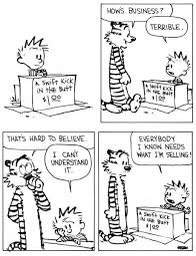
If you were going to open up a shop, what would you sell?
OK, OK, in all seriousness, I would probably open a jazz café / restaurant. But only on the weekends.
We live at the foot of a mountain trail, and it’s really popular with retired folks and young families.
My wife and I have already begun thinking about our “second life” after retirement, and I’ve been frankly bored with the whole EFL teaching thing for a while now.


 M Thomas Apple Author Page