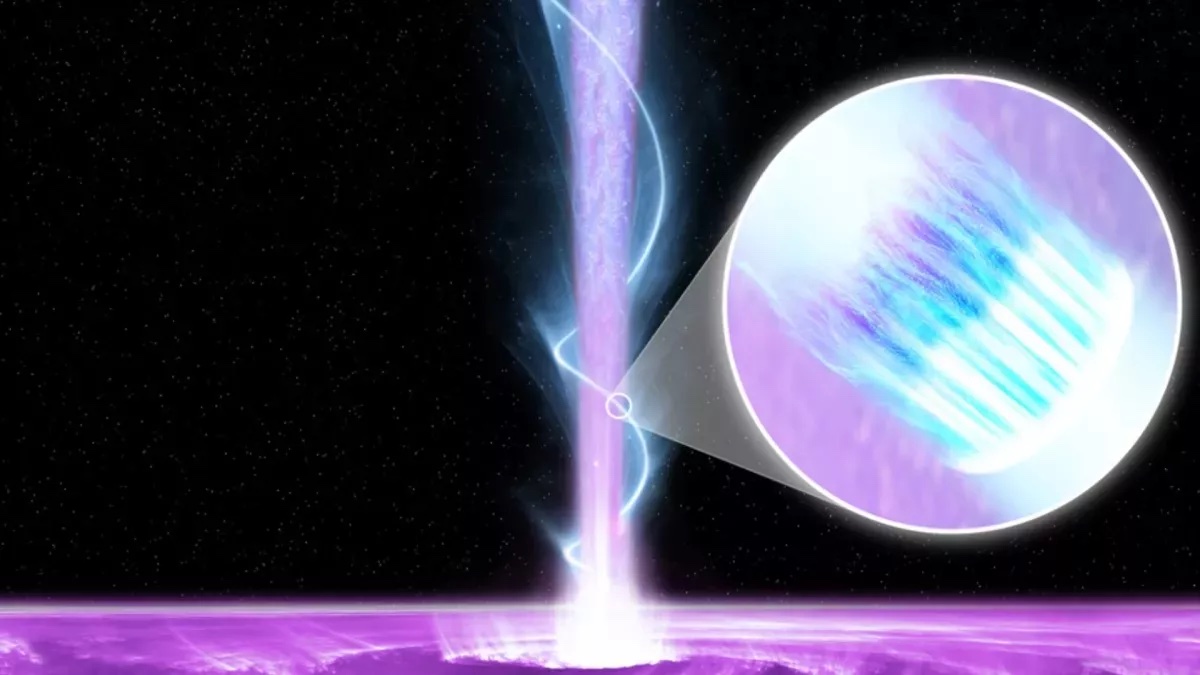
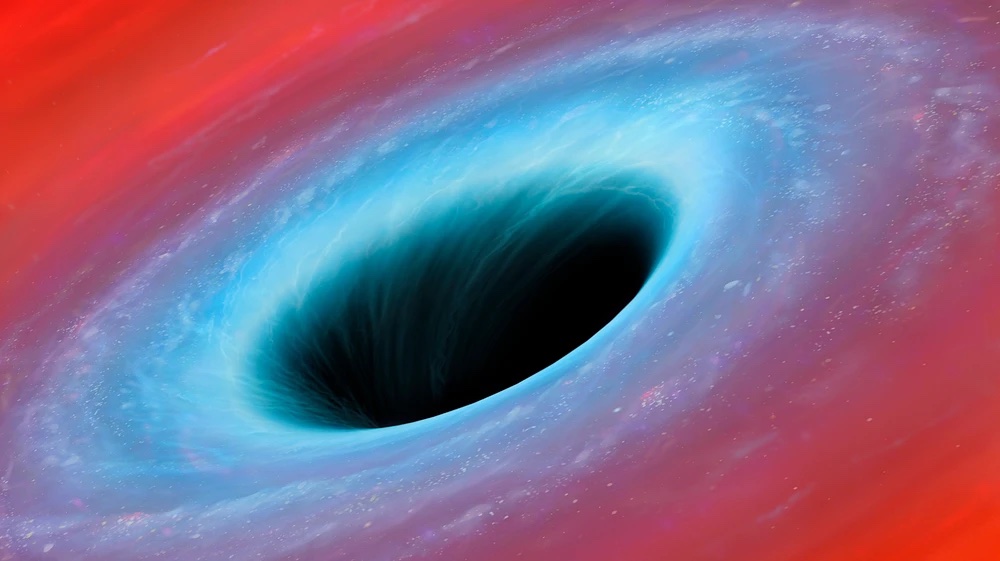
A NASA mission has observed a supermassive black hole pointing its highly energetic jet straight toward Earth. Don’t panic just yet, though. As fearsome as this cosmic event is, it’s located at a very safe distance of about 400 million light-years away.
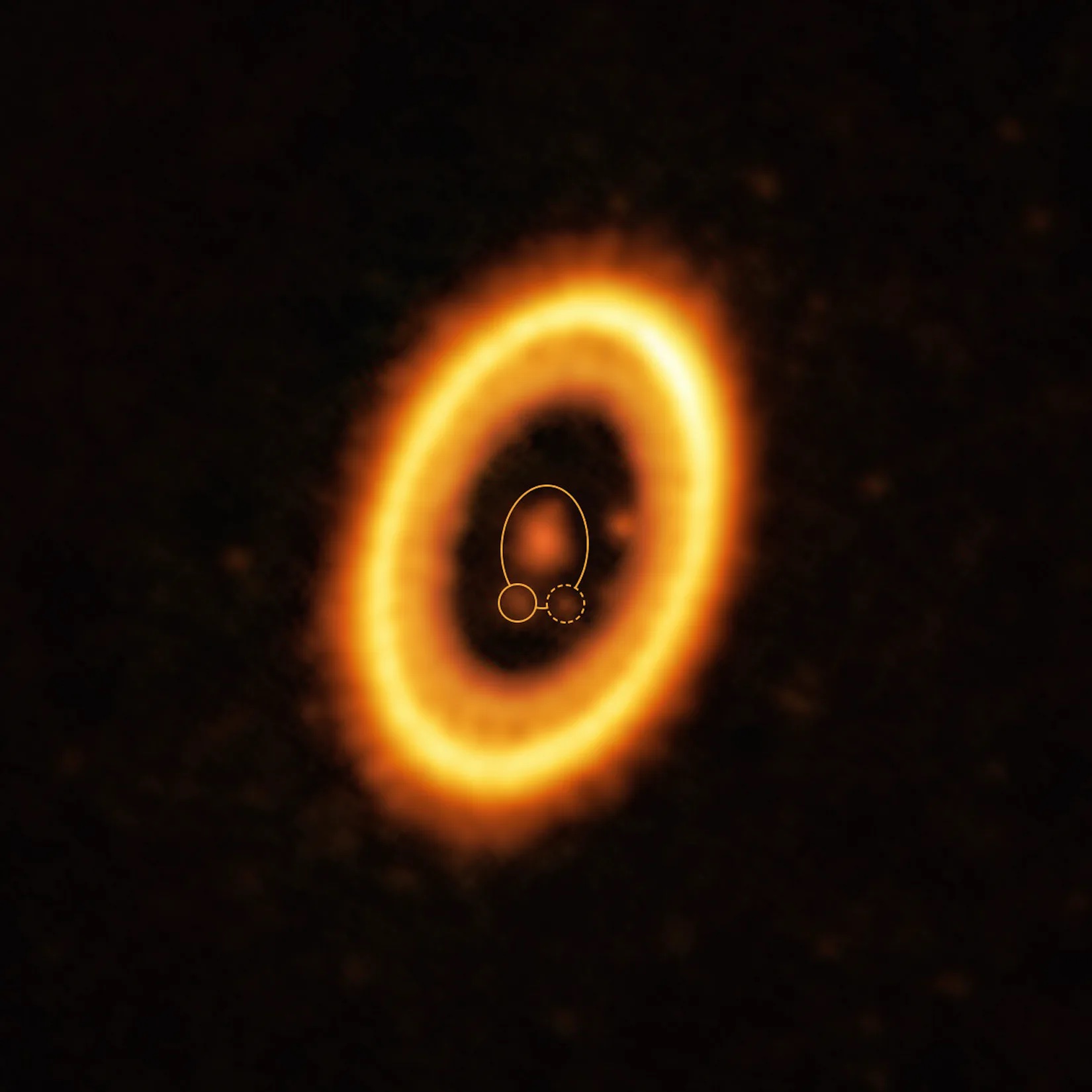
The two planets are in circles that kind of look like, er….let’s just call the whole thing a cosmic donut (the outer “halo” is the protoplanetary disc of gas and dust from which planets eventually coalesce).
We already know that more than one object can share the same orbit; Jupiter has a collection of 120,000 asteroids following its same path around the Sun, for example. Earth has one, too. But although it’s theoretically possible, astronomers have never discovered two whole planets sharing the same orbit around a star before.
Hmm…the language here is a bit misleading. The two objects are technically not both “planets.”
The article comments later on that the object in the dotted line circle is “a cloud of debris about twice the mass of our Moon trailing a bit behind the innermost gas giant” in one of its LaGrange points (where “Trojan” asteroids follow gas giants such as Jupiter and Saturn). So it’s way too early to say that “two” planets formed in the same orbit.
Still, this is the first time that astronomers have spotted two such objects this close to one another in the same orbit. Who knows if both will remain viable (the debris cloud could become partly or mostly absorbed by the gas giant with the rest either being expelled or thrust into separate orbits).
So why is this called a “cosmic unicorn”?
Apparently because although such Trojans “are allowed to exist by theory, but no one has ever detected them.”
Um. OK.
So, like, totally NOT at all like this? Kind of a bummer, really…
The link below includes a night sky in Montana, which makes little sense when the researchers were in Beijing and Honolulu…
“The first-generation star we observed has the potential to become the oldest star we have ever seen,” said Alexander Heger, a professor in the school of physics and astronomy at Monash University in Australia who was part of the research team. “It probably had only lived for 2 1/2 million years and then exploded.”
Oh, and it also was discovered to be 260 times the size of our own Sun…just as theorized.
More importantly, this involved scientists from three different countries (China, Japan, and Australia), sharing information and working together for science.
Imagine if that spirit of cooperation could be extended into other domains…
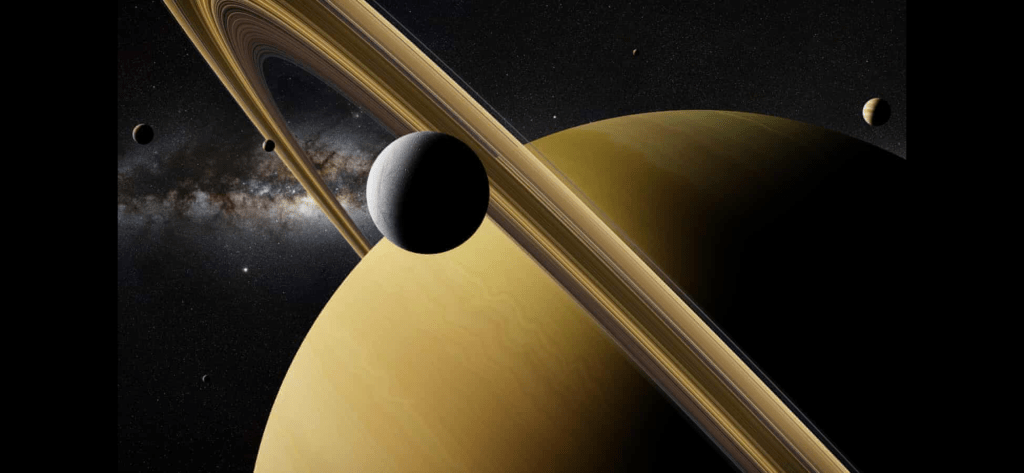
The record-breaking plume reached nearly 6,000 miles into space – covering the distance between Ireland and Japan – and poured water into the void at an estimated rate of 300 litres a second.
Note that the water jetted out into space nearly 40 times longer than the actual size of the moon (about 500 in diameter, or as the Gurdian puts it “500-mile-wide” for those who forgot the meaning of “diameter).
Enceladus is probably the best bet for life elsewhere in the solar system due to its water — and while whipping around Saturn once per day, which is likely the reason for underwater volcanos and other vents that may provide the proper chemistry for life.
Manhattanhenge, a portmanteau of “Manhattan” and “Stonehenge,” is a twice-a-year solar event when the sunset lines up directly with the city’s grid, casting golden rays down city streets. Several of the stones in Stonehenge, the prehistoric monument in Wiltshire, England, experience perfect alignment with the sun during the summer and winter solstices, which is why the event takes its name from the rock formation.
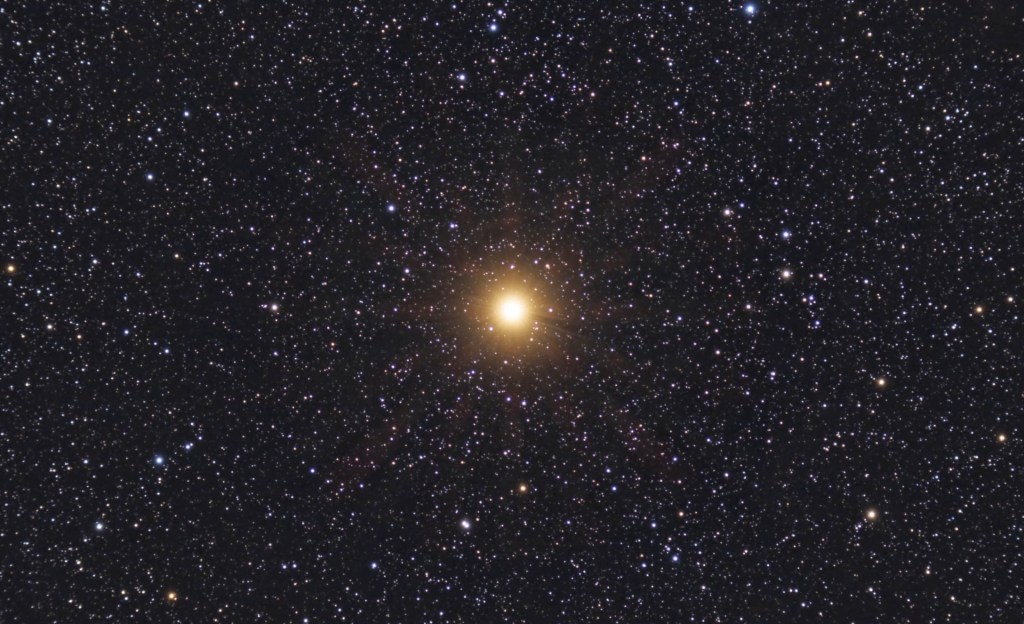
Betelgeuse, the closest red giant to Earth, has long been understood to move between brighter and dimmer in 400-day cycles. But from late 2019 to early 2020, it underwent what astrophysicists called “the great dimming”, as a dust cloud obscured our view of the star.
Now, it is glowing at 150% of its normal brightness, and is cycling between brighter and dimmer at 200-day intervals – twice as fast as usual…It is currently the seventh brightest star in the night sky – up three places from its usual tenth brightest.
Betelgeuse is the closet red giant Star to our solar system, one of the shoulders of the Greek constellation of Orion.
The cultural information in the linked article was actually more interesting than the phenomenon observed. For instance, the fact that an Aboriginal people in Australia saw it long before the Greeks did was something I didn’t know.
And that the Greek name comes originally from the Arabic “bat al-jawzāʾ” meaning “giant’s shoulder.”
And all three cultures saw the star as connected with fire held by a giant hunter of some sort.
And so have ancient Babylonians, Egyptians, and probably everyone else, too. We just can’t help personifying even the stars.
The kicker?
When it does eventually explode, it could – over the course of a week – grow so bright that it will be visible during daylight, and cast shadows at night.
Now that’s something I’d like to be around to see. Hmm. If only I could manage to live for another 10- to 100,000 years…
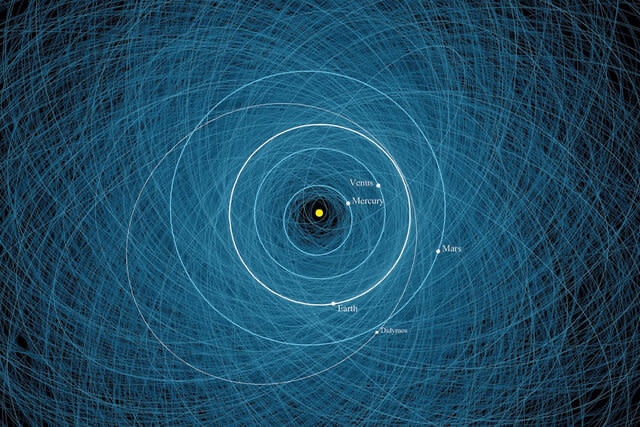
Of all the asteroids they modeled, the one with the largest risk of impact was a kilometer-wide asteroid known as 1994 PC1. Over the next thousand years, the probability that 1994 PC1 will cross within the orbit of the Moon is a paltry 0.00151%, hardly worth worrying about.
Thanks to Glen Hill over at Engagin’ Science (formerly Scientia, which apparently was far too Latin- and science-esque for search engines to handle) for bringing this (not-so Earth-shattering) info to my attention.
Sorry, folks. Hollywood was once again wrong (sigh).
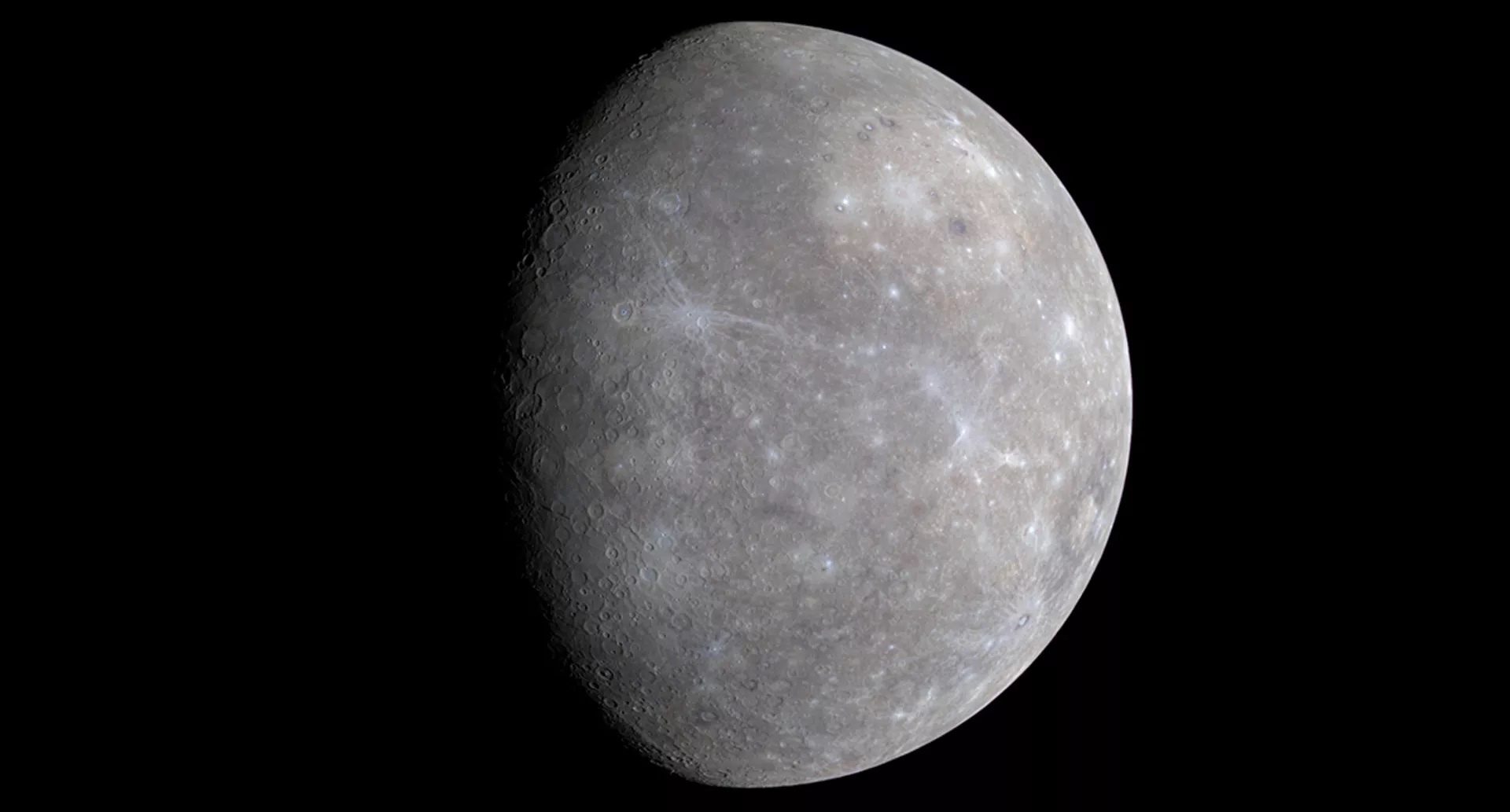
Mercury is a planet that just doesn’t make sense. It’s incredibly small yet hosts a relatively massive core. Mercury is so strange that astronomers have not been able to explain its properties with simulations of the solar system’s formation. But now, researchers have found an important clue, and Mercury’s weirdness appears to be the fault of the giant planets.
Basically, Mercury is nearly as dense as the Earth despite being less than 6% the size. This is due to the gas giants in our solar system yanking material (“planetesimals” and protoplanets) and ejecting it from the solar system, leaving Mercury with very little material left to form itself.
“I was quite surprised by how simple the story hiding behind the curtain of complexity in the data,” Sneppen continued. “You have this immensely complex physics, unimaginable dense stars and the birth of a black hole — and then it all reduces to this beautiful sphere.”
The neutron stars that crashed into each other are “dense and compact,” Sneppen said. They only measured around 20 km in diameter — about 12 miles — but they are “heavier than the sun,” he said. “A teaspoon of neutron star matter weighs more than Mount Everest.”
First reported in 2017, a new study in Nature gives more details about a “kilo nova” only detected by using gravitational waves. The collision led to the formation of a black hole.
Fortunately, this sort of cosmic event doesn’t occur too often. But..
…if a kilonova were to occur in the Milky Way — less than 30,000 light- years away — it would be the brightest star in the night sky, making it discoverable to the human eye…
Still, it’d be safer for Earth if it never happened…
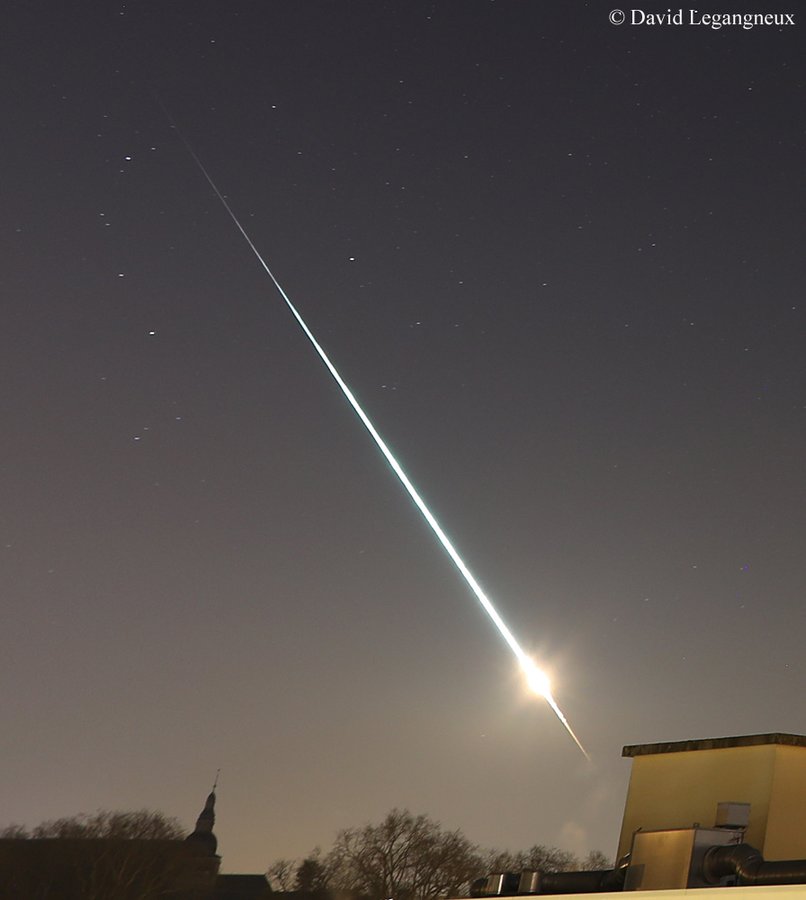
Anyway, “SAR2667” provided some cross-cultural entertainment for people living in England, France, Belgium, and the Netherlands. Lots of photos and videos online.
Interesting note from ESA: they were able to detect it and notify everyone exactly where and when it would disintegrate.
Since there are more than 30,000 of these things that orbit the Sun relatively close to Earth’s orbit, it’s a good thing we’re getting better at detecting them. Maybe we’d better up the ante on deflecting them…






 M Thomas Apple Author Page