Half of a dilithium crystal? (It’s a new type of crystal called “Chang’esite” (after the ancient Chinese moon goddess).
I should be posting another chapter from Bringer of Light, but I don’t feel like writing that right now, what with a humongoid typhoon slowing churning its way here.
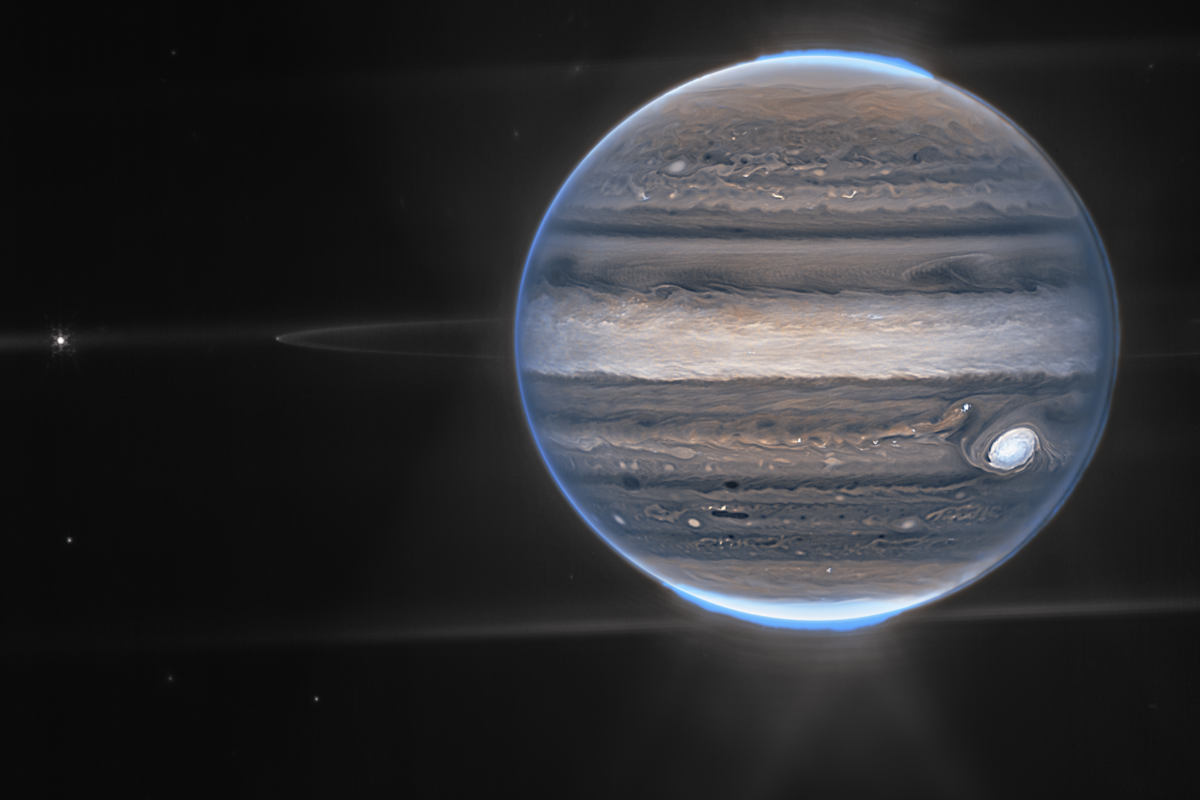
Courtesy NASA. Note that the blue, white, green, yellow, and orange colors are artificial, only added to make features revealed by infrared stand out for human eyes. You can see the planet’s rings, aurora, and two “tiny” moons (at left; they’re not really that tiny!).
“We’ve never seen Jupiter like this. It’s all quite incredible,” said planetary astronomer Imke de Pater, of the University of California, Berkeley, who helped lead the observations.
“We hadn’t really expected it to be this good, to be honest,” she added in a statement.
The above is supposed to be in “quote” format, but WP really messed up this feature when they switched to so-called “block” mode (which I can’t stand).
Anyway, the image is fairly spectacular, from the new James Webb Space Telescope which is positioned 1 million miles away from Earth (i.e., in the second LaGrange point, or L2).
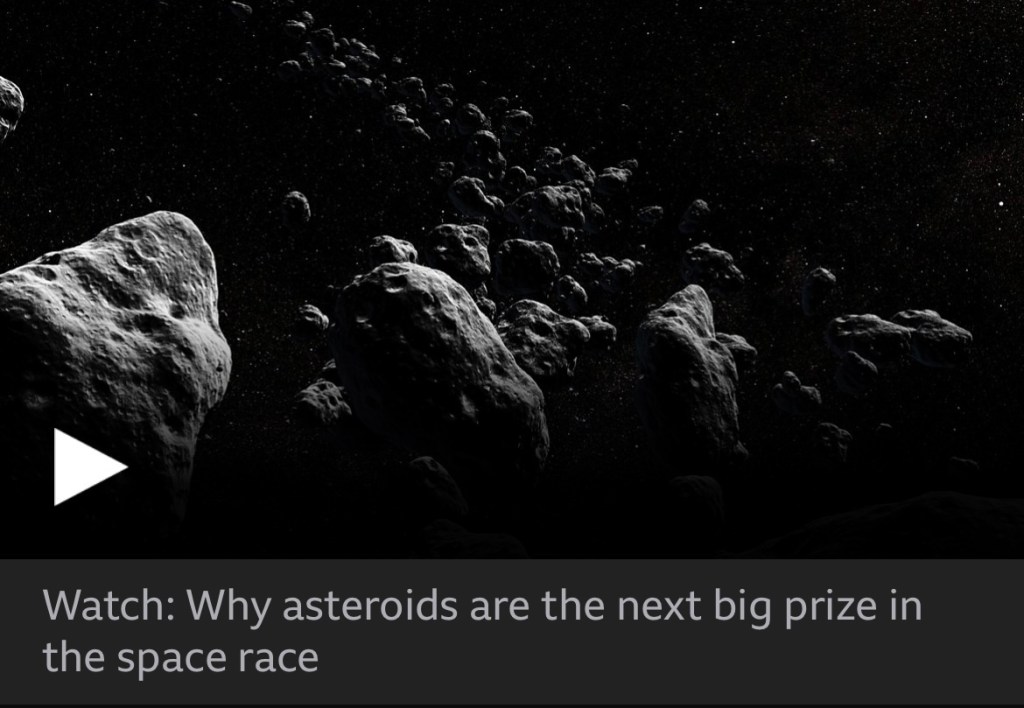
First of all, stop calling it “the golden asteroid.” That’s confusing people (the headline of the article linked below even uses the phrase “gold mine.” Come on, lazy journalists.)
If 16 Psyche is worth mining, when could such operations proceed? Citigroup thinks that space mining, including from the moon and asteroids, will be a $100 billion-per-year business by 2040. Launch costs will continue to decrease and experience in operating in space will continue to expand until such a business makes economic sense.
Well, how heavy do you think the materials to make buildings and ships in outer space are?
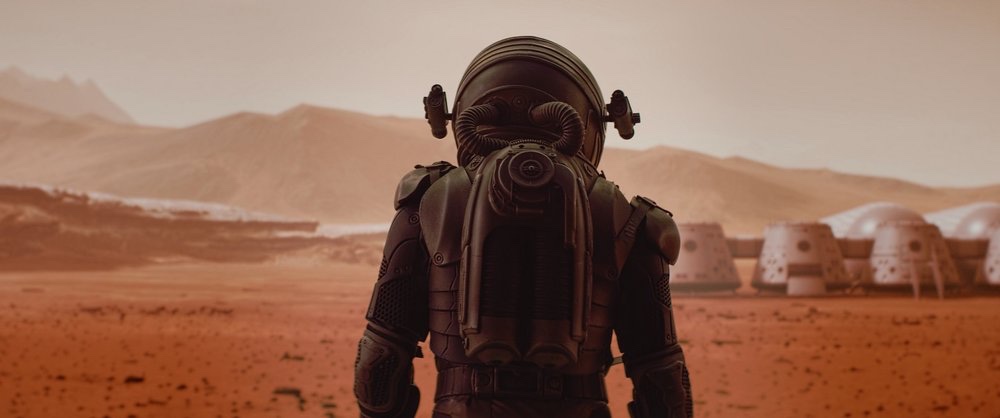
If we’re serious about putting people on the Moon and Mars, then it makes much more sense to set up robotic mining factories and assemble everything in space.
All this needs is a little incentive…like a new space race…
Our search for alien life is getting serious. With better telescopes and a growing scientific consensus that we’re probably not alone in the universe, we’re beginning to look farther and wider across the vastness of space for evidence of extraterrestrials.
But it’s possible we’re looking for too few signs in too few places. Having evolved on Earth, surrounded by Earth life, we assume alien life would look and behave like terrestrial life.
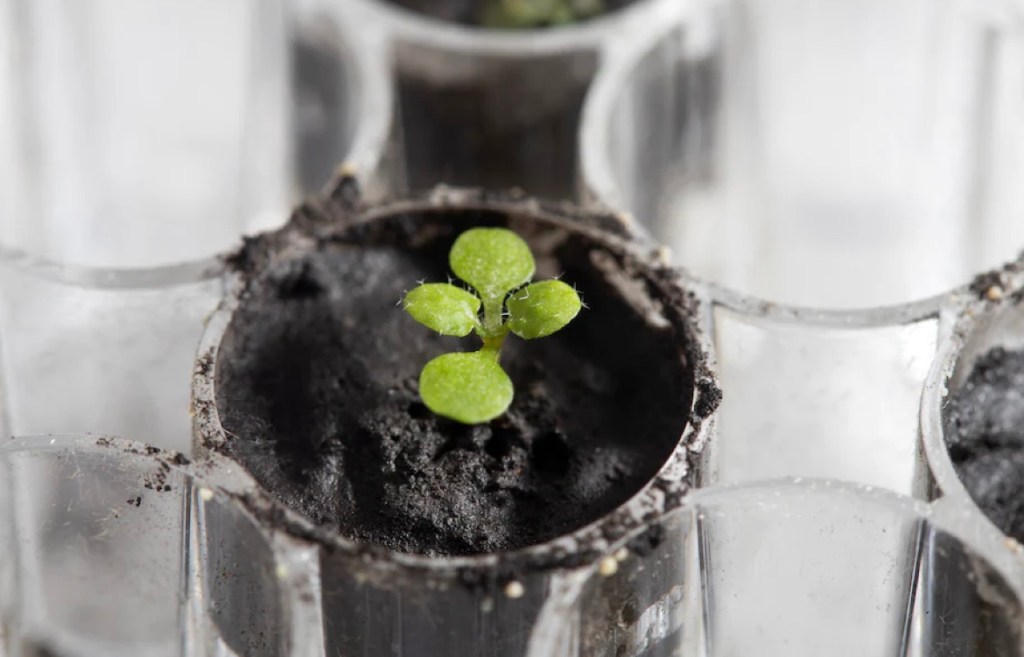
The samples were extremely hydrophobic, and repelled water as if it were the most disgusting thing ever invented. Researchers labored to get the lunar soil to gradually soak up water. They also added a nutrient solution.
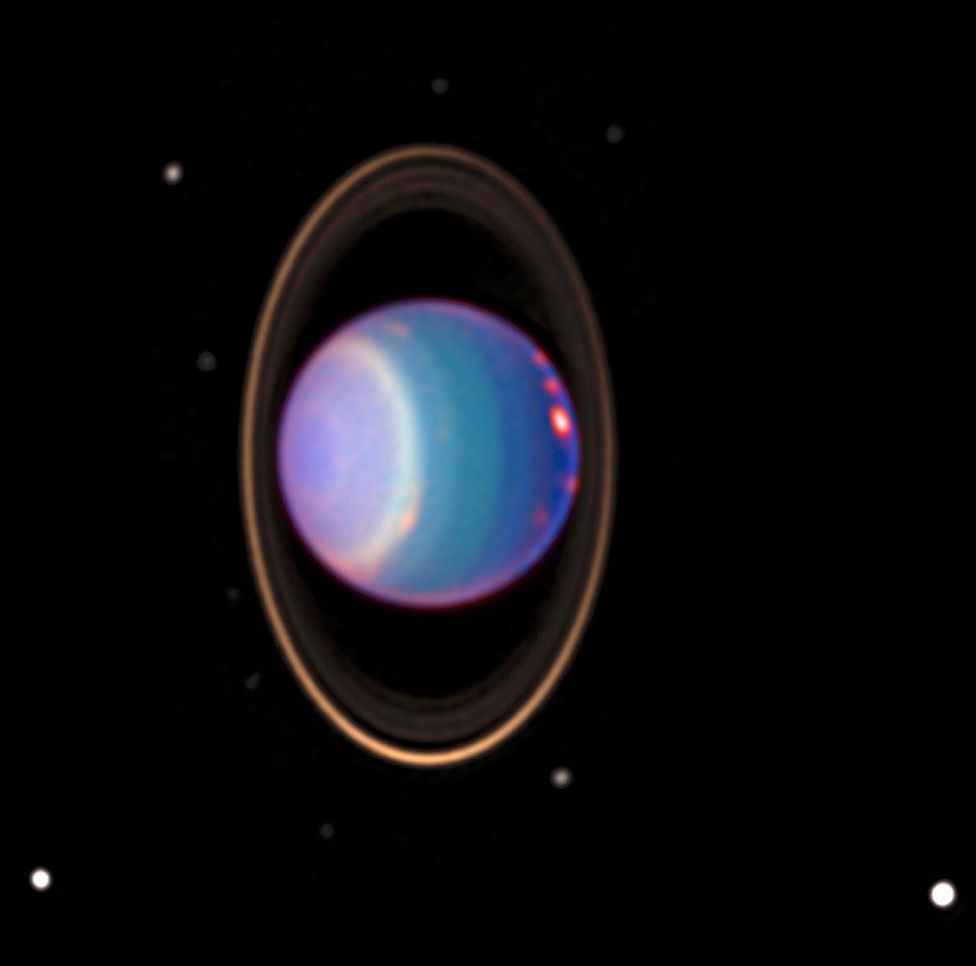
“Researchers think an in-depth study of Uranus can help them better understand the many similarly sized objects now being discovered around other stars.“
Uranus’s strange tilt is probably due to getting smacked by a very large body a long time ago…
Uranus is weird. It has rings. It has 13 moons, some of which may harbor life beneath their icy surfaces.
It has a funny name.
I get it. But learning more about how its formation affects planet formation is just not that important.
“Pure” researchers probably are interested, but frankly, if NASA wastes its time doing this, they will miss the opportunity to settle the Moon and Mars, mine asteroids for valuable resources, and explore other moons like Titan and Europa.
China will get there first.
Pure research is all fine and dandy, but it’s also incredibly expensive — taxpayer dollars should be spent on projects with more tangible benefits.
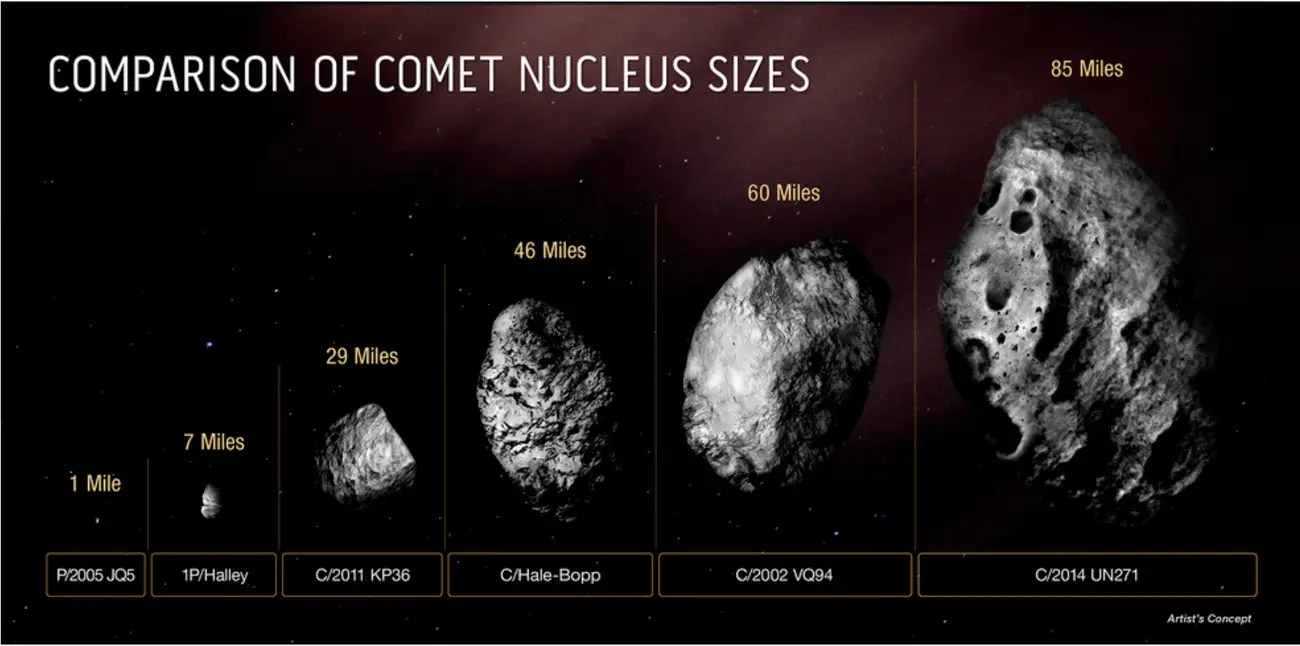
C/2014 UN271 on the far right has a nucleus 50 larger than the average comet.
“Its size, which NASA noted is larger than the state of Rhode Island, is an estimation because the comet is still too far away for Hubble to tell for certain.”
Note that the original title was “…toward the Inner Solar System”…and yet the article goes on to explain that it won’t come any closer than a billion miles from the Sun, “‘slightly farther than the distance of the planet Saturn,’ NASA said in a statement.“
Uh. The inner solar system is *no where near* Saturn. Try again, fear-mongers.
Sigh.
Anyway, it really is the proverbial “tip of the iceberg,” since this was seen with Hubble, and we have yet to see just what the new James Webb telescope can do. The Oort Cloud is a big place. There must be millions upon millions comets just waiting to be discovered.
In short, the algae will use sunlight to transform CO2 into sugars that are then enhanced by bio-engineered E.coli into 2,3-butanediol. Interestingly, 2,3-BDO is not entirely conceptual as it currently exists and is mainly used to produce rubber components. It has just never been thought of as fuel before.