A Japanese telescope positioned on top of Mauna Kea, a dormant volcano on the Big Island of Hawaii, captured video of an eerie flying spiral in the night sky on Jan. 18.
In the video, a small bright spot appears and slowly gets brighter and starts to dissipate into a spiral before getting small again and disappearing.
In fact, it was the remains of a discarded Falcon 9 booster from the launch of a SpaceX satellite. And it isn’t the first time this has happened. Japanese TV talked about this, too (since it was a Japanese astronomy, at the Subaru Telescope, that first recorded it).
So, an Identified Flying Object!
Yay, more metallic junk.
(Thanks to Glen Hill for bringing this article to my attention.)
Well, I managed to watch the first two episodes, but I really couldn’t continue after that.
Watanabe is right. Netflix screwed up by doing what all US-based companies do when they try to make scifi: they focus on the violence and forget about the ambiance.
But as he says at the end of the interview, “The value of the original anime is somehow far higher now.”
(Read the original interview in its entirety here, if you can stomach the political pop-ups.)
Since the Hayabusa2 returned with the sample from the Ryugu asteroid in December 2020, several important discoveries have been made – most notably analyzes confirming the presence of substances thought to be the building blocks of life on the asteroid, such as liquid water and organics fabrics.
Hayabusa-2 took several years to land on Ryugu (literally “Dragon Palace”), pound out just over 5 grams of asteroid material, and bring it back to Earth (landing in Australia in late 2020).
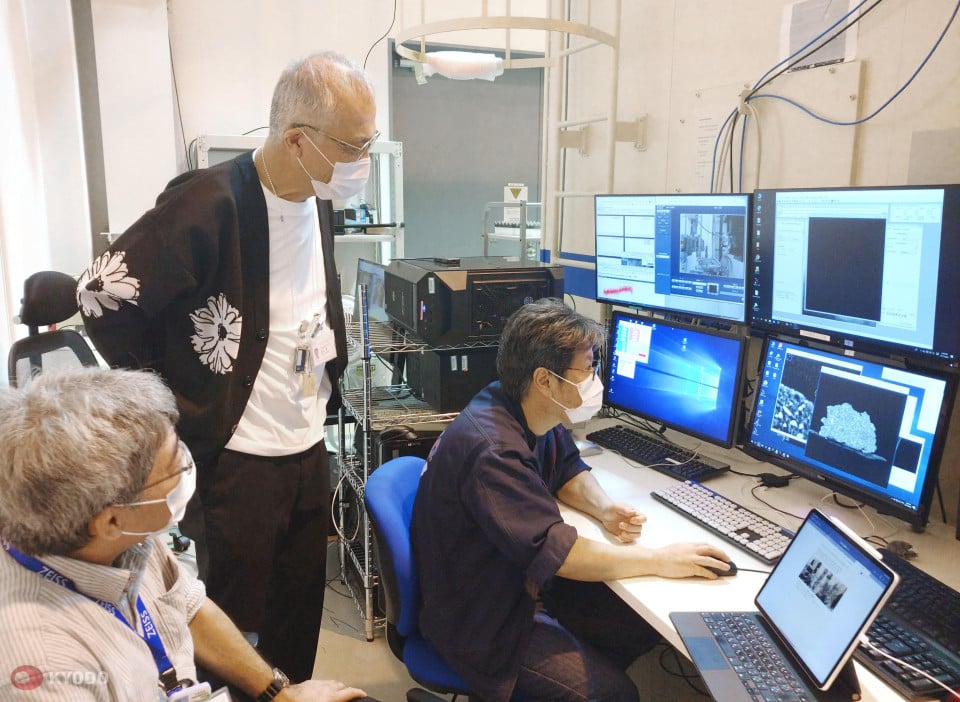
NASA scientists have confirmed not just frozen water but liquid — inside crystals called pyrrhotites. JAXA scientists (pictured above with Prof Tsuchiyama of Ritsumeikan University, my main employer!) continue to check the density of the samples.
The water is similar to the carbon dioxide-laden water of hot springs. The research teams have already discovered over 20 amino acids, the basic protein building blocks of carbon-based life.
Another theory called “panspermia” proposes that a key mineral (boron) missing on early Earth came in an asteroid from Mars. ☄️ Hmm. Did Mars produce asteroids? Or more like asteroids hit Mars and broke off lots of tiny fragments? That somehow survived the journey to Earth?
Seems a little unlikely. But there is now evidence that at least some proteins came from space rocks.
So, sorry, Ridley. This isn’t how it happened. Cool movie, though.
Though definitions sometimes differ, cislunar space generally refers to the space between Earth and the moon, including the moon’s surface and orbit. Any nation or entity that aims to establish a presence on the moon, or has ambitions to explore deeper into the solar system, has a vested interest in operating in cislunar space, either with communication and navigation satellites or outposts that serve as way stations between Earth and the moon.
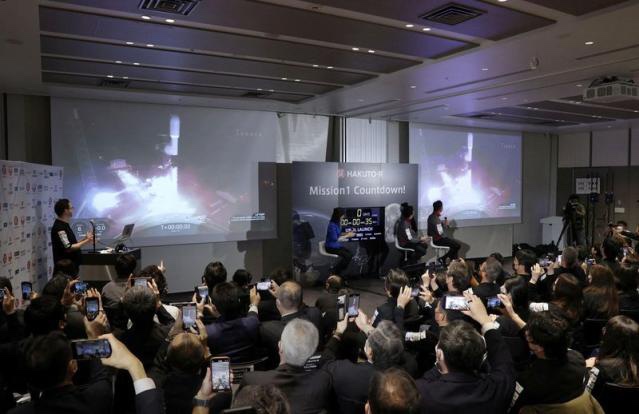
A Japanese start-up (I.e., a small private company)…
using a SpaceX rocket (I.e., a private company owned by the world’s wealthiest pri…er, person)…
sends up a small craft made in Germany… 🇩🇪
along with the Rashid rover (made by the UAE)…
and “a two-wheeled, baseball-sized device from Japan’s JAXA space agency”…
and somehow this is cooperation between the US and Japan versus China and Russia?
I’m not seeing it. The project may have used a NASA launchpad, but the people are charge (and the ones paying for it) are not part of any national government.
And I have a feeling this is the wave of the future. More and more private companies will get involved in space projects as they realize that they can thus ignore politics and aim at profits.
I, for one, welcome our future corporate overlords…
Just saw someone on my morning commuter train wearing a fluffy beige coat with a single word in all capital letters, stretching across the back from left elbow to right elbow:
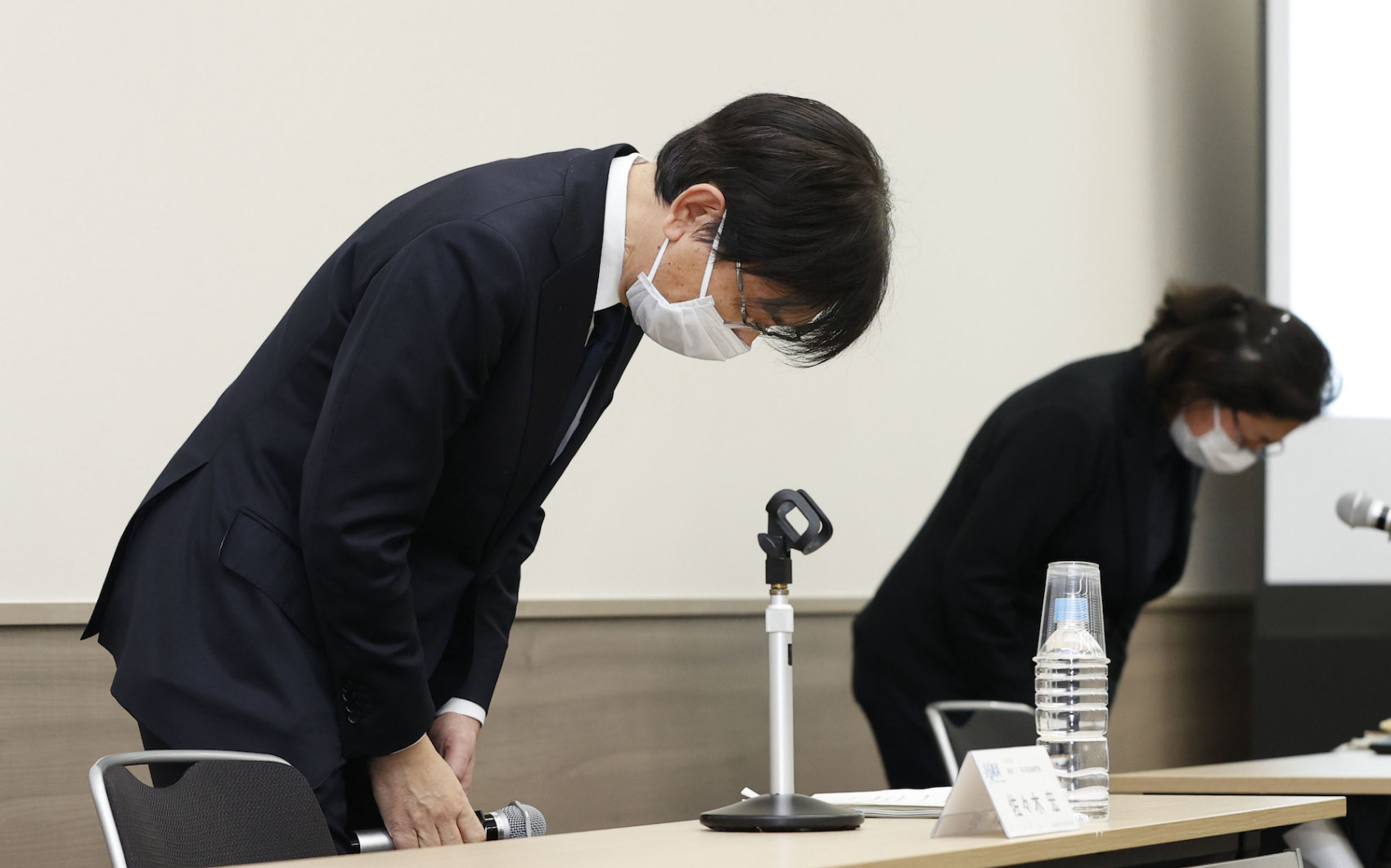
Falsified space research? No problem. The “apology bow” (sha zai, 謝罪) makes it all better.
There is a reason why Japan’s newest “micro” satellite spectacularly failed to do, well, anything.
The Japan version of NASA (Japan Aerospace Exploration Agency, called “JAXA” for some reason rather than “JAEA” — maybe the founder was a fan of X-Japan?) is riddled with incompetency and sycophancy.
Much like the rest of Japan’s government, one of the most corrupt of the world’s industrialized countries thanks to its strict “senpai-kohai” hierarchy where those at the top do no work and those at the bottom have no choice but to do what those at the top say – even if it’s illegal or immoral.
Last weekend was partly fun (Halloween party with our kids, pre-teen and teen) and partly melancholic (4th year anniversary of my mother’s untimely death from cancer).
But even before then, I just wasn’t feeling all that great. Not sick. Just sort of…not with it. On autopilot, kind of.
Now that fall is well and truly here, the pollen is going away and the skies are clearing.
Hoping I’ll find my muse again.
And, no, I’m not going to write anything about Twitter, elections, or crazy beliefs in satanic rituals making a comeback among the bonkers-crazy folk of my home country. Way too easy.