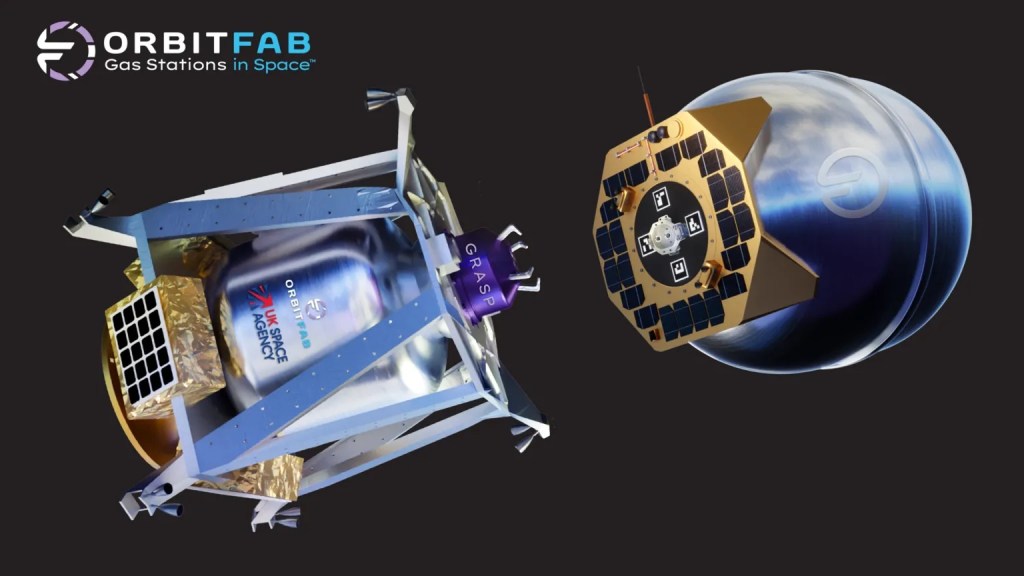
Jas Tiruvuru, business development manager for Orbit Fab in the UK and Europe, said the company was aiming to successfully demonstrate the technology in space by 2027.
“This will essentially be the first ever satellite to satellite refuelling demonstration funded here in the UK,” she said.
“Once we’ve proven that we can refuel to two spacecrafts we’ll be able to unlock a huge market potential.”
You know, maybe it’s just me, but I think 2027 may be a little optimistic. Just like the figure given in the article for how much the satellite sector will be worth in the future.
Aren’t there too many satellites already?
I’d like to see how this would help us colonize the solar system.
Actually, I’d like to see how they plan to get fuel up there in the first place.
Maybe my novel’s idea of using certain moons of Jupiter or Saturn as giant space gas pumps might help? 🪐
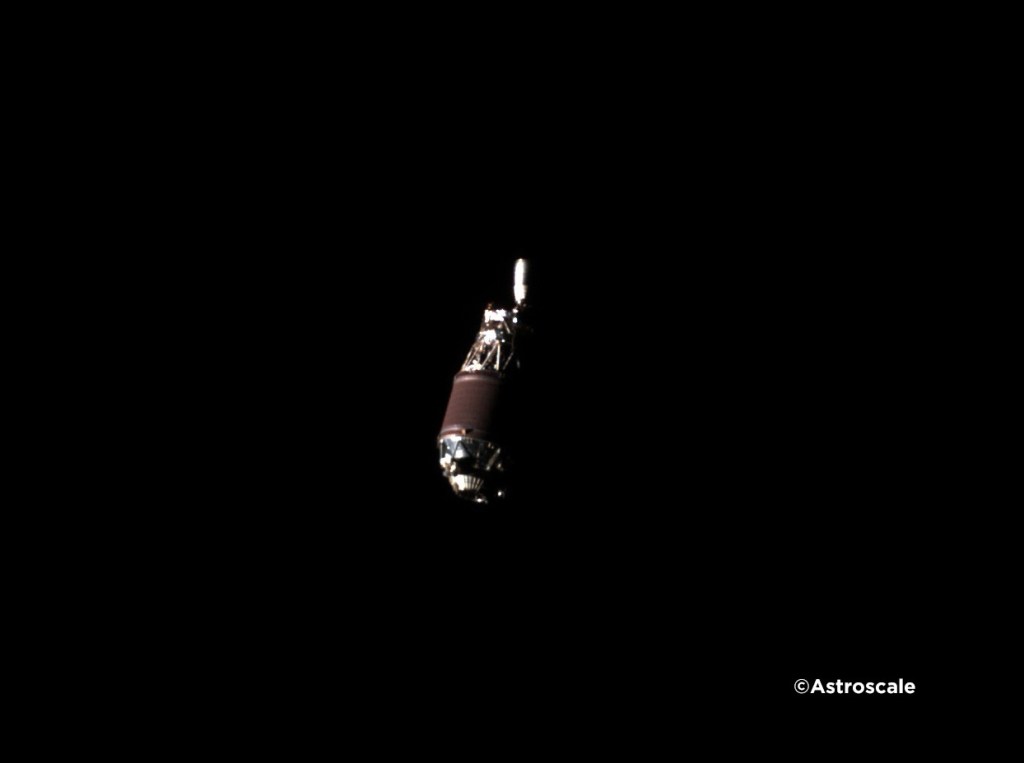
Japanese space company Astroscale Holdings Inc has unveiled what it calls the world’s first publicly released close-up image taken of space debris, hailing it as progress toward understanding the challenges posed by trash orbiting Earth.
How NOT to look at their smartphone while zombie walking on a train platform or stairs.
Smartphones should be programmed to send tiny electrical shocks into your hand when you walk while reading them. Put the thing in your pocket until you clear the field.
Are there things you try to practice daily to live a more sustainable lifestyle?
Now this is an interesting prompt.
1. Organic gardening
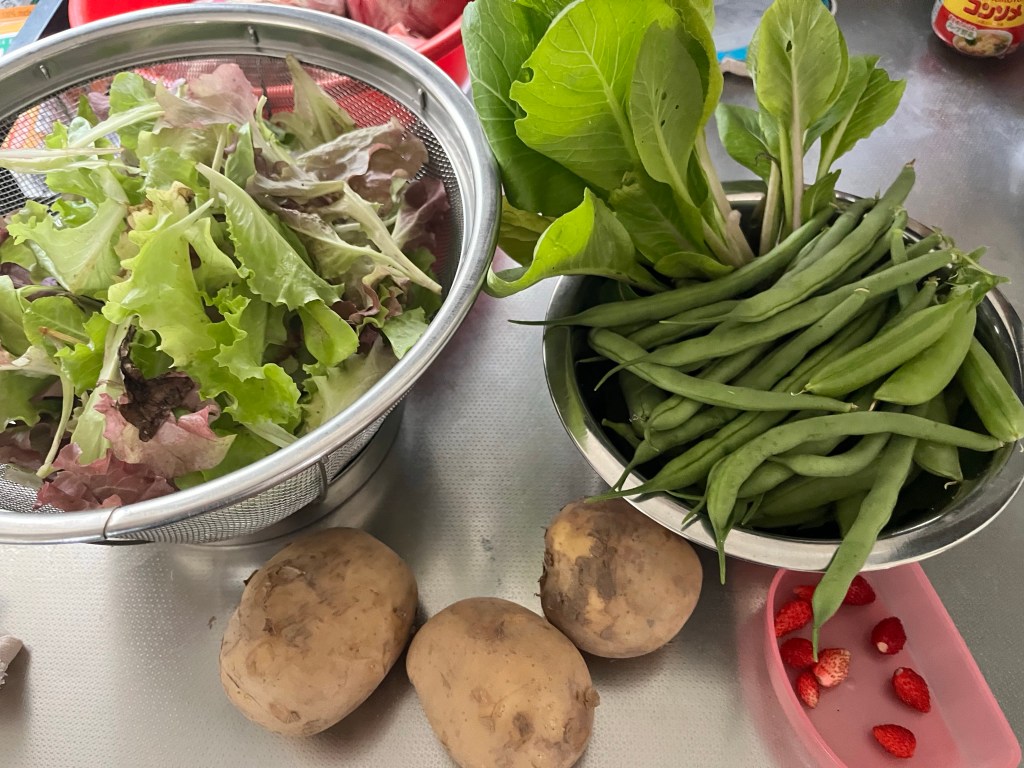
I’ve been gardening for just over ten years now. My father had an organically-grown garden for several decades, and I’ve been able to get a lot of advice from him on how to grow vegetables without using chemically-based fertilizers and pesticides/herbicides.
To be honest, sometimes the insects and the weather do get the best of the plants. But at least I know what’s in them, and I can keep the soil healthy as well.
Everything in this photo was organically grown. Well, not the bowls…
2. Composting
Part of gardening is using compost, or rotten food scraps, as fertilizer. We recycle any food left uneaten as well as the bits of vegetables that are often tossed into the garbage, things like roots, insides of peppers, the ends of beans, and of course egg shells.
Egg shells can be reused to help bushes as well, due to their calcium content. Although I have found that the shells need to be rinsed before chucking them near the stem of bushes. Otherwise we get some unwelcome animal nightlife…
3. Reuse reuse reuse
Any clothing we no longer have a use for (kids got too big, Dad spilled coffee on a favorite shirt or cooking oil on a favorite pair of shorts, a towel that frayed and is too dangerous to use…) we do one of two things:
(i) recycle with our local school’s monthly clothing pick up, or
(ii) turn it into rags that can be used to clean up spills rather than use kitchen paper towels.
We also get a lot of plastic bags — and I do mean a lot — because practically everything in Japan comes wrapped in plastic. Cookies and sweets are all wrapped individually. Vegetables are wrapped in plastic. Even meat from the store winds up in separate plastic bags (just in case they leak on the way home).
So we reuse as many of the plastic bags as possible, typically to collect household trash (especially during allergy season!). And, of course, to collect plastic, plastic bottles, cans and bottles for recycling.
4. Bath water
Like most homes in Japan, we have a pump attached to our clothes washer. Japanese are accustomed to taking evening baths (I don’t; at least, not in summer, since the water makes me sweat and then I have to take a shower all over again). The next morning, we reuse the bath water to wash clothes.
5. No AC or dryers
Strictly speaking, we do use the AC on occasion. But we designed our home to have lots of sliding doors between rooms and wide windows and balcony doors. That way, we can just open up everything and have a nice breeze come down the mountain behind us. The house stays relatively cool even during the hot sticky summer months and we can avoid using air conditioning (except when it rains and we have to close windows).
We also hang out clothing to dry to avoid using the dryer. It’s better for clothing, anyway, and in addition to not wasting electricity, lowers our utility bills.
These are just a few examples. It’s not much, but a little bit here and there adds up to a lot over time.
Now if you’ll excuse me, I need to go throw some used egg shells under the tomato plants. 🍅 🥚
Not too terribly helpful if you can’t read Japanese, but you can probably figure out which is water and which is “radical water.”
From 11 to 17 January, the Demonstration Business Promotion Team Osaka along with Sustainable Energy Inc. ran trials on a synthetic fuel produced from water and carbon dioxide present in the air. If successful, this could become the first carbon-based and truly carbon-neutral fuel of its kind.
So basically this company in Osaka did some water 💧 experiments with “radical water” (water whose molecules were subjected to a kind of electrolysis⚡️ to ionize them), then a “seed fuel” (a fossil fuel like kerosene) was added to create synthetic fuel ⛽️ which in turn will create more CO2 that can be used to create more synthetic fuel.
And no, I didn’t have to insert goofy 😜 icons, but I’m on the train right now 🚊 so why not. 😝
Anyway, this all just sounds too good to be true. Surely it’s prohibitively expensive 💴 to constantly electrify water to the point where its unbound electrons can be available to bind with synthetic fuel electrons. Tidal 🌊 generators, wind 💨 turbines, solar sun ☀️ panels, and thermal heat from volcanos 🌋 all seem more likely a source of electricity to power EVs. 🚗
At any rate, there’s been nothing in the news 📰 about this, so I doubt the experiments worked. Or if they did, someone has a vested interest in continuing Japan’s reliance on Middle Eastern, Indonesian, and Russian fossil fuels.
OK I arrived, so I can stop it with the icons 🛑 ✋ for now.
A Japanese telescope positioned on top of Mauna Kea, a dormant volcano on the Big Island of Hawaii, captured video of an eerie flying spiral in the night sky on Jan. 18.
In the video, a small bright spot appears and slowly gets brighter and starts to dissipate into a spiral before getting small again and disappearing.
In fact, it was the remains of a discarded Falcon 9 booster from the launch of a SpaceX satellite. And it isn’t the first time this has happened. Japanese TV talked about this, too (since it was a Japanese astronomy, at the Subaru Telescope, that first recorded it).
So, an Identified Flying Object!
Yay, more metallic junk.
(Thanks to Glen Hill for bringing this article to my attention.)
A new study that analyzes data from more than 50,000 amateur stargazers finds that artificial lighting is making the night sky about 10% brighter each year.
Each spring in my Current Events and Global Issues class, I have students read about environmental issues.
Pollution is obviously related. But they almost never guess the “seven types of pollution” (yes, I know some people country eight, or ten, or even twelve…it all depends on how you categorize them).
Maybe it’s because most of my students (to the order of 90%) come from medium and large cities. To me, having grown up in a mostly rural area (in elementary school, my town had about 400 residents and in junior and senior high I lived in a “queen village” that had — gasp — an incredible 4,000 residents) — well, being surrounded by darkness was no big deal.
We could see stars from our backyard. Lots of stars. We learned all the major constellations (of the Northern Hemisphere, anyway, since that’s what we could see).
And more importantly we could see lightning bugs (or “fireflies” or “glowworms” or “candle bugs” etc). Decreasing water quality is thought to contribute to their declining numbers, but it’s far more likely that our insistence on lighting up the skies all the time are preventing them from finding a mate (hence the reason they “flicker” at night).






 M Thomas Apple Author Page