NASA says it is once again able to get meaningful information back from the Voyager 1 probe, after months of troubleshooting a glitch that had this venerable spacecraft sending home messages that made no sense.
There are many words that could be used to describe WASP-76b — hellish, scorching, turbulent, chaotic, and even violent. This is a planet outside the solar system that sits so close to its star it gets hot enough to vaporize lead. So, as you can imagine, until now, “glorious” wasn’t one of those words.
This planet (located in the constellation Pisces) seems to have a rainbow effect of concentric rings…despite being so hot that iron falls from the sky.
Researchers will fly rockets into the path of the eclipse, stand in zoos watching animals, send radio signals across the globe, and peer into space with massive cameras.
And you don’t need to be a scientist to take part.
If you’re lucky enough to have no clouds or rain, that is.
Things the eclipse affects:
Radio waves
Animal behavior
The birds and the bees (seriously; read about what tortoises did last time)
Things scientists can view thanks to an eclipse:
The solar wind (plasma on the surface of the Sun)
Coronal mass ejections (which interfere with satellites)
Dust rings around the Sun and possibly even new asteroids
The East Coast of North America, where most of my relatives live, is currently 13 hours behind me in Japan. So the event will be long over by the time I wake up.
Hope to see video of it on the morning news show tomorrow!
The asteroids in question are Iris (124 miles / 200 km in diameter) and Massalia (84 miles / 135 km). Both are in the asteroid belt between Mars and Jupiter. Iris is about the size of the US state of Maryland, while Massalia is roughly the size of Connecticut.
Note that the same observatory also found water on the Moon, about a “12-ounce bottle” worth. Not nearly enough for a settlement, but where there’s surface water (albeit trapped in soil on the surface), there’s likely to be more underneath.
“It should be able to make a smarter AGI, then an even smarter AGI, then an intelligence explosion,” he added, presumably referring to the singularity.
A robotic spacecraft made history Thursday becoming the first privately built craft to touch down on the lunar surface, as well as the first American vehicle to accomplish the feat in more than 50 years.
OK, so my post about a big ole spider got the most likes of any post in ten years of blogging about science.
I have so not got the zeitgeist of the 2024 blogosphere lol – anyway, thanks, all, for the “likes”! Although one person used AI to write a very meaningless comment about arachnophobia. What’s the point, man?
By the way, back to science and space stuff. I forgot to post about the Europa Clipper project back in October.
So here you go. (It’s too late to add a message, but the project obviously is going to take some time arriving there, and you can supposedly hear US Poet Laureate Ada Limón read her poem online, although I’ve had trouble with the audio lately:
“Arching under the night sky inky with black expansiveness, we point to the planets we know, we
pin quick wishes on stars. From earth, we read the sky as if it is an unerring book of the universe, expert and evident.
Still, there are mysteries below our sky: the whale song, the songbird singing its call in the bough of a wind-shaken tree.
We are creatures of constant awe, curious at beauty, at leaf and blossom, at grief and pleasure, sun and shadow.
And it is not darkness that unites us, not the cold distance of space, but the offering of water, each drop of rain,
each rivulet, each pulse, each vein. O second moon, we, too, are made of water, of vast and beckoning seas.
We, too, are made of wonders, of great and ordinary loves, of small invisible worlds, of a need to call out through the dark.”
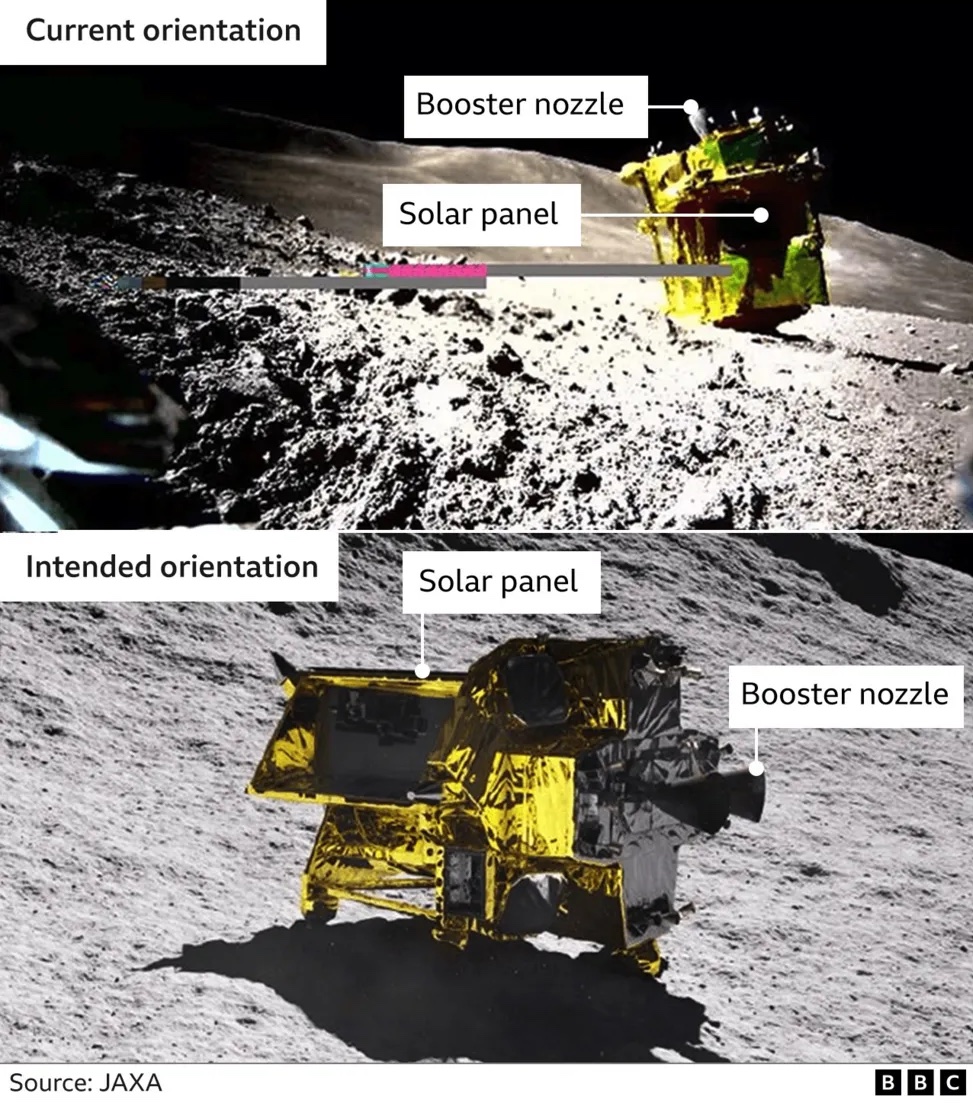
The craft is at a very awkward angle. A picture, captured by the small baseball-sized robot called Sora-Q – which was ejected from Slim moments before touchdown – showed the lander face-down on the lunar surface.
That left its solar panels facing away from the sunlight and unable to generate power. The decision was taken to put the lander into sleep mode – and conserve what power remained – less than three hours after it landed.
That tactic appears to have worked. A change in the direction of the sunlight has now “awoken” the craft.
As previously reported, JAXA did achieve its goal of a “precision landing” — as some put it, a “pinpoint” touchdown within 100 meters of the intended target — within 55 meters, although if all had gone as planned, it would have been within 10 meters.
That’s far, far closer than previous Moon landings.
Too bad SLIM is essentially standing on its nose. But at least this is a beginning. Japan has now become the fifth country (US, USSR, China, India) to successfully “soft land” an object on the Moon.
And the robots it brought with it are pretty amazing. And tiny.
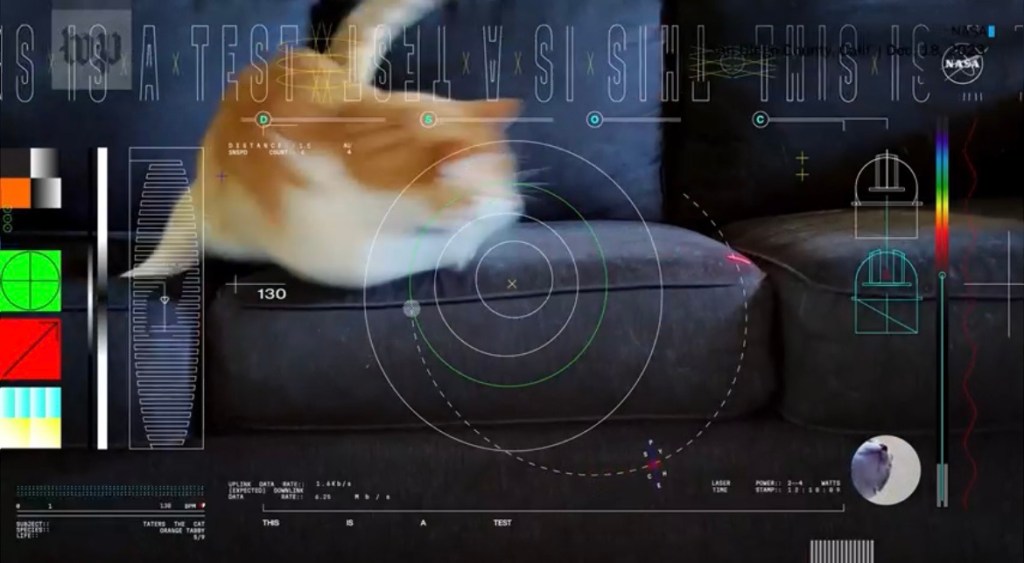
Taters the cat chases a laser pointer in a video sent to Earth from Psyche
Aiming the laser at the spacecraft so the transceiver knows where to point back is the most difficult part, Wright said. And because Earth and the spacecraft are both moving, the lasers must point to where the destination will be in a few minutes. “The beam’s so narrow, it can’t just point to Earth. It needs to know exactly where on Earth,” Wright said. “Trying to hit a dime from a mile away while you’re moving at 17,000 miles an hour — that’s the challenge.”
So NASA has been working on this idea for a while now. The invisible laser beam that carried this video file came from the Psyche probe, on its way to the asteroid belt between Mars and Jupiter.
Psyche is 19 million miles away right now. The laser beam took 108 seconds to reach Earth.
Mars and Earth are on average 140 million miles apart and can be up to 250 million miles apart depending on the timing of their respective orbits.
I don’t think lasers are the answer here. A good start, maybe, but you can do the math. Having to wait between 10 to 20 minutes, or more, for a one-way transmission (double that for an exchange of messages) would not be ideal for a human settlement in an emergency.
Star Trek style instant interstellar communication is still just scifi. Unless there’s still something out there we haven’t found yet, even quantum communication will take time…
But at least NASA has finally realized that non-science people like cat videos.



 M Thomas Apple Author Page