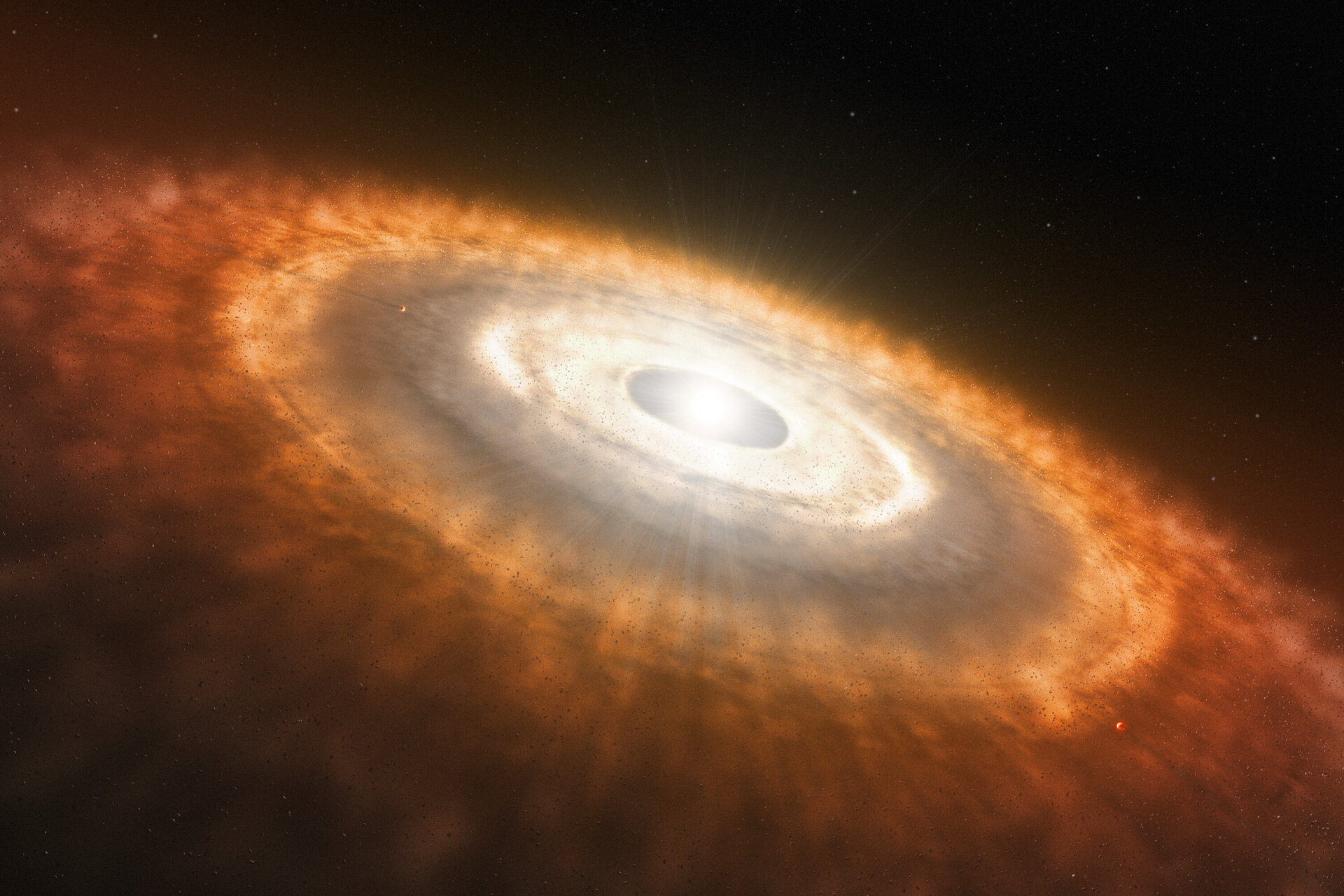
This is an artist’s impression of a young star surrounded by a protoplanetary disc in which planets are forming. An international team of astronomers have used the NASA/ESA/CSA James Webb Space Telescope to provide the first observation of water and other molecules in the inner, rocky-planet-forming regions of a disc in one of the most extreme environments in our galaxy. These results suggest that the conditions for rocky-planet formation, typically found in the discs of low-mass star-forming regions, can also occur in massive-star-forming regions and possibly a broader range of environments.
Because of its location near several massive stars in NGC6357, scientists expect XUE 1 to have been constantly exposed to a high ultraviolet radiation field throughout its life. However, in this extreme environment the team still detected a range of molecules that are the building blocks of rocky planets.
“NASA will hold off sending commands to its Mars fleet for two weeks, from Nov. 11 to 25, while Earth and the Red Planet are on opposite sides of the sun. Called Mars solar conjunction, this phenomenon happens every two years,” NASA said in a statement.
It’s funny that Live Science just announced this three days…given that the time period in which Mars is directly behind the Sun opposite the Earth only lasts from November 11th through November 25th.
Things just got busy at work and at home. And influenza really is strong this year, as predicted (I found out long ago that teenagers – especially guys – completely ignore suggestions regarding ways of avoiding illness due to an unwavering belief in their invulnerability).
I’ll try to make it up to you over the next couple of days.
In the meantime, here’s an Apple IIe showing the matrix (“all I see is blond…brunette…”).
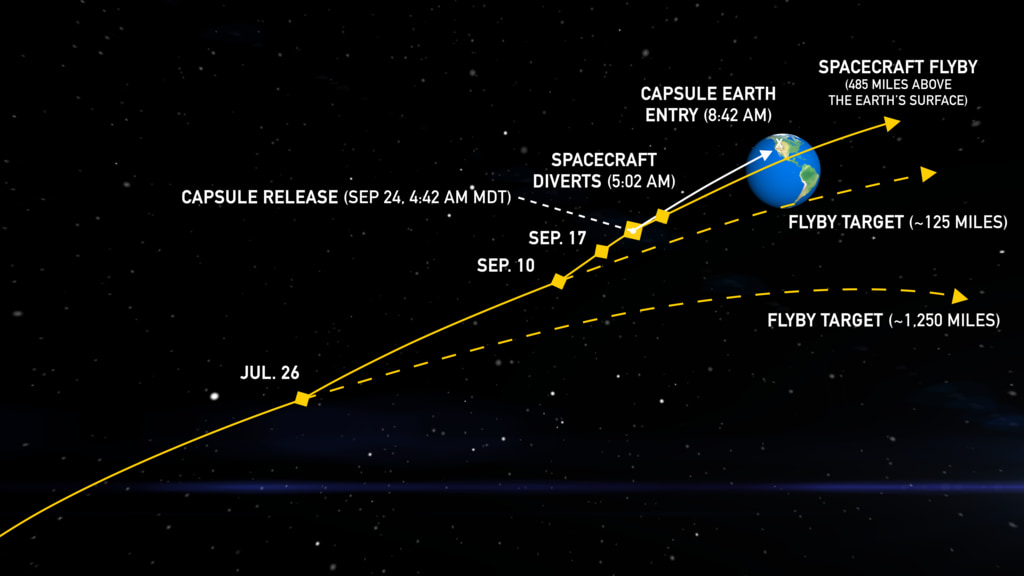
Currently, OSIRIS-REx is located at a distance of 7 million km from our planet. On September 24, OSIRIS-REx will drop a capsule with samples of asteroid matter, after which it will enter the earth’s atmosphere and land on the territory of the Utah Test and Training Range.
The tiny spacecraft launched back in 2016 and reached the asteroid Bennu in 2021.
One main reason for this mission is to find out what Bennu is made of. After the asteroid spewed out tiny “micromoons,” OSIRIS-REx successfully collected a tiny soil sample. By “tiny,” I mean less than 50 to 60 grams. And it couldn’t actually land, since the asteroid is too small to have enough gravity to support the spacecraft.
Now we have less than two weeks to find out what’s in the soil — assuming the capsule is retrieved without incident. And then OSIRIS-REx will head back out to visit yet another asteroid (Apophis) in 2029.
Yes, that famous “planet-killer” the media screamed about a few years ago as “the most dangerous asteroid in the world.” (uh. “in the world”?) It will “only” approach within 38,000 km in April 2029, but could possibly collide in 2036.
It’s easy to see why fractals have been used to explain the complexity of human consciousness. Because they’re infinitely intricate, allowing complexity to emerge from simple repeated patterns, they could be the structures that support the mysterious depths of our minds.
But if this is the case, it could only be happening on the quantum level, with tiny particles moving in fractal patterns within the brain’s neurons. That’s why Penrose and Hameroff’s proposal is called a theory of “quantum consciousness”.
Quantum computers can only operate at extreme low temperatures (-272C, or -460F, which is basically colder than even the average temperature of outer space, so cold that we made up a new temperature scale called Kelvin to measure it — and no, the “Kelvin timeline” of Star Trek was not named after the temperature but after J J Abram’s grandfather).
So anyway, how is it possible that human consciousness can be considered “quantum” if we need (quite obviously) a much higher temperature to survive? (Making us controlled by classical physics and not quantum physics.)
Our brains are composed of cells called neurons, and their combined activity is believed to generate consciousness. Each neuron contains microtubules, which transport substances to different parts of the cell. The Penrose-Hameroff theory of quantum consciousness argues that microtubules are structured in a fractal pattern which would enable quantum processes to occur.
Scientists have measured electron wave functions (their quantum state) by injecting photons into two types of fractal structures, one triangular and one square-shaped (like the Sierpinski carpet pictured above). The next step would be to take quantum measurements from the brain’s microtubules.
Hmm. I think I’ve seen a shape similar to the Sierinski carpet somewhere before…
All artificial intelligence, all robots and Chatbots and everything else electronically-programmed by a human being, will inevitably have human bias.
Even women prefer women’s voices to men’s when it comes to customer service.
On the other hand, women are also historically relegated to work with lower pay, lower status, kept out of positions of power — subject to the “male gaze.”
Now, we have AI that can be treated as sex objects. Even “married.”
So it is all “sinister,” as BBC asks?
Creepy, maybe. Sad, perhaps. Entirely predictable, definitely.
As we continue to lead more and more isolated individual lives, cut off from human contact and left unable to socialize, the rise of the “AI companion” seems inevitable…
ESA image. Gateway is planned to be much smaller and more cramped than ISS (about 1/6 the size).
NASA and its international partners see Gateway as a key platform to support the agency’s Artemis moon program and to build the technology required for future deep-space missions. Although the first elements of the small space station are expected to launch before the Artemis 3 mission lifts off in 2025 or 2026, NASA previously said that those astronauts will not use Gateway to “make that mission have a higher probability of success.”
While it’s a good idea to see some planning for this, I think maybe NASA should focus on getting Artemis 1 to work properly before they go on about Artemis 3 and 4.
Taking advantage of Gateway’s orbit far away from Earth’s protective magnetic field, three instruments will study risks due to radiation from the sun and from cosmic rays. Scientists hope this knowledge can help inform future long-term missions to the moon and Mars.
Since Gateway will orbit the Moon and not the Earth, the biggest problem will be preventing astronauts (and instruments!) from getting fried by solar radiation. Scientists need to come up with materials to shield people on Gateway and the Moon, or else we’re going nowhere…
One main reason for landing at the Moon’s South Pole is that the presence of water would help us build permanent settlements…
This region on the moon is an attractive place for humans to build a lasting presence due to the fact that water ice is located underfoot. Future moon-dwellers can potentially tap into that water for consumption, or even to create rocket propellant, instead of depending on water shipped from Earth.
Another reason has now been found…iron, manganese, aluminum, titanium…and “surprisingly” sulfur. Why should they be surprised? It’s already been established that the Moon has ice, and sulfur forms every time hydrocarbon and sulfates combine. Plus sulfur obviously results from volcanic activity, and it’s likely the Moon was volcanic when it first formed. And sulfur is also produced through nuclear fusion – i.e., the Sun.
So what can we do with this knowledge?
Having a more complete chemical composition of the lunar south pole area means future travelers to — and possible inhabitants of — the region can also plan for what else they don’t need to bring from Earth. In particular, some scientists have suggested moon-dwellers could use sulfur in bits of infrastructure such as building materials, solar cells and batteries.
Hmmm…I think more studies are needed first…define “bits,” for example.
To explore new ways to control this fundamental force of nature, scientists from the City College of New York (CCNY) trapped light inside a magnetic metamaterial and made the material itself 10 times more magnetic in the process.
Next up, magnetic lasers and lots and lots of more magnetic memory savings.
(Note that Popular Mechanics links the phrase “magneto-optical technologies” to an article claiming that the US has somehow managed to reverse-engineer alien technology from crashed UFOs…Um…OK…)









 M Thomas Apple Author Page