I’ve been testing ChatGPT over the last couple of days. (If you don’t know what this chatbot is, here’s a good NYT article about ChatGPT and others currently in development.)
The avowed purpose of ChatGPT is to create an AI that can create believable dialogues. It does this by scouring the web for data it uses to respond to simple prompts.
By “simple,” I mean sometimes “horribly complicated,” of course. And sometimes a little ridiculous.
Somehow, I doubt that people in the US said “livin’ the dream” in the ’50s…
As has been pointed out, chatbots only generate texts based on what they have been fed, i.e., “garbage in / garbage out.” So if you push the programs hard enough, they will generate racist, sexist, homophobic etc awful stuff — because unfortunately that kind of sick and twisted garbage is still out there, somewhere online in a troll’s paradise.
So far, I have asked the program to:
Write a haiku about winter without using the word “winter”
Write a limerick about an Irish baseball player
Write a dialogue between God and Nietzsche (I just had to…)
Imagine what Jean-Paul Sartre and Immanuel Kant would say to each other (see above) but using US ’50 slang
Have Thomas Aquinas and John Locke argue about the existence of God (that one was fun)
Write a 300 word cause-effect essay about climate change
Write a 300 word compare and contrast essay about the US and Japan
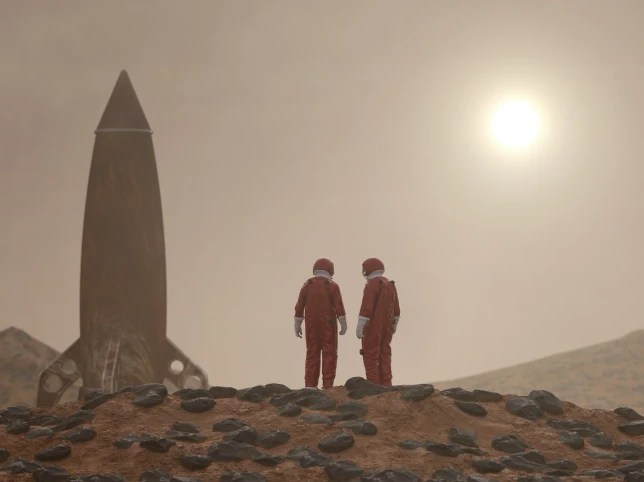
Write a 1000 word short science fiction story based on Mars
Write a 1500 word short science fiction about robots in the style of Philip K Dick
First of all, stop calling it “the golden asteroid.” That’s confusing people (the headline of the article linked below even uses the phrase “gold mine.” Come on, lazy journalists.)
If 16 Psyche is worth mining, when could such operations proceed? Citigroup thinks that space mining, including from the moon and asteroids, will be a $100 billion-per-year business by 2040. Launch costs will continue to decrease and experience in operating in space will continue to expand until such a business makes economic sense.
Well, how heavy do you think the materials to make buildings and ships in outer space are?
If we’re serious about putting people on the Moon and Mars, then it makes much more sense to set up robotic mining factories and assemble everything in space.
All this needs is a little incentive…like a new space race…
“Researchers think an in-depth study of Uranus can help them better understand the many similarly sized objects now being discovered around other stars.“
Uranus’s strange tilt is probably due to getting smacked by a very large body a long time ago…
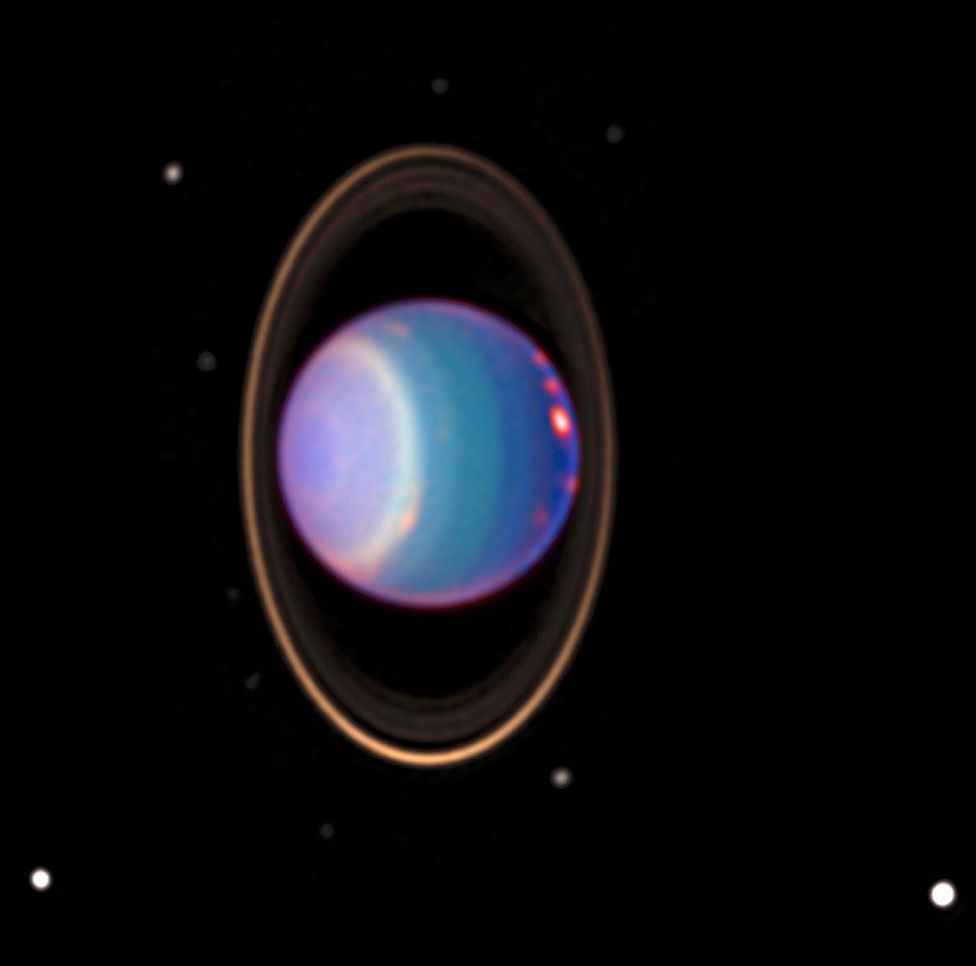
Uranus is weird. It has rings. It has 13 moons, some of which may harbor life beneath their icy surfaces.
It has a funny name.
I get it. But learning more about how its formation affects planet formation is just not that important.
“Pure” researchers probably are interested, but frankly, if NASA wastes its time doing this, they will miss the opportunity to settle the Moon and Mars, mine asteroids for valuable resources, and explore other moons like Titan and Europa.
China will get there first.
Pure research is all fine and dandy, but it’s also incredibly expensive — taxpayer dollars should be spent on projects with more tangible benefits.
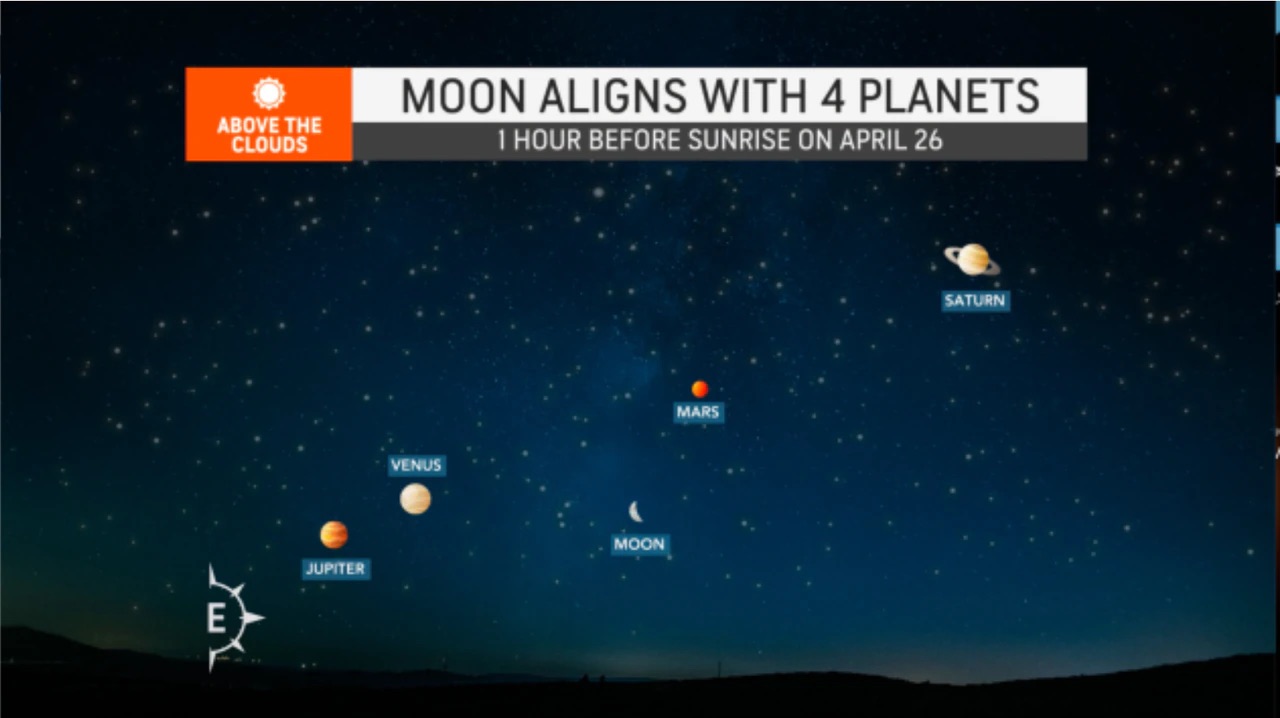
(Note: You won’t be able to see the planets actually looking like these photoshopped images…unless you happen to have a really powerful telescope in your backyard.)
Not sure why I first got this info from a site based in New Jersey. The info about what time of day and in what part of the sky is only relevant to people living in the NJ_NYC area.
Still, it’s an interesting phenomenon that occurs once every few years…
2005. 2016. 2020. And 2022. Not exactly a regular pattern, it seems.
And, no, there is no “spiritual significance” to a planetary alignment. It’s an illusion, an imaginary lining up of the solar system that doesn’t affect you personally. Sorry.
But it’s still fun to watch. Er, if you enjoy getting up before dawn (I don’t).
According to nj.com, “The planetary parade of sorts will occur when Jupiter, Venus, Mars and Saturn all appear to be lined up in a row above the horizon during the pre-dawn hours — starting Saturday morning, April 23. The alignment will also be visible during the next few mornings, and April’s crescent moon will soon join the parade, according to experts from LiveScience and AccuWeather.”
Yeah, lots of web sites are covering this. At least the one I linked above doesn’t have automated videos, flashing ad gifs, and other random pop-ups that drain your smartphone battery.
In short, the algae will use sunlight to transform CO2 into sugars that are then enhanced by bio-engineered E.coli into 2,3-butanediol. Interestingly, 2,3-BDO is not entirely conceptual as it currently exists and is mainly used to produce rubber components. It has just never been thought of as fuel before.
Ya know, I’m pretty sure we need to figure out “this whole food-air deal” first (to quote comedian Bill Hicks).
“The US space agency confirmed that there were currently no plans for a field or project office to explore the topic in any detail but that could change as we get closer to putting humans on Mars.“
“The laser, a 10-meter wide array on Earth, would heat hydrogen plasma in a chamber behind the spacecraft, producing thrust from hydrogen gas and sending it to Mars in only 45 days. There, it would aerobrake in Mars’ atmosphere, shuttling supplies to human colonists or, someday perhaps, even humans themselves.”
The only problem is that there’s no way to slow the thing down right now…”aerobraking” using current technology would cause gees of 8 or above for several minutes and temperatures hot enough to cook whatever’s in the ship to a nice toasty crisp.
Not even the G-Force would survive! Well, OK, maybe. (But only if they reverted to their original Japanese name – “Gatchman.”)
But what if robots could design a receiving station with lasers to “catch” the ship and slow it down…?
Hmmm. Sounds like a science fiction work in progress…
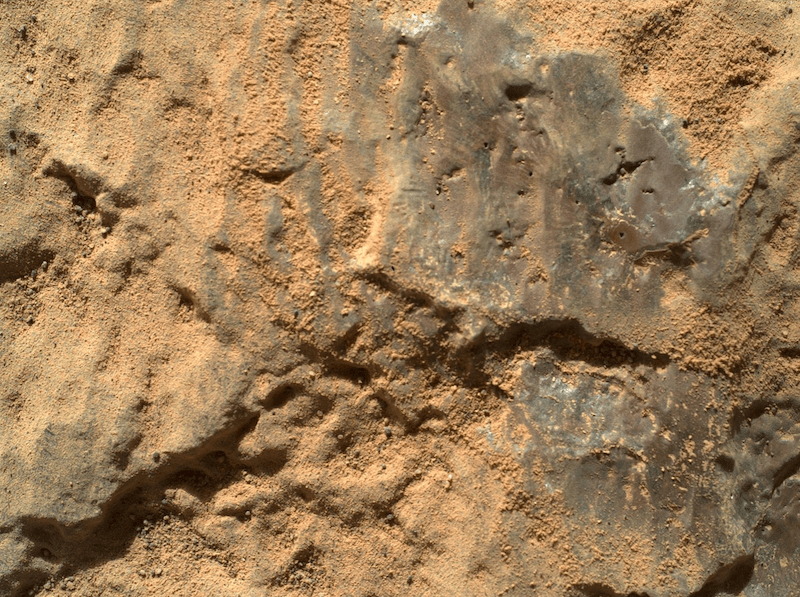
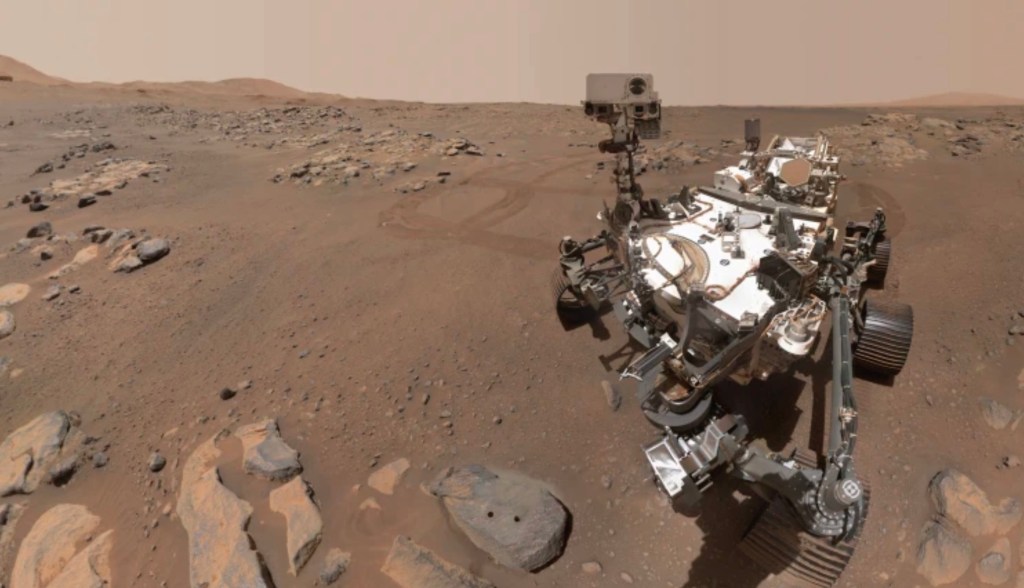
SuperCam showed that the coatings are enriched in hydrogen and sometimes magnesium. In addition, images from Mastcam-Z suggest that they also contain iron oxides. Both the hydrogen and iron oxides point to past water being involved in the formation of the coatings. That shouldn’t be too surprising, perhaps, since this area in Jezero Crater used to be a lake a few billion years ago.
The rocks resemble so-called desert varnish, which protect microbes from the sun’s radiation. It’d be interesting to find out whether cyanobacteria that once existed on Mars did this…but the four billion year old question is, how did those bacteria get there in the first place?
“Astronomers Detect Secret Water Reserves in The Largest Canyon in The Solar System”
Science isn’t quite as catchy. The hydrogen may indicate water in the form of permafrost 3 feet and more under the surface.
The high-hydrogen region is about the size of the Netherlands, and overlaps with Candor Chasma, one of the largest canyons in the Valles Marineris system.
Looks like there may be some competition for who gets to land near here first…