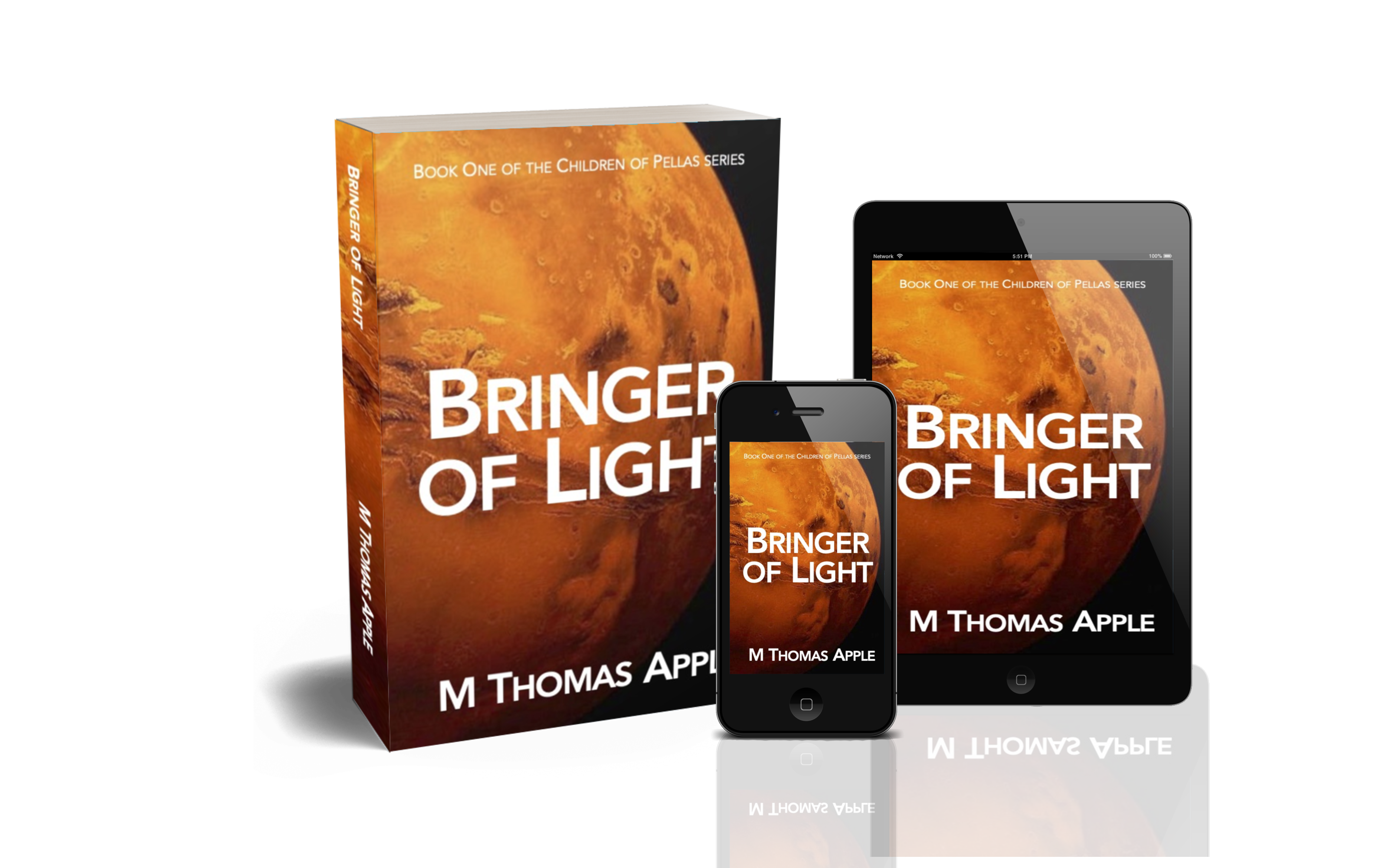
The moment we’ve all been waiting for is nearly here!
Bringer of Light is finally set to be released on March 15, 2024! (Click the link to see a book synopsis and two brief excerpts; Smashwords also has an excerpt from the beginning chapters.)
Stop by Draft2Digital to see links to your favorite bookstore online!
UPDATE: I have some difficulty convincing D2D to distribute to Amazon. Therefore, I have decided to publish Bringer of Light directly on Amazon. Stop by here to order for Kindle (released March 15th). Paperback and hard cover are also in the works.
Now that I’ve got the manuscript completed, it’s time to search for typos!
Yup. Found some already. Oops.
I figure to rearrange and combine some of the later chapters as well. Look for a publication online in late March!
It’s taken nearly 9 years. Hm. Only 11 years fewer than Adam’s Stepsons.
Fortunately, I have outlined book two and started writing the opening chapters already. Hopefully it won’t take another 9 years to see the continuation of the Bringer of Light story!
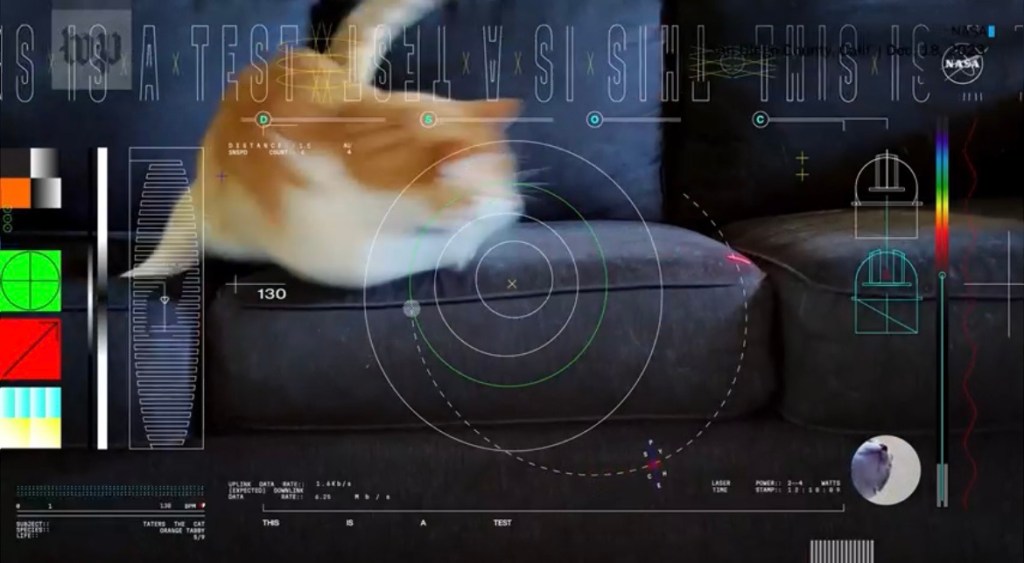
Taters the cat chases a laser pointer in a video sent to Earth from Psyche
Aiming the laser at the spacecraft so the transceiver knows where to point back is the most difficult part, Wright said. And because Earth and the spacecraft are both moving, the lasers must point to where the destination will be in a few minutes. “The beam’s so narrow, it can’t just point to Earth. It needs to know exactly where on Earth,” Wright said. “Trying to hit a dime from a mile away while you’re moving at 17,000 miles an hour — that’s the challenge.”
So NASA has been working on this idea for a while now. The invisible laser beam that carried this video file came from the Psyche probe, on its way to the asteroid belt between Mars and Jupiter.
Psyche is 19 million miles away right now. The laser beam took 108 seconds to reach Earth.
Mars and Earth are on average 140 million miles apart and can be up to 250 million miles apart depending on the timing of their respective orbits.
I don’t think lasers are the answer here. A good start, maybe, but you can do the math. Having to wait between 10 to 20 minutes, or more, for a one-way transmission (double that for an exchange of messages) would not be ideal for a human settlement in an emergency.
Star Trek style instant interstellar communication is still just scifi. Unless there’s still something out there we haven’t found yet, even quantum communication will take time…
But at least NASA has finally realized that non-science people like cat videos.
“NASA will hold off sending commands to its Mars fleet for two weeks, from Nov. 11 to 25, while Earth and the Red Planet are on opposite sides of the sun. Called Mars solar conjunction, this phenomenon happens every two years,” NASA said in a statement.
It’s funny that Live Science just announced this three days…given that the time period in which Mars is directly behind the Sun opposite the Earth only lasts from November 11th through November 25th.
[Context: my mother had just passed away, and I was remembering that both my parents’ choice in reading materials influenced my own fictional likes and dislikes.]
I guess both Mom and Dad liked Trek from its inception [in 1966]. I remembering watching the original series (in syndicated reruns of course) in the late ’70s/ We saw it in the “TV room” in my grandparents’ house….They had a color Zenith; we only had a tiny black and white on a bookcase. I remember being fascinated by the bright reds and blues (this was the point…color TV was new in the late ’60s and the sets and costumes deliberately used bright primary colors)…
Mom had all three “Star Trek Readers” I through III, by James Blish….Later I would borrow more complicated science fiction / fantasy stories from my Dad — Frank Herbert’s Dune and Robert A. Heinlein’s Stranger in a Strange Land stood out. And of course, Ray Bradbury’s Martian Chronicles, which were televised when we lived in Berne [a small village in New York west of Albany]. Once I discovered [The Chronicles of] Narnia and The Hobbit in 3rd grade, it was all over. I was a nerd for life.
And now look at the influence on pop culture. Movies, books, music, clothes, shoes, bags…the Internet and modern media. Smartphones. Tablets. Skype. Wireless devices. Bluetooth. GPS.
Nerd-dom has conquered the world. And my mom got there first. Way to go, Mom.
Way back in 2015, my good friend Rami Z Cohen came to me with an idea for a story. He had written two or three scenes about a group of asteroid hunters who stumbled upon something bizarre. The idea of mining asteroids was news at the time (and still is, although probably too expensive right now and not a worthwhile investment until we actually get some people in space who need metals without relying on NASA/ESA/JAXA/ISRO/etc).
So Rami and I began to email ideas back and forth for a few weeks, then we started to flesh out his characters and plot. I wrote a synopsis and outline and we hashed out the background.
ESA image. Gateway is planned to be much smaller and more cramped than ISS (about 1/6 the size).
NASA and its international partners see Gateway as a key platform to support the agency’s Artemis moon program and to build the technology required for future deep-space missions. Although the first elements of the small space station are expected to launch before the Artemis 3 mission lifts off in 2025 or 2026, NASA previously said that those astronauts will not use Gateway to “make that mission have a higher probability of success.”
While it’s a good idea to see some planning for this, I think maybe NASA should focus on getting Artemis 1 to work properly before they go on about Artemis 3 and 4.
Taking advantage of Gateway’s orbit far away from Earth’s protective magnetic field, three instruments will study risks due to radiation from the sun and from cosmic rays. Scientists hope this knowledge can help inform future long-term missions to the moon and Mars.
Since Gateway will orbit the Moon and not the Earth, the biggest problem will be preventing astronauts (and instruments!) from getting fried by solar radiation. Scientists need to come up with materials to shield people on Gateway and the Moon, or else we’re going nowhere…
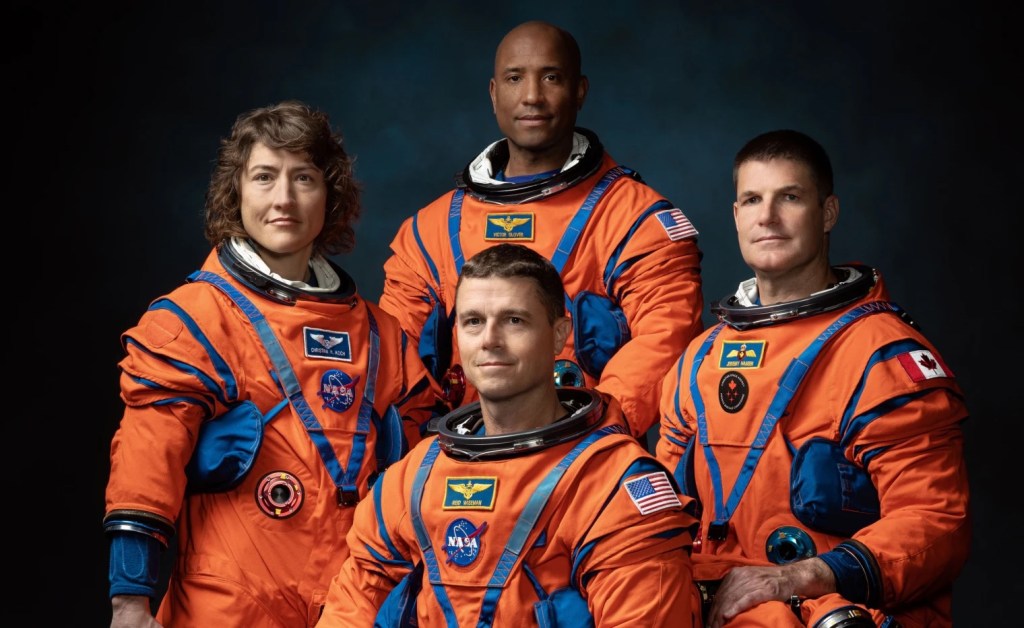
The astronauts will be the first humans to fly in the vicinity of the moon in more than 50 years. They will also be the first to launch aboard NASA’s next-generation megarocket and Orion space capsule. The crew will not land on the moon but will swing around the celestial body, testing the performance of the Orion spacecraft, before returning to Earth.