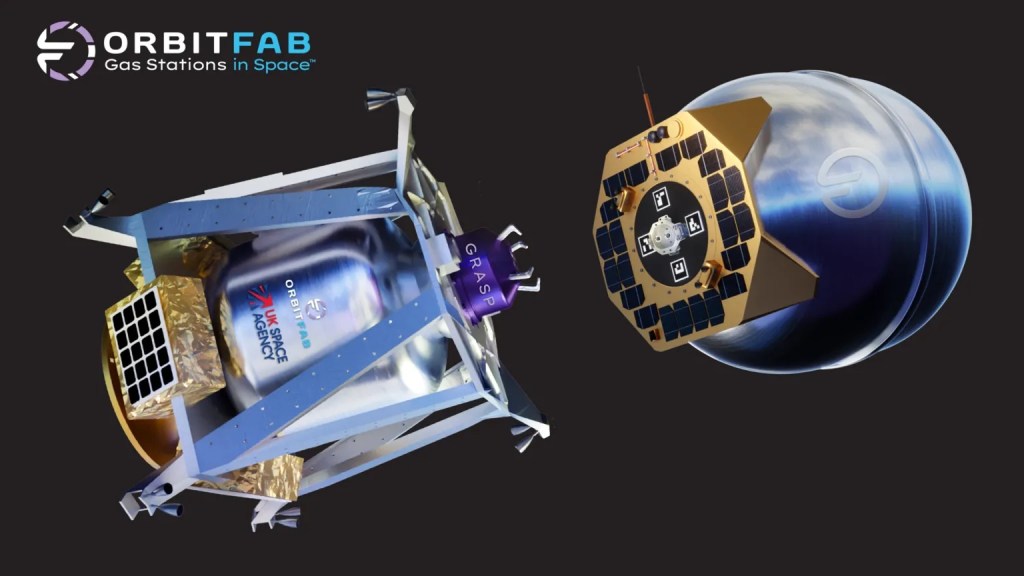
Jas Tiruvuru, business development manager for Orbit Fab in the UK and Europe, said the company was aiming to successfully demonstrate the technology in space by 2027.
“This will essentially be the first ever satellite to satellite refuelling demonstration funded here in the UK,” she said.
“Once we’ve proven that we can refuel to two spacecrafts we’ll be able to unlock a huge market potential.”
You know, maybe it’s just me, but I think 2027 may be a little optimistic. Just like the figure given in the article for how much the satellite sector will be worth in the future.
Aren’t there too many satellites already?
I’d like to see how this would help us colonize the solar system.
Actually, I’d like to see how they plan to get fuel up there in the first place.
Maybe my novel’s idea of using certain moons of Jupiter or Saturn as giant space gas pumps might help? 🪐
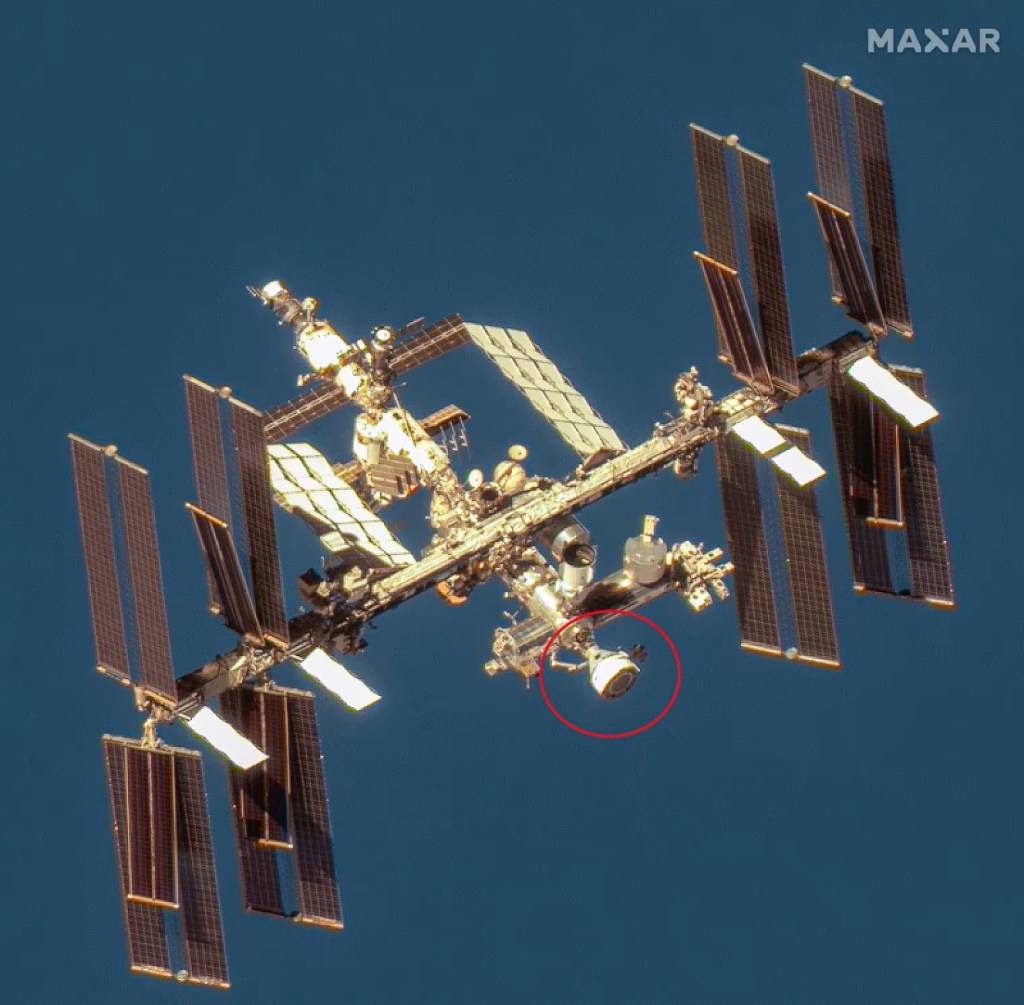
Starliner, the Boeing spacecraft whose launch was delayed by a helium leak, has now developed four additional helium leaks after docking successfully with the ISS.
They had to delay the docking due to a little problem with thrusters…
Five of the 28 thrusters were not operating but, after troubleshooting, Boeing recovered four of Starliner’s malfunctioning jets and NASA allowed the spacecraft to dock.
I’m a TESOL teacher. Learning to use technology — appropriately — has always been a part of my job.
It’s the “appropriate” part that has difficult to deal with the past few years.
Yeah. Hi, Chat.
Forget about Zoom, LMS, video editing software, and all sorts of online sites that don’t need any knowledge of programming language.
I was making my own web pages in basic HTML and JavaScript back when people still though InternetExplorer was a good browser.
But tech is nothing more than a tool. And tools can be used well and badly.
And often the simple tech of a piece of paper and a pencil are all you need. No bandwagon mentality here.
So if anything I would say that, although I have always used technology to some degree for my job, I have had the luxury of experience (and a lot of mistakes!) to figure out when technology can help my job, and when it just gets in the way.
(FWIW I also teach a one-semester class about language, identity, and technology. And yes, we do analyze our selfies.)
Both Russian and Ukrainian forces are integrating traditional weapons with AI, satellite imaging and communications, as well as smart and loitering munitions, according to a May report from the Special Competitive Studies Project, a non-partisan U.S. panel of experts. The battlefield is now a patchwork of deep trenches and bunkers where troops have been “forced to go underground or huddle in cellars to survive,” the report said.
I found it interesting that many people online were commenting about Iain M Bank’s take on AI (for an in-depth analysis of his Culture series check this out on Blood Knife) and how he “predicted” all this.
Uh. You know, I’m not sure whether Banks wrote much about integrating traditional weapons with AI (since I haven’t read his series). But I do know that PK Dick wrote a short story called “Second Variety” about trench warfare and AI robots making more versions of themselves and taking over the world.
It’s easy to see why fractals have been used to explain the complexity of human consciousness. Because they’re infinitely intricate, allowing complexity to emerge from simple repeated patterns, they could be the structures that support the mysterious depths of our minds.
But if this is the case, it could only be happening on the quantum level, with tiny particles moving in fractal patterns within the brain’s neurons. That’s why Penrose and Hameroff’s proposal is called a theory of “quantum consciousness”.
Quantum computers can only operate at extreme low temperatures (-272C, or -460F, which is basically colder than even the average temperature of outer space, so cold that we made up a new temperature scale called Kelvin to measure it — and no, the “Kelvin timeline” of Star Trek was not named after the temperature but after J J Abram’s grandfather).
So anyway, how is it possible that human consciousness can be considered “quantum” if we need (quite obviously) a much higher temperature to survive? (Making us controlled by classical physics and not quantum physics.)
Our brains are composed of cells called neurons, and their combined activity is believed to generate consciousness. Each neuron contains microtubules, which transport substances to different parts of the cell. The Penrose-Hameroff theory of quantum consciousness argues that microtubules are structured in a fractal pattern which would enable quantum processes to occur.
Scientists have measured electron wave functions (their quantum state) by injecting photons into two types of fractal structures, one triangular and one square-shaped (like the Sierpinski carpet pictured above). The next step would be to take quantum measurements from the brain’s microtubules.
Hmm. I think I’ve seen a shape similar to the Sierinski carpet somewhere before…
All artificial intelligence, all robots and Chatbots and everything else electronically-programmed by a human being, will inevitably have human bias.
Even women prefer women’s voices to men’s when it comes to customer service.
On the other hand, women are also historically relegated to work with lower pay, lower status, kept out of positions of power — subject to the “male gaze.”
Now, we have AI that can be treated as sex objects. Even “married.”
So it is all “sinister,” as BBC asks?
Creepy, maybe. Sad, perhaps. Entirely predictable, definitely.
As we continue to lead more and more isolated individual lives, cut off from human contact and left unable to socialize, the rise of the “AI companion” seems inevitable…
For all these technological “advances,” we are no better than the ancients. We are still prisoners to our emotions — or to the biological impulses of electricity and hormones whose results we deem emotive.
To explore new ways to control this fundamental force of nature, scientists from the City College of New York (CCNY) trapped light inside a magnetic metamaterial and made the material itself 10 times more magnetic in the process.
Next up, magnetic lasers and lots and lots of more magnetic memory savings.
(Note that Popular Mechanics links the phrase “magneto-optical technologies” to an article claiming that the US has somehow managed to reverse-engineer alien technology from crashed UFOs…Um…OK…)
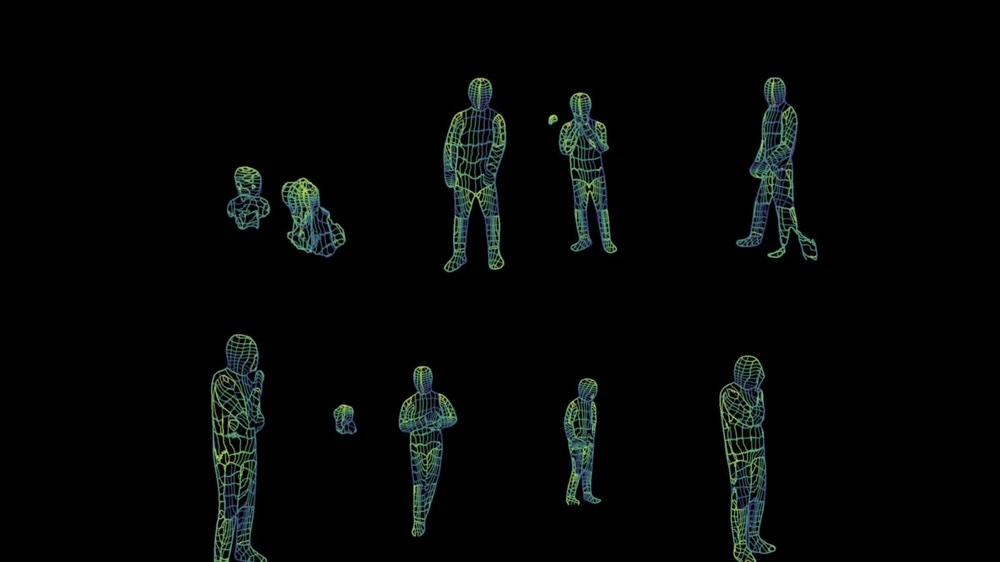
Interestingly, they position this advancement as progress in privacy rights; “In addition, they protect individuals’ privacy and the required equipment can be bought at a reasonable price,” they wrote.






 M Thomas Apple Author Page