No problem: it’s just a 1,300 pound satellite falling down from the sky and disintegrating into random pieces everywhere all at once…
“For the average person, it will be a nice light in the sky if you get lucky and, otherwise, don’t worry about it,” Dr. McDowell said. “We have much more scary re-entries that happen. Occasionally, there is a 20-ton Chinese rocket stage that comes down. Those are much scarier for me.”
OK, granted that the odds are 1 in 4200. But still, we should figure out how to predict where pieces of satellites are going to land. There’s far too much stuff floating above our heads for us to feel 100% safe.
And an expectation of “7:45 pm give or take 24 hours” is not particularly helpful, either…
Especially when a private corporation is saying 11:45, give or take three hours.
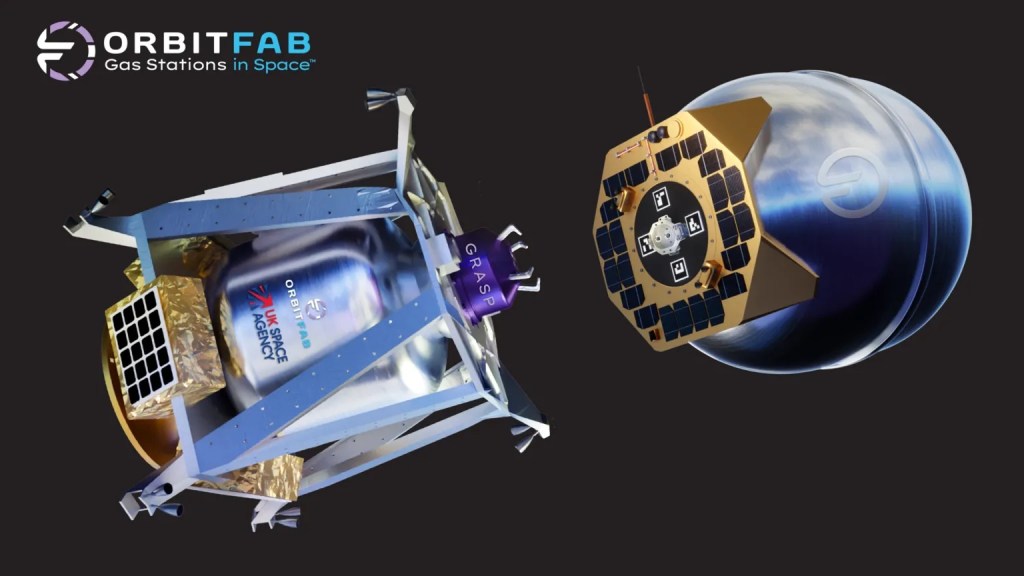
Jas Tiruvuru, business development manager for Orbit Fab in the UK and Europe, said the company was aiming to successfully demonstrate the technology in space by 2027.
“This will essentially be the first ever satellite to satellite refuelling demonstration funded here in the UK,” she said.
“Once we’ve proven that we can refuel to two spacecrafts we’ll be able to unlock a huge market potential.”
You know, maybe it’s just me, but I think 2027 may be a little optimistic. Just like the figure given in the article for how much the satellite sector will be worth in the future.
Aren’t there too many satellites already?
I’d like to see how this would help us colonize the solar system.
Actually, I’d like to see how they plan to get fuel up there in the first place.
Maybe my novel’s idea of using certain moons of Jupiter or Saturn as giant space gas pumps might help? 🪐
The researchers argue that “if” trees could be planted on Mars…
OK, just stop right there. I’m pretty sure Mars will struggle to support even grass, let alone trees.
And the argument that, due to a lack of oxygen, flammable wooden structures in space would not be in danger strikes me as a bit ludicrous…surely there would be oxygen inside the wooden structures?
And, you know, I do think I’ve seen this before some where…nah…
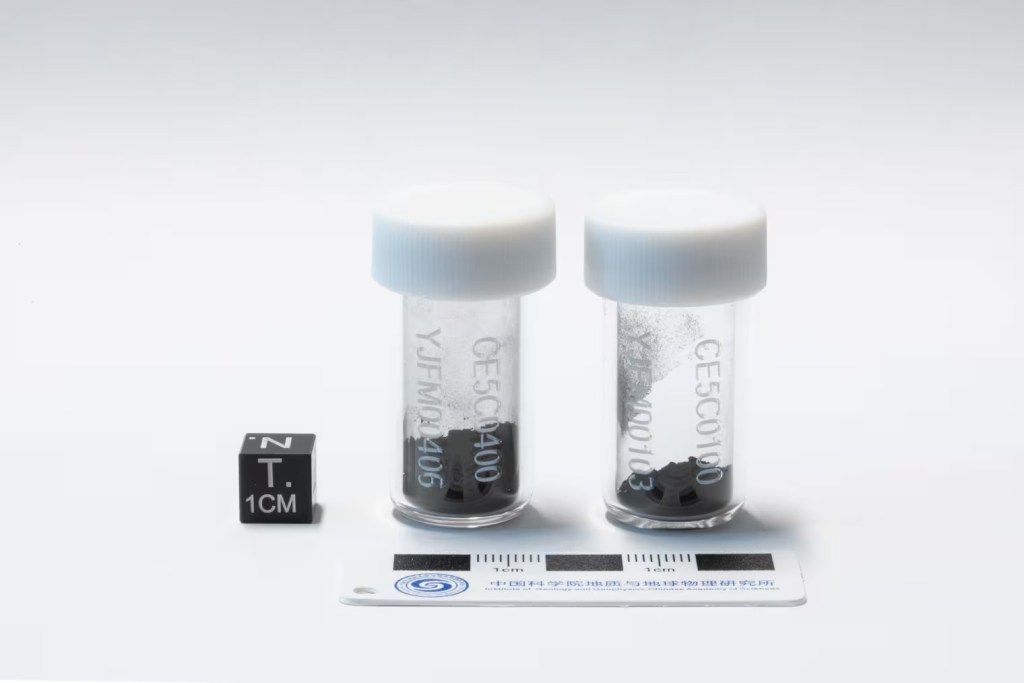
Using the new method, one metric tonne of lunar soil will be able to produce about 51 to 76 kilograms of water, equivalent to more than a hundred 500-millileter bottles of water, or the daily drinking water consumption of 50 people, the state broadcaster said.
The soil was from the 2020 expedition, which was the first in 44 years to bring back soil from the Moon.
Considering all of NASA’s problems, it looks like China will have a moon base years before the US does…and probably in prime resource locations as well.
And don’t forget that the hydrogen in the soil can also be used for rocket fuel. It would be a lot easier to launch ships to Mars and beyond without having to deal with Earth’s gravity…
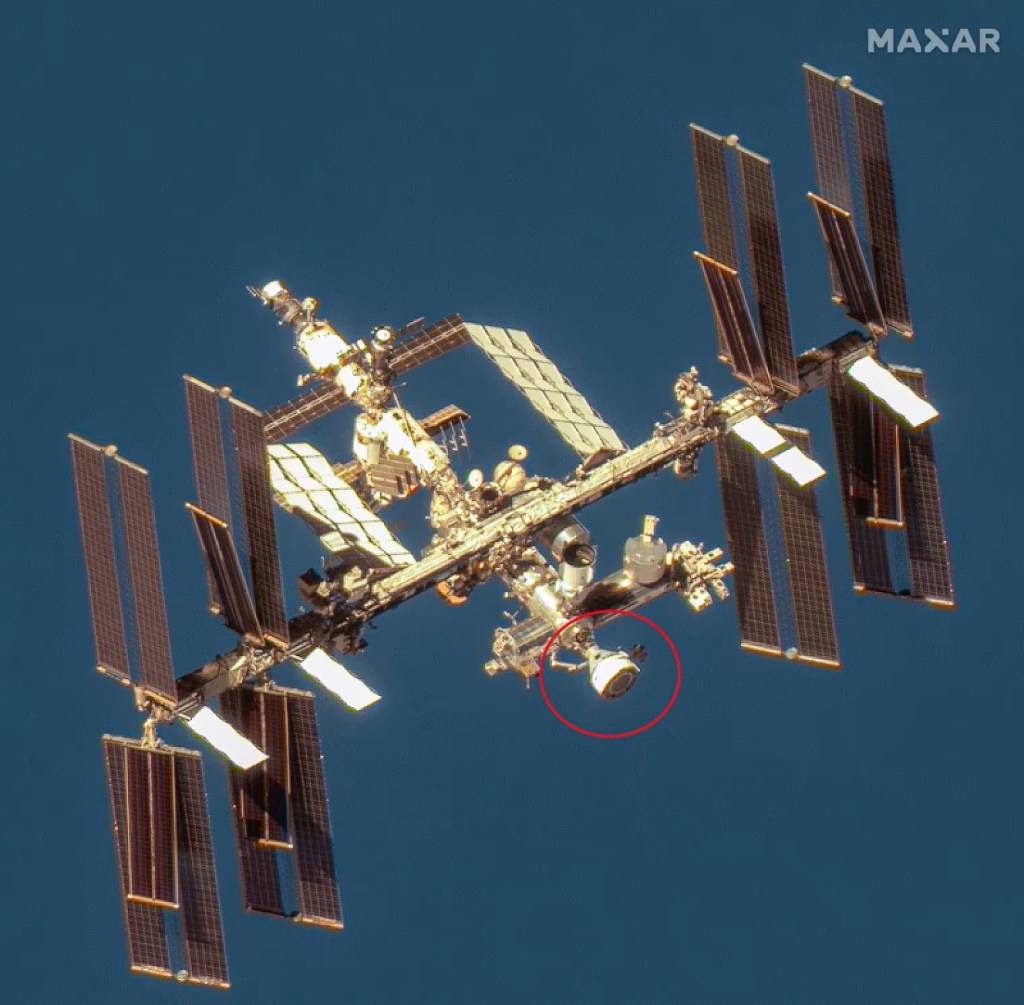
Starliner, the Boeing spacecraft whose launch was delayed by a helium leak, has now developed four additional helium leaks after docking successfully with the ISS.
They had to delay the docking due to a little problem with thrusters…
Five of the 28 thrusters were not operating but, after troubleshooting, Boeing recovered four of Starliner’s malfunctioning jets and NASA allowed the spacecraft to dock.
“Normal means” for whom, exactly? I can’t imagine the average worker in Tokyo will be able to afford this thing. Even if they had a physical space to store in.
And, you know, I think I’ve seen a “flying vehicle” like this somewhere already… 🚁
Researchers will fly rockets into the path of the eclipse, stand in zoos watching animals, send radio signals across the globe, and peer into space with massive cameras.
And you don’t need to be a scientist to take part.
If you’re lucky enough to have no clouds or rain, that is.
Things the eclipse affects:
Radio waves
Animal behavior
The birds and the bees (seriously; read about what tortoises did last time)
Things scientists can view thanks to an eclipse:
The solar wind (plasma on the surface of the Sun)
Coronal mass ejections (which interfere with satellites)
Dust rings around the Sun and possibly even new asteroids
The East Coast of North America, where most of my relatives live, is currently 13 hours behind me in Japan. So the event will be long over by the time I wake up.
Hope to see video of it on the morning news show tomorrow!
“We continue receiving valuable data,” the company said in a statement, “and providing spaceflight operations for components and software relating to our next lunar lander mission, Griffin.”
Well, yeah, great. But the Peregrine lander still is a failure. Propulsion leak. Solar panels that didn’t open in time.
And NASA is counting on these privately operated products to get people back to the Moon? And they’ve delayed the Artemis again by another year?
When I was in school, we were all talking about people on Mars, living in permanent communities in the 2020s. And we can’t even get a tiny Moon lander to work right.
Sigh. And after BBC posted “Vulcan rocket” I so had my hopes up. (“The Vulcan rocket,” not “Vulcan rocket,” Spock 🖖)
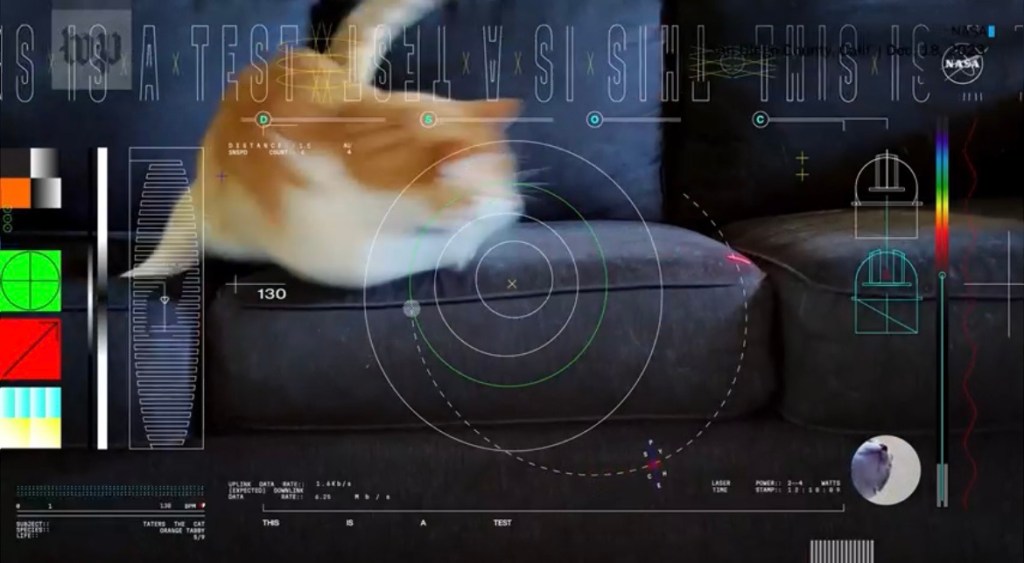
Taters the cat chases a laser pointer in a video sent to Earth from Psyche
Aiming the laser at the spacecraft so the transceiver knows where to point back is the most difficult part, Wright said. And because Earth and the spacecraft are both moving, the lasers must point to where the destination will be in a few minutes. “The beam’s so narrow, it can’t just point to Earth. It needs to know exactly where on Earth,” Wright said. “Trying to hit a dime from a mile away while you’re moving at 17,000 miles an hour — that’s the challenge.”
So NASA has been working on this idea for a while now. The invisible laser beam that carried this video file came from the Psyche probe, on its way to the asteroid belt between Mars and Jupiter.
Psyche is 19 million miles away right now. The laser beam took 108 seconds to reach Earth.
Mars and Earth are on average 140 million miles apart and can be up to 250 million miles apart depending on the timing of their respective orbits.
I don’t think lasers are the answer here. A good start, maybe, but you can do the math. Having to wait between 10 to 20 minutes, or more, for a one-way transmission (double that for an exchange of messages) would not be ideal for a human settlement in an emergency.
Star Trek style instant interstellar communication is still just scifi. Unless there’s still something out there we haven’t found yet, even quantum communication will take time…
But at least NASA has finally realized that non-science people like cat videos.
Carbon accounted for almost five percent of the sample’s total weight, and was present in both organic and mineral form, while the water was locked inside the crystal structure of clay minerals, he said.
Scientists believe the reason Earth has oceans, lakes and rivers is because it was hit with water-carrying asteroids 4 to 4.5 billion years ago, making it a habitable planet.
We have ample evidence now that all water on Earth was brought during the “Late Heavy Bombardment” period (4~4.5 billion years ago). Imagine how many rocks it took to get enough water (estimates anywhere between 20 and 200 million years of asteroid after asteroid slamming into the Earth).
And the only reason life exists on Earth is that there is enough iron and nickel in the Earth’s core to generate a magnetic field to prevent solar radiation from ripping off the atmosphere. Which is likely what happened to Mars.
(Alright, alright, technically electrical currents running through the liquid iron outer core as well as in the crust and ionosphere also contribute to the magnetic field. Go check out this horribly complicated explanation if you like.)
Note that this is the third time to get asteroid dust to examine. JAXA has managed to do this twice now. But Hayabusa-2 only got about 5 grams. The OSIRIS-REx project got about 250 grams (1/2 lb). Lots more = lots more to save for future researchers who will have developed even more sophisticated analysis methods.
Now lets get some PEOPLE on those things and start mining and living in space, already!







 M Thomas Apple Author Page