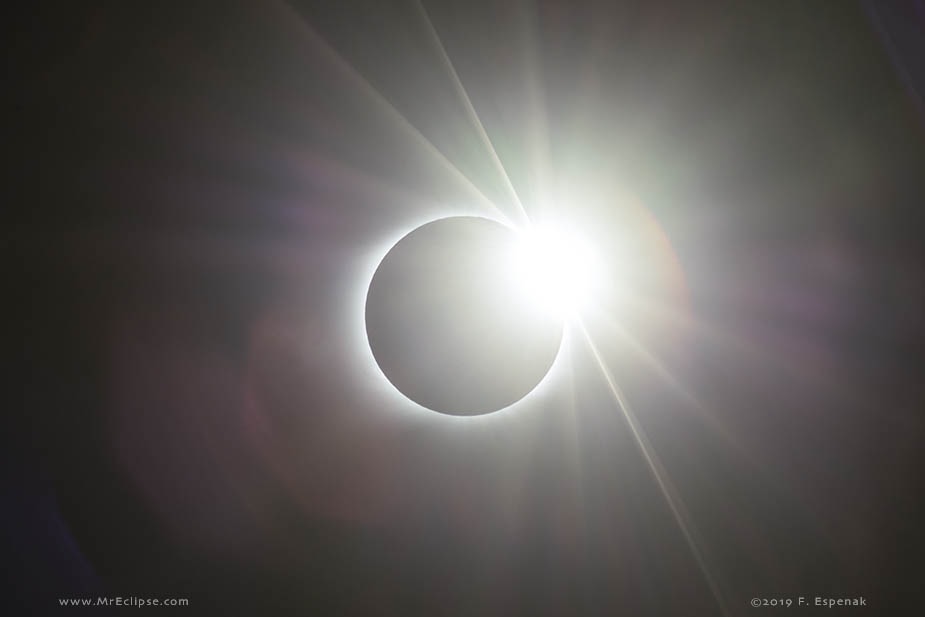
The eclipse begins as a small notch slowly appears along one edge of the Sun. During the next hour, the Moon gradually covers more and more of the Sun’s bright disk. You’ll need a Solar Filter to both view and photograph the partial phases.
On April 8, 2024, there will be a total solar eclipse across parts of North America. It starts on Mexico’s Pacific coast and ends on Canada’s Atlantic coast. (So, no, it’s not just “from San Antonio to the Canadian border” as one article puts it).
I’m a little jealous of friends and family in the path. The eclipse lasts for over four minutes this time — if you’re in the area, enjoy!
The asteroids in question are Iris (124 miles / 200 km in diameter) and Massalia (84 miles / 135 km). Both are in the asteroid belt between Mars and Jupiter. Iris is about the size of the US state of Maryland, while Massalia is roughly the size of Connecticut.
Note that the same observatory also found water on the Moon, about a “12-ounce bottle” worth. Not nearly enough for a settlement, but where there’s surface water (albeit trapped in soil on the surface), there’s likely to be more underneath.
So, astronomers need to know both mass and diameter to determine whether a planet is truly similar enough to ours to host some form of Earth-like life. If the planet has a low mass and a large radius, it is likely like a so-called mini-Neptune with a gassy atmosphere and little rock. If it has a higher mass but a smaller radius, it’s probably a rocky planet like ours.
The possibility that TOI-715 b is rocky “would be exciting because that supports it being more of a habitable planet versus some sort of other world,” says Moran.
TOI-715 orbits a red dwarf star around 137 light years away, so we won’t be getting there any time soon. But after finding this planet last year, astronomers also are trying to confirm the existence of another smaller, closer to Earth-sized planet in the habitable zone (i.e., in an orbit that permits liquid water necessary for life to evolve).
And the name of the possibly new “sibling” planet?
Astronomers have discovered what may be the brightest object in the universe, a quasar with a black hole at its heart growing so fast that it swallows the equivalent of a sun a day.
A robotic spacecraft made history Thursday becoming the first privately built craft to touch down on the lunar surface, as well as the first American vehicle to accomplish the feat in more than 50 years.
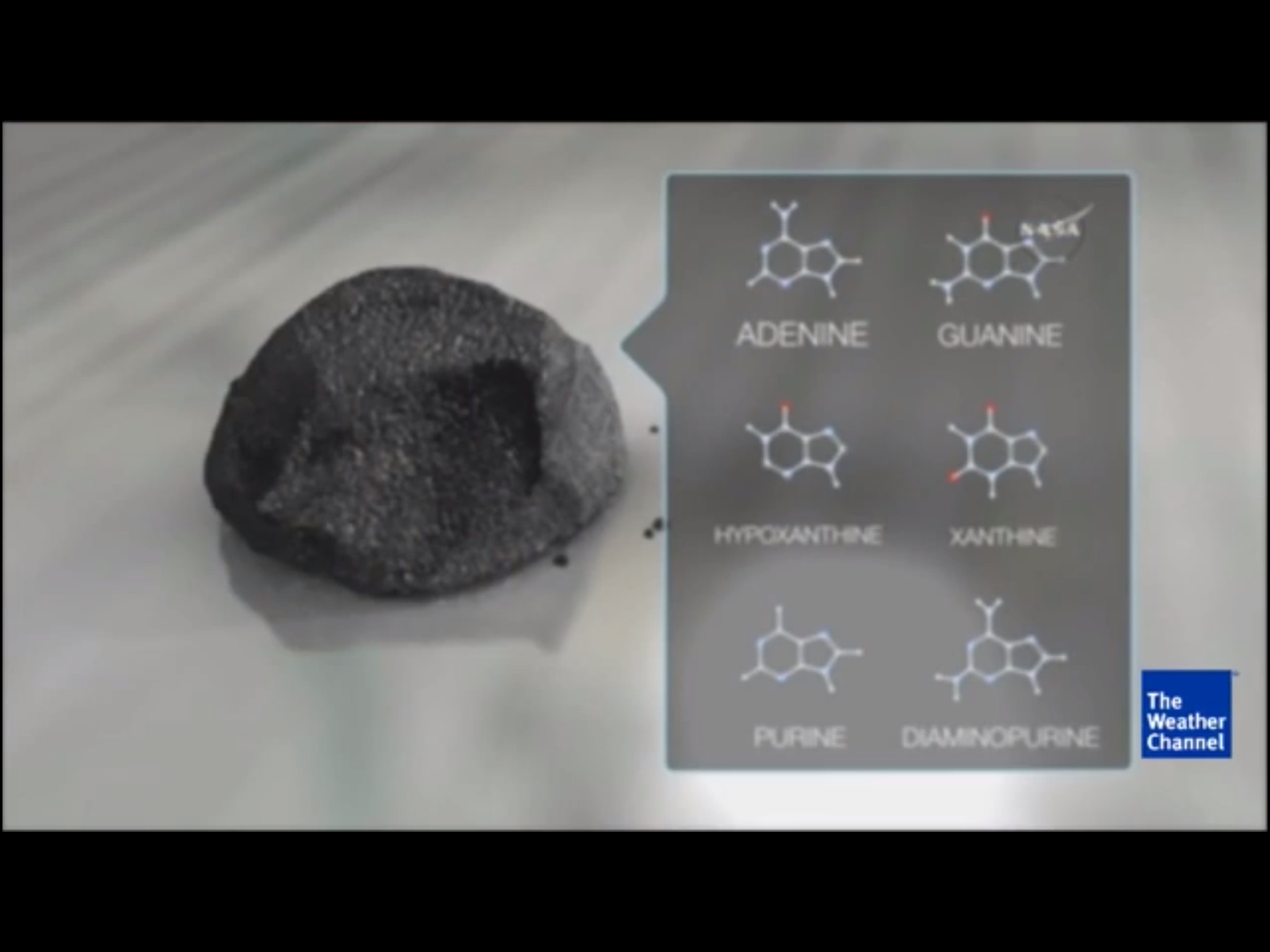
It’s also thought that water on Earth is largely (or entirely) the result of comets and asteroids bombarding it (it remains debatable to what degree Earth already had water, but since when it formed the Earth was first molten lava and then dry as a bone, I think it far more likely that water came here from elsewhere, and science tends to agree).
I’ve already blogged about the origins of Bringer of Light, when I (finally) finished the first draft back in early September. In a sense, I’ve been constantly blogging the science behind the story.
But I haven’t discussed the characters at all. And despite what some old-fashioned writers may think (just finished a particularly badly-written snarky “why your books don’t sell” piece of trash that claimed science fiction shouldn’t have any emotions in it…say what? sorry not sorry), if the characters of a story aren’t interesting, there isn’t much point in reading a story.
So for the next couple of weeks, I’ll write a bit about the characters — the crew of the Artemis, the crew of the Sagittarius, the UN flunkies (sorry, career politicos) on Mars and Luna and so forth. There are lots of characters, and their interaction is complicated. Or is it?
I would get into my scifi influences at this point, but long blogs are slogs. So I’ll come back to that tomorrow!
Coffee time. Also to finish up at least one unrelated project and also the hardcover manuscript (which needs to be a different paper size than the paperback for some reason).
Mimas, the smallest and innermost of Saturn‘s major moons, is believed to generate the right amount of heat to support a subsurface ocean of liquid water
But it demonstrates the fact that water may in fact be common in space, opening the possibility of finding life on celestial bodies with older (much older) water sources.
(FYI: Mimas orbits Saturn once every 22 hours, and is affected by tidal forces from Saturn that appear to have melted part of its icy surface.)
OK, so my post about a big ole spider got the most likes of any post in ten years of blogging about science.
I have so not got the zeitgeist of the 2024 blogosphere lol – anyway, thanks, all, for the “likes”! Although one person used AI to write a very meaningless comment about arachnophobia. What’s the point, man?
By the way, back to science and space stuff. I forgot to post about the Europa Clipper project back in October.
So here you go. (It’s too late to add a message, but the project obviously is going to take some time arriving there, and you can supposedly hear US Poet Laureate Ada Limón read her poem online, although I’ve had trouble with the audio lately:
“Arching under the night sky inky with black expansiveness, we point to the planets we know, we
pin quick wishes on stars. From earth, we read the sky as if it is an unerring book of the universe, expert and evident.
Still, there are mysteries below our sky: the whale song, the songbird singing its call in the bough of a wind-shaken tree.
We are creatures of constant awe, curious at beauty, at leaf and blossom, at grief and pleasure, sun and shadow.
And it is not darkness that unites us, not the cold distance of space, but the offering of water, each drop of rain,
each rivulet, each pulse, each vein. O second moon, we, too, are made of water, of vast and beckoning seas.
We, too, are made of wonders, of great and ordinary loves, of small invisible worlds, of a need to call out through the dark.”
The so-called Big Ring has a diameter of about 1.3bn light years, making it among the largest structures ever observed. At more than 9bn light years from Earth, it is too faint to see directly, but its diameter on the night sky would be equivalent to 15 full moons.
This is important because it contradicts the so-called “cosmological principle” that everything in the universe is basically evenly distributed.
Just thinking about it, though, it makes little sense to assume that galaxies are all evenly spaced. Assuming the Big Bang was a single point should not imply even spacing of anything.
FWIW the “Big Ring” is evidently more a corkscrew shape, directly aimed at us. Evidence of “cosmic strings”? Maybe.
This is not as interesting as technology that will allow us to build hotels and colonies at LaGrange points or communities on Mars, but it’s still interesting. Sorta. Maybe?







 M Thomas Apple Author Page