I must explore alone. I will redefine the quality of being alone for generations to come. The word “alone” will no longer suffice — “aloneness,” the feeling human isolation; “alonetivity,” the alienation from society; “subjectivitis,” the alienation from the objective word; “individualreality,” the division from the former self.
A story must be more than merely a story. It must be an examination, of the human heart, of the mind, of the spirit. Of experience and existence. A simple recapitulation of one’s personal past or the delusional suffering of a dysfunctional suburban American family have no merit. Overcoming the reality we believe we live in, debunking fiction and elevating the truth, that is worthwhile.
“Three things are needed for beauty: wholeness, harmony, radiance.” (as translated by “Stephen,” i.e., James Joyce.)
Or more simply integrity, consonance, clarity.
Note that the original is a bit longer, in St. Thomas Aquinas’ Summa Theologica:
Ad pulchritudinem tria requiruntur: Primo quidem integritas sive perfectio: quae enim diminuta sunt, hoc ipso turpia sunt. Et debita proportio sive consonantia. Et iterum claritas.
Sometimes I wish I could put my thoughts directly onto paper. I think all the time, about everything…I see pictures in my head, pictures of my past — exact details of what I saw and experienced. Déjà-vu often occurs to me. It’s strange, that feeling of already having been someplace. Sometimes I can tell what’s going to happen in a matter of minutes. I can’t stand things like that — they send chills up my spine.
The lecture about Irish folk songs [note: at the time, I was in the Gaeltacht, west of Galway, learning Irish language] last night, two nights ago, whichever (time has no meaning in this place), was wrong. Why do we write, the léachtóir asked; to communicate; the poet wants to communicate.
No.
That is not why I write. Sometimes I write for fun, to play at words, to play with feelings. Sometimes I try to work out my problems myself in writing (I can’t). Sometimes I write just to relieve tension. Sometimes I write because I have to, because if I don’t get these words out of me and onto paper they’ll rip their way out.
Today I talked to virtually no one for the first time in quite a while. It’s almost like meditation. Reminds me of what L said when we were out drinking Friday night (as usual). She and G were talking about scuba diving, about how being underwater hearing only your own breath and hardly being able to see anything unless it’s right in front of you gives you a feeling of being alone in the universe, a feeling of vulnerability and isolation, of insignificance. I commented, “That’s just like meditation.” No reaction.
I don’t need to go scuba diving in the Philippines to experience such a feeling.
For all these technological “advances,” we are no better than the ancients. We are still prisoners to our emotions — or to the biological impulses of electricity and hormones whose results we deem emotive.
In that case, you should keep a diary, his advisor suggested. Write every day.
OK, he said.
And bring me a story or two to look at.
OK.
October
These aren’t stories, his advisor informed. These are more like diary entries.
How should I write a story, then? he asked.
Write what you know. Base your stories on people and things around you.
OK.
And bring me another story or two.
OK.
November
The narration isn’t believable, his advisor imparted.
Why? he asked.
It’s too difficult for the reader to identify with the characters. Nobody has a family with nine children.
What should I do?
Go read Sherwood Anderson’s Winesburg, Ohio.
OK.
And bring me a couple more stories.
OK.
December
I don’t get any sense of through-story, his advisor complained.
What do you mean? he asked.
The stories aren’t connected. They’re all different.
Well, what should I do?
Try an internal perspective. Go read James Joyce’s Portrait of the Artist as a Young Man.
OK.
And bring me another story.
OK.
January
This is too abstract, his advisor mused.
What do you mean? he asked.
This isn’t a true plot. The symbolism is too obscure.
It’s a translation of something I wrote for a German class.
You don’t want to be Kafka.
I don’t?
You need real life stories, with real people and real problems.
What should I do?
Go read Raymond Carver’s “Cathedral.”
OK.
And…
Bring you another story?
Two.
February
I think I see the problem, his advisor intuited.
What is it? he asked.
I think you need to experience more life before you can be an effective writer.
What do you mean?
You need to go out into the world and work different jobs, meet different people, move around a bit.
My thesis is due in two months.
So it is. Make sure you give your draft to me next month.
OK.
And…
Another story?
No. Just read my comments and rewrite what you have.
OK.
March
I don’t see the point of adding poetry between the stories, his advisor grumped.
Why? he pondered.
The poems interfere with the prose.
I thought you didn’t like the prose.
I would say you need to add a poetic sense to your prose.
How do I do that?
Try writing poetry. For practice.
…
And finish the rewrite of the draft by next week.
OK.
And print three copies on a laser printer. And buy three of those thesis black cover binders.
OK.
April
Well, the three of us have examined your thesis, and we decided on a grade of B+, his advisor beamed.
…
I know it’s not as high as you wanted, but I argued that the interplay of letters, poetry, and stories woven together formed an interesting kind of metadiscourse narrative depth to the thesis structure.
…
Congratulations.
Thanks.
If you like this, you might enjoy Notes from the Nineties, a book with short stories and poems (the above is the first one, and may or may not be partially based on personal experiences my senior year in college).
I got two bone spurs, separated by two years, thanks to playing baseball in junior high school. Both were fingers on my left hand.
The first time was my left thumb first joint. The second time was my left hand ring finger second joint.
Both times, our local health clinic doctor put a metal splint on the finger, wrapped it in flexible bandage and sealed it off with a tiny metal clip.
And of course I stupidly went on playing baseball, because at age 15 guys think they are completely indestructible.
My ring finger stuck out when I batted. I’m lucky I didn’t get hit by a pitch in the hand (I did get hit on the knee, but that’s a whole ‘nother story).
Also, it inspired my baseball novel. So there was a silver lining!
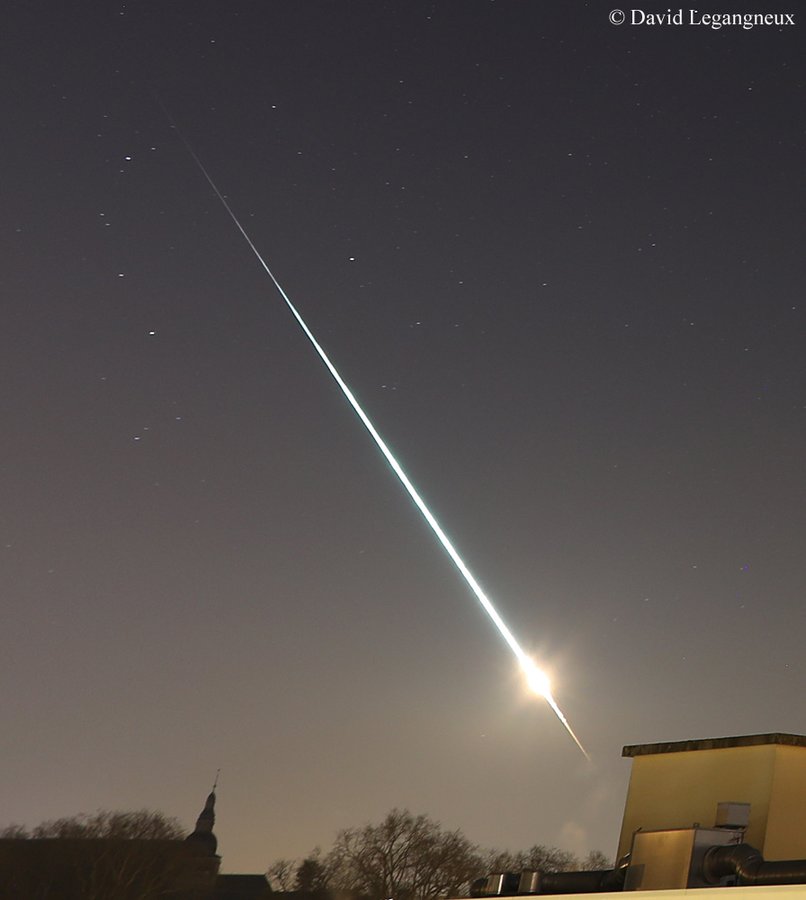
Anyway, “SAR2667” provided some cross-cultural entertainment for people living in England, France, Belgium, and the Netherlands. Lots of photos and videos online.
Interesting note from ESA: they were able to detect it and notify everyone exactly where and when it would disintegrate.
Since there are more than 30,000 of these things that orbit the Sun relatively close to Earth’s orbit, it’s a good thing we’re getting better at detecting them. Maybe we’d better up the ante on deflecting them…

 M Thomas Apple Author Page