M Thomas Apple Author Page

Science fiction, actual science, history, and personal ranting about life, the universe, and everything

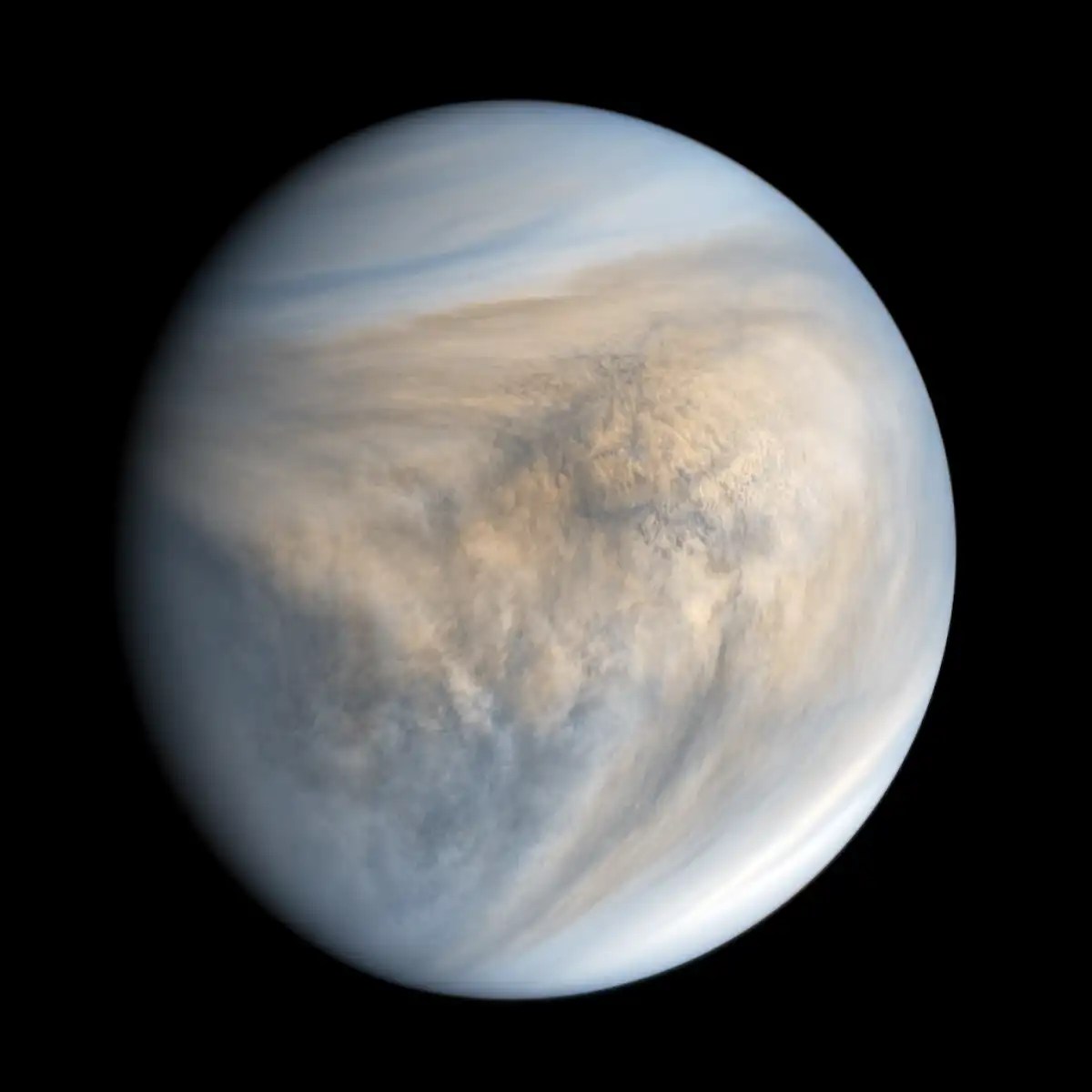
Venus used to have as much water as Earth. What happened?

May 7, 2024
MThomas

Over time, that water has nearly all been lost. Figuring out how, when and why Venus lost its water helps planetary scientists like me understand what makes a planet habitable — or what can make a habitable planet transform into an uninhabitable world.

https://theconversation.com/venus-is-losing-water-faster-than-previously-thought-heres-what-that-could-mean-for-the-early-planets-habitability-229342

The process in which Venus lost most of its water is called “hydrodynamic escape.” When Venus got too hot, the hydrogen in its atmosphere left. (The linked article explains this using a metaphor of having too many blankets on your bed.)

However, Venus is still losing hydrogen, even though there is too little of it for hydrodynamic escape to work. So, logically, there must be another process at work: “HCO⁺ dissociative recombination,” in which individually positively charged atoms of hydrogen, carbon, and oxygen in the atmosphere react with negatively charged electrons. The process was first examined on Mars, and based on a reexamination of results from previous missions (Pioneer Venus 1 and Pioneer Venus 2), the same research group thinks it’s time to try it on Venus…perhaps a first step to seeing whether Venus had life at some point.

Well, hello, Voyager 1! The venerable spacecraft is once again making sense

April 23, 2024
MThomas

NASA says it is once again able to get meaningful information back from the Voyager 1 probe, after months of troubleshooting a glitch that had this venerable spacecraft sending home messages that made no sense.

https://www.npr.org/2024/04/23/1246392066/nasa-voyager-1-spacecraft-talks-back

Hmm. Just a short while ago, Voyager’s days were numbered.

I guess these things were built to last… (also built when NASA got a lot more funding…)

Get ready for the 2024 totality, North Americans!

April 8, 2024
MThomas

Researchers will fly rockets into the path of the eclipse, stand in zoos watching animals, send radio signals across the globe, and peer into space with massive cameras. 

And you don’t need to be a scientist to take part.

https://www.bbc.com/news/science-environment-68742516

If you’re lucky enough to have no clouds or rain, that is.

Things the eclipse affects:

  • Radio waves
  • Animal behavior
  • The birds and the bees (seriously; read about what tortoises did last time)

Things scientists can view thanks to an eclipse:

  • The solar wind (plasma on the surface of the Sun)
  • Coronal mass ejections (which interfere with satellites)
  • Dust rings around the Sun and possibly even new asteroids

The East Coast of North America, where most of my relatives live, is currently 13 hours behind me in Japan. So the event will be long over by the time I wake up.

Hope to see video of it on the morning news show tomorrow!

Bringer of Light: Locations video

March 15, 2024
MThomas


This time I figured out how to import the slides directly into mmHmm, and I managed to update my MacOS to Sonoma, which allowed me to use my USB mic (yay). But I also called Ceres a “moon” at some point (it’s not a Moon but a dwarf planet in the asteroid belt near Mars). Oops. Not enough time to edit that bit out or record it again, so just word to the wise! Always fact-check videos, folks. Enjoy!

Water molecules detected on the surface of an asteroid in space for the first time

March 13, 2024
MThomas

Water molecules have been detected in asteroid samples returned to Earth, but this marks the first time that the molecules have been discovered on the surface of an asteroid in space. The team studied four silicate-rich asteroids using data from the now-retired Stratospheric Observatory for Infrared Astronomy(SOFIA). 

https://www.popsci.com/science/water-asteroid-space/

The asteroids in question are Iris (124 miles / 200 km in diameter) and Massalia (84 miles / 135 km). Both are in the asteroid belt between Mars and Jupiter. Iris is about the size of the US state of Maryland, while Massalia is roughly the size of Connecticut.

Note that the same observatory also found water on the Moon, about a “12-ounce bottle” worth. Not nearly enough for a settlement, but where there’s surface water (albeit trapped in soil on the surface), there’s likely to be more underneath.

(See also https://www.swri.org/press-release/swri-scientists-identify-water-molecules-asteroids-the-first-time — the PopSci linked article above essentially plagiarised almost its entire text. Bad scientist, bad.)

Original article here: Arrendono et al. (2024) Detection of molecular H20 on nominally anhydrous asteroids. Planet. Sci. J. 5. 37 doi 10.3847/PSJ/ad18b8 – good luck trying to read it!

Introducing the Bringer of Light!

March 8, 2024
MThomas

Hello, everyone, and thank you for reading!

This is a short (~8 minute) video I made to introduce the story Bringer of Light.

I’ll be posting a couple more videos in the near future about the characters, location, and science behind the story.

Check it out, and share freely!

That’s no m…no, wait, sorry, it is!

February 25, 2024
MThomas

Astronomers have found three previously unknown moons in our solar system — two additional moons circling Neptune and one around Uranus.

https://www.nbcnews.com/science/space/astronomers-spot-new-tiny-moons-neptune-uranus-rcna140285

One takes nearly 27 years to circle Neptune.

The “new” moon of Uranus is only 8 kilometers (5 miles) in diameter.

And there are likely many more yet to be discovered.

Bringer of Light: Background Notes (1)

February 21, 2024
MThomas

It’s been well-known for some time now that the building blocks of life called amino acids can be found on asteroids strewn throughout the solar system.

It’s also thought that water on Earth is largely (or entirely) the result of comets and asteroids bombarding it (it remains debatable to what degree Earth already had water, but since when it formed the Earth was first molten lava and then dry as a bone, I think it far more likely that water came here from elsewhere, and science tends to agree).

I’ve already blogged about the origins of Bringer of Light, when I (finally) finished the first draft back in early September. In a sense, I’ve been constantly blogging the science behind the story.

But I haven’t discussed the characters at all. And despite what some old-fashioned writers may think (just finished a particularly badly-written snarky “why your books don’t sell” piece of trash that claimed science fiction shouldn’t have any emotions in it…say what? sorry not sorry), if the characters of a story aren’t interesting, there isn’t much point in reading a story.

So for the next couple of weeks, I’ll write a bit about the characters — the crew of the Artemis, the crew of the Sagittarius, the UN flunkies (sorry, career politicos) on Mars and Luna and so forth. There are lots of characters, and their interaction is complicated. Or is it?

I would get into my scifi influences at this point, but long blogs are slogs. So I’ll come back to that tomorrow!

Coffee time. Also to finish up at least one unrelated project and also the hardcover manuscript (which needs to be a different paper size than the paperback for some reason).

Photo by Lukas on Pexels.com

That’s no (stealth ocean) moon…oh, wait…

February 12, 2024
MThomas

Mimas, the smallest and innermost of Saturn‘s major moons, is believed to generate the right amount of heat to support a subsurface ocean of liquid water

https://www.space.com/saturn-moon-mimas-stealth-ocean-world

Unfortunately the “stealth ocean” is only a few million years old, not nearly enough to harbor life.

But it demonstrates the fact that water may in fact be common in space, opening the possibility of finding life on celestial bodies with older (much older) water sources.

(FYI: Mimas orbits Saturn once every 22 hours, and is affected by tidal forces from Saturn that appear to have melted part of its icy surface.)

Well, *that* was interesting!

February 1, 2024
MThomas

OK, so my post about a big ole spider got the most likes of any post in ten years of blogging about science.

I have so not got the zeitgeist of the 2024 blogosphere lol – anyway, thanks, all, for the “likes”! Although one person used AI to write a very meaningless comment about arachnophobia. What’s the point, man?

By the way, back to science and space stuff. I forgot to post about the Europa Clipper project back in October.

So here you go. (It’s too late to add a message, but the project obviously is going to take some time arriving there, and you can supposedly hear US Poet Laureate Ada Limón read her poem online, although I’ve had trouble with the audio lately:

“Arching under the night sky inky
with black expansiveness, we point
to the planets we know, we

pin quick wishes on stars. From earth,
we read the sky as if it is an unerring book 
of the universe, expert and evident.

Still, there are mysteries below our sky:
the whale song, the songbird singing
its call in the bough of a wind-shaken tree.

We are creatures of constant awe,
curious at beauty, at leaf and blossom, 
at grief and pleasure, sun and shadow.

And it is not darkness that unites us, 
not the cold distance of space, but
the offering of water, each drop of rain,

each rivulet, each pulse, each vein.
O second moon, we, too, are made 
of water, of vast and beckoning seas.

We, too, are made of wonders, of great
and ordinary loves, of small invisible worlds, 
of a need to call out through the dark.”

Blog at WordPress.com.
The Silmaril Chick

Writing Fanfiction in the worlds of Tolkien and Beyond!

Our Awesome Universe

Learning more about our place in the universe...

TechWordly

Best Tech Gadgets Advise

Weird Science Marvel Comics

Marvel Comics Reviews, Previews and News

Universe discoveries

Writing blogs is miracle I am a writer blogger and my site mission is to give information on maximum information to audiences

Robby Robin's Journey

Reflections of an inquiring retiree ...

Stylish Home Solutions

Simple ideas to make every room feel stylish and welcoming

Fox Reviews Rock

Rock & Metal Reviews That Hit Hard

My little corner of the world

Short stories | Reflections | Poetry

Dimmajoblog

Read. Reflect. Grow