According to Thorne, who served as a consultant on the science of Interstellar, quantum mechanics could hypothetically explain a way to time travel via wormhole. So far, it’s a thought experiment that leads to the conclusion that you’d lose information along the way—not very practical.
First off, I’m incredibly annoyed at the way WordPress has screwed up the “quotation” function. It seems they are more focused on encouraging bloggers to use AI to write.
Uh. I don’t need AI. I blog. The end. WTH is the point of using AI to write my thoughts? It’s already being trained to USE my blog in the first place! Idiots.
OK. Second, the Popular Mechanics article I’m linking to is entitled “Interstellar travel is possible if we break into a higher dimension, scientists say.”
Only, that is NOT what scientists say. It’s still a thought experiment!
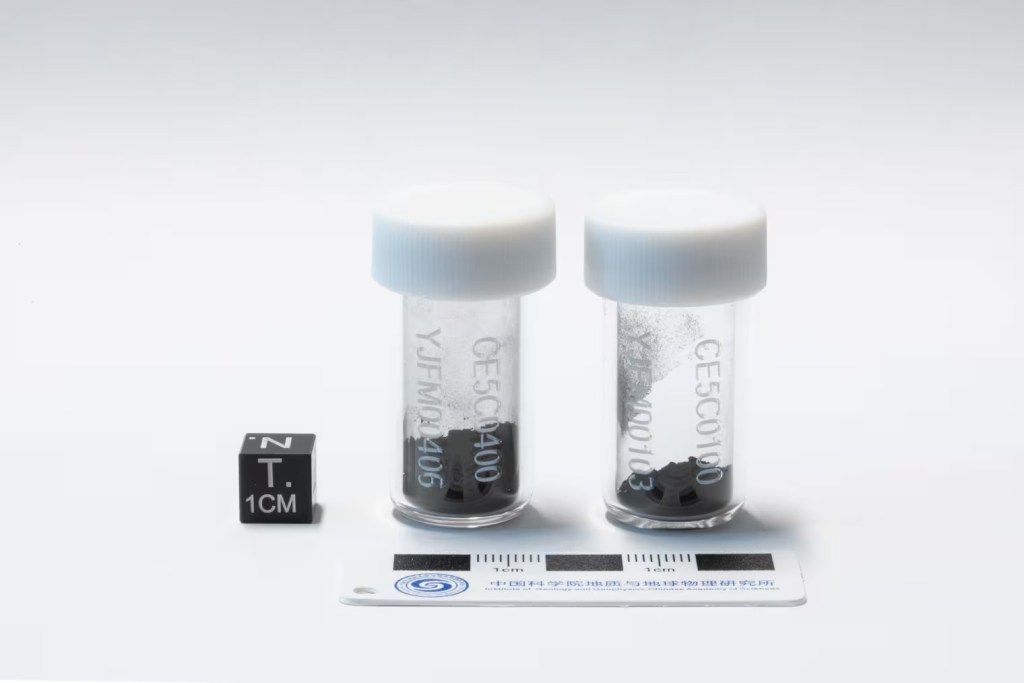
Using the new method, one metric tonne of lunar soil will be able to produce about 51 to 76 kilograms of water, equivalent to more than a hundred 500-millileter bottles of water, or the daily drinking water consumption of 50 people, the state broadcaster said.
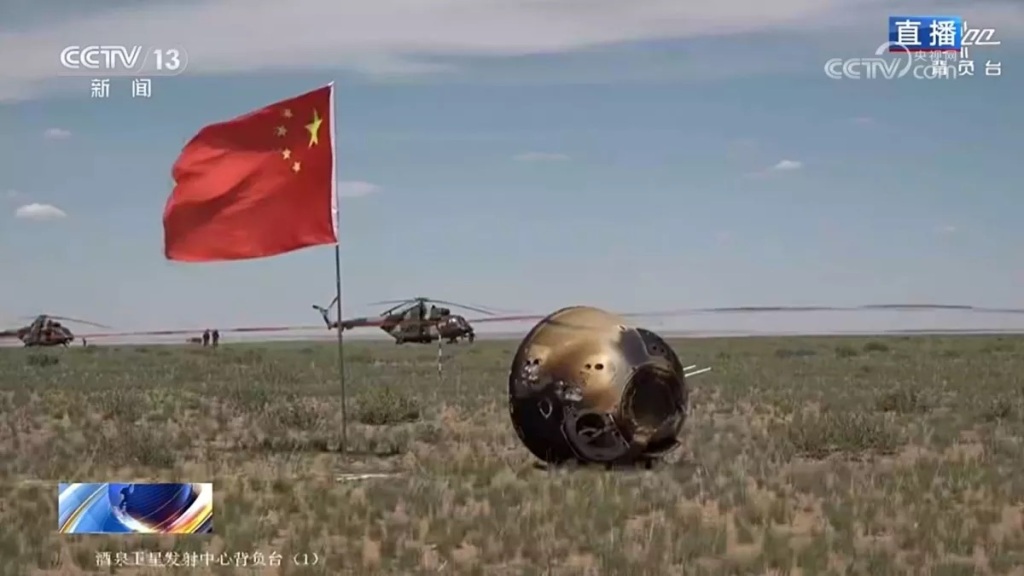
The soil was from the 2020 expedition, which was the first in 44 years to bring back soil from the Moon.
Considering all of NASA’s problems, it looks like China will have a moon base years before the US does…and probably in prime resource locations as well.
And don’t forget that the hydrogen in the soil can also be used for rocket fuel. It would be a lot easier to launch ships to Mars and beyond without having to deal with Earth’s gravity…
Researchers at Cornell have come up with a novel way to control a walking robot: with a mushroom.
Cornell explained in a press release that these four-legged “biohybrid” robots were built by researchers who literally grew mycelia, the belowground connective threads that allow fungal communities to communicate, into the robot itself.
Psyche! There are no “mycelial network” in space, and the drive would only work if we could somehow find a fifth spatial dimension (this was discussed a few years ago).
Too bad the spore drive is “laughably ridiculous,” said one scientist, and if all Star Trek ships had one, over half its episodes wouldn’t have happened.
Footage making the rounds on social media shows what appear to be astonishingly lifelike humanoid robots posing at the World Robot Conference in Beijing last week.
But instead of showing off the latest and greatest in humanoid robotics, two of the “robots” turned out to be human women cosplaying as futuristic gynoids, presumably hired by animatronics company Ex-Robots.
During the World Robot Conference 2024 in Beijing from Aug 21 – Aug 25, 🇨🇳 animatronics company EX-Robot (or EX Robots as reported by some news media) hired 2 women cosplayed as robots to spice up the exhibition.
Haven’t posted anything in about five or six weeks. Sorry!
I was going to initially post something about the Boeing crew that got stranded on the ISS, but NASA kept delaying their decision to use SpaceX. It was a given that they’d have no choice.
Boeing, quite obviously, cannot be trusted to spend millions of taxpayer’s dollars and make a proper spacecraft.
Anyway, I’ll start posting something more interesting soon.
In the meantime, here’s a Star Trek TOS selfie by Catwoman. I mean Lee Meriwether. (S3:14, That Which Survives)
The Perseids get their name because the shooting stars appear to stream from a point in the sky where the constellation of Perseus is located…The constellation rises in the northeast, but meteors should be visible all over the sky if conditions are clear.
The best time to watch is after midnight in the northern hemisphere. The meteors are actually debris leftover from the Swift-Tuttle comet, discovered in the early 1860s.
The annual celestial event started this past Sunday and lasts for about two months, but the peak this year is around August 12th.
Post a comment on Reddit, answer coding questions on Stack Overflow, edit a Wikipedia entry or share a baby photo on your public Facebook or Instagram feed and you are also helping to trainthe next generation of artificial intelligence.
West Japan Railways (West JR), one of six companies that make up Japan Railways Group, has unveiled a giant “humanoid robot” to work on heavy machinery on its lines…
Interesting that in English the official name is West Japan Railways Company, while in Japanese it’s JR Nishi-Nihon Guruupu (JR西日本グループ), which means Japan Railways West Japan Group. It’s one of six “companies” that comprise what used to be “National Railroad” (Kokutetsu), owned by the government.
JR West is renowned to be badly run and somewhat corrupt. I wonder about this “robot” project. With the increase in “human accidents” (ie people hit by a train), I think it’d be better to hire more workers than to reduce staff and have the top level desk jockeys pocket the…
But China has also offered to share at least some of its new moon samples with American researchers, and NASA is allowing the U.S. scientists to submit proposals.
This is a welcome change of heart. International politics need not prevent international space exploration.
On the other hand…
China is not planning a mere short-term, flags-and-footprints presence on the Moon. Their ambition is more like Nasa’s Artemis than it is Apollo. China plans to launch two separate missions to the south pole of the Moon around 2026 and 2028 – including testing using lunar soil to 3D print bricks – as precursors to a lunar base.
What jobs have I *not* had would be a better question.
Right…
Lawn mower (right after I got my “working papers” at age 14, along with my social security number — this is now assigned at birth in the US)
Pizza dough maker (seriously, that’s all I did at first)
Pizza maker and deli worker (same restaurant)
Tarred the school parking lot and roof (no idea what this job would be called)
McDonald’s (who hasn’t? Both opening and closing, including cleaning the deep oil fryer. Ugh.)
Gymnasium weight room staff
Gymnasium pool cleaner
Volleyball court setup and take down
Softball umpire (all four work-study jobs at college with a max number of hours per week)
Bookstore clerk (Barnes & Nobles)
Dishwasher (summer time only)
Short order cook (same restaurant as the dishwasher job)
Stock boy (stationery store for all of two days)
Temp worker (stuffing envelopes for three days, yawn)
Blockbuster clerk (out of business video rental store—anybody remember VHS tapes?)
Bookstore clerk (used bookstore in Ann Arbor, mostly stocking and organizing overflow in the basement, although I did help set up a comic book and gaming store annex)
First year composition teacher (this was a paid TA job for one semester in grad school)
Computer software store clerk (mall seasonal job—I got in trouble once for suggesting that a customer try another software store for a game series we didn’t carry rather than lie by saying we’d let him know when we got it; I hadn’t realized lying was company policy…)
Computer salesperson (my first “full time” job—I lasted two months—definitely not slick enough to work for sales commish)
Kinko’s (computer design department)
Weekly newspaper (computer layout)
A small H&R firm (computer design…you can probably sense a trend…)
Assistant language teacher (the jump to Japan)
Language instructor (late night after school cram school for junior high kids)
Assistant Professor (both part time and full time contractual)
Professor (it’s amazing now to see how I wound up teaching TESOL…)
This may not include some odds and ends here and there when I was in JHS and SHS. I worked a lot of summer jobs and Christmas/ New Year’s break jobs. I worked most weekends while I was a full time students, and most Friday evenings, too. I don’t recall the pay for all of them, but I remember the pizza dough job paid $3.15 an hour, and four years later McDonald’s paid a whopping $3.75 an hour.
You know, I’d be very interested to find out what jobs my colleagues have had. In college when I borrowed money to study abroad in Germany, my classmates wandered around Europe for the summer while I returned and had exactly $0 to my name and worked double-shifts. I wonder how many literature or history professors spent summer days getting burned on their arms with 400F cooking oil or getting yelled at by bankers because their document wasn’t printed fast enough…