The asteroids in question are Iris (124 miles / 200 km in diameter) and Massalia (84 miles / 135 km). Both are in the asteroid belt between Mars and Jupiter. Iris is about the size of the US state of Maryland, while Massalia is roughly the size of Connecticut.
Note that the same observatory also found water on the Moon, about a “12-ounce bottle” worth. Not nearly enough for a settlement, but where there’s surface water (albeit trapped in soil on the surface), there’s likely to be more underneath.
This time I tried “mmhmm” studio. Some bumps and bruises, but managed to survive!
Oh, and it doesn’t really have a “pronunciation guide.” Oops. The names (I thought) were fairly easy to pronounce. (Weng is not “wehng” but more like “wong,” or even “wung,” but otherwise straightforward…)
It’s also thought that water on Earth is largely (or entirely) the result of comets and asteroids bombarding it (it remains debatable to what degree Earth already had water, but since when it formed the Earth was first molten lava and then dry as a bone, I think it far more likely that water came here from elsewhere, and science tends to agree).
I’ve already blogged about the origins of Bringer of Light, when I (finally) finished the first draft back in early September. In a sense, I’ve been constantly blogging the science behind the story.
But I haven’t discussed the characters at all. And despite what some old-fashioned writers may think (just finished a particularly badly-written snarky “why your books don’t sell” piece of trash that claimed science fiction shouldn’t have any emotions in it…say what? sorry not sorry), if the characters of a story aren’t interesting, there isn’t much point in reading a story.
So for the next couple of weeks, I’ll write a bit about the characters — the crew of the Artemis, the crew of the Sagittarius, the UN flunkies (sorry, career politicos) on Mars and Luna and so forth. There are lots of characters, and their interaction is complicated. Or is it?
I would get into my scifi influences at this point, but long blogs are slogs. So I’ll come back to that tomorrow!
Coffee time. Also to finish up at least one unrelated project and also the hardcover manuscript (which needs to be a different paper size than the paperback for some reason).
The moment we’ve all been waiting for is nearly here!
Bringer of Light is finally set to be released on March 15, 2024! (Click the link to see a book synopsis and two brief excerpts; Smashwords also has an excerpt from the beginning chapters.)
Stop by Draft2Digital to see links to your favorite bookstore online!
UPDATE: I have some difficulty convincing D2D to distribute to Amazon. Therefore, I have decided to publish Bringer of Light directly on Amazon. Stop by here to order for Kindle (released March 15th). Paperback and hard cover are also in the works.
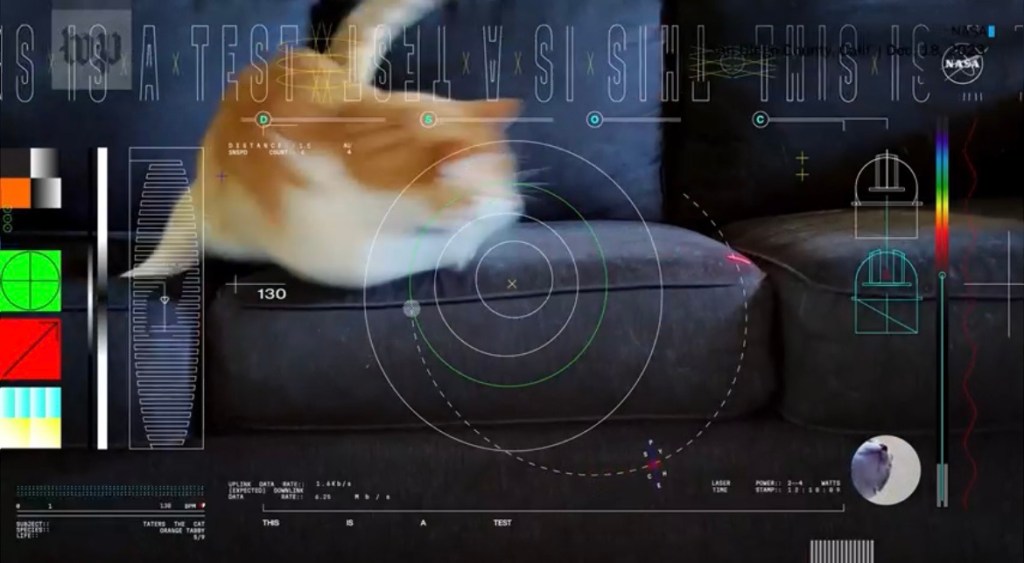
Taters the cat chases a laser pointer in a video sent to Earth from Psyche
Aiming the laser at the spacecraft so the transceiver knows where to point back is the most difficult part, Wright said. And because Earth and the spacecraft are both moving, the lasers must point to where the destination will be in a few minutes. “The beam’s so narrow, it can’t just point to Earth. It needs to know exactly where on Earth,” Wright said. “Trying to hit a dime from a mile away while you’re moving at 17,000 miles an hour — that’s the challenge.”
So NASA has been working on this idea for a while now. The invisible laser beam that carried this video file came from the Psyche probe, on its way to the asteroid belt between Mars and Jupiter.
Psyche is 19 million miles away right now. The laser beam took 108 seconds to reach Earth.
Mars and Earth are on average 140 million miles apart and can be up to 250 million miles apart depending on the timing of their respective orbits.
I don’t think lasers are the answer here. A good start, maybe, but you can do the math. Having to wait between 10 to 20 minutes, or more, for a one-way transmission (double that for an exchange of messages) would not be ideal for a human settlement in an emergency.
Star Trek style instant interstellar communication is still just scifi. Unless there’s still something out there we haven’t found yet, even quantum communication will take time…
But at least NASA has finally realized that non-science people like cat videos.
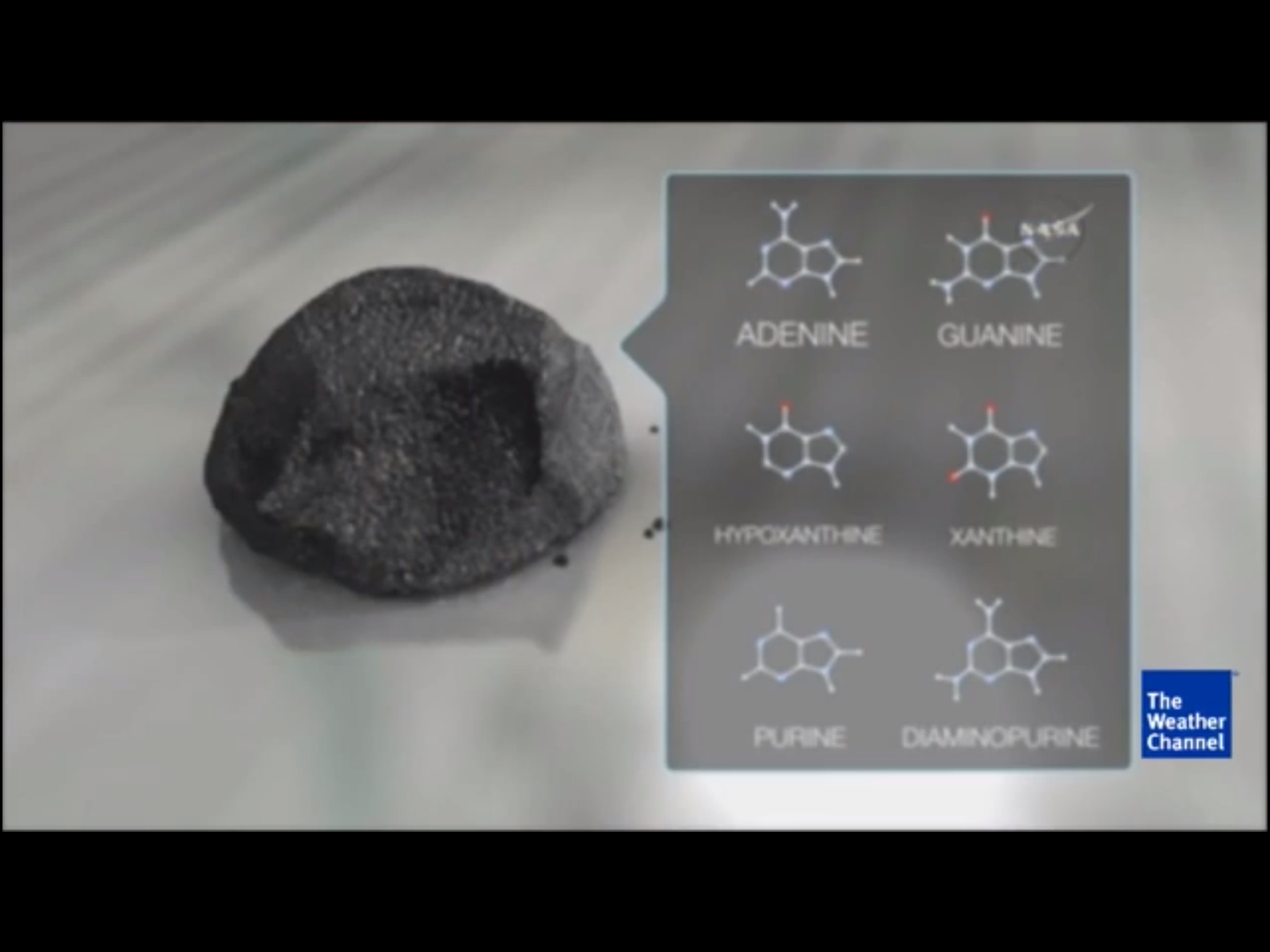
Carbon accounted for almost five percent of the sample’s total weight, and was present in both organic and mineral form, while the water was locked inside the crystal structure of clay minerals, he said.
Scientists believe the reason Earth has oceans, lakes and rivers is because it was hit with water-carrying asteroids 4 to 4.5 billion years ago, making it a habitable planet.
We have ample evidence now that all water on Earth was brought during the “Late Heavy Bombardment” period (4~4.5 billion years ago). Imagine how many rocks it took to get enough water (estimates anywhere between 20 and 200 million years of asteroid after asteroid slamming into the Earth).
And the only reason life exists on Earth is that there is enough iron and nickel in the Earth’s core to generate a magnetic field to prevent solar radiation from ripping off the atmosphere. Which is likely what happened to Mars.
(Alright, alright, technically electrical currents running through the liquid iron outer core as well as in the crust and ionosphere also contribute to the magnetic field. Go check out this horribly complicated explanation if you like.)
Note that this is the third time to get asteroid dust to examine. JAXA has managed to do this twice now. But Hayabusa-2 only got about 5 grams. The OSIRIS-REx project got about 250 grams (1/2 lb). Lots more = lots more to save for future researchers who will have developed even more sophisticated analysis methods.
Now lets get some PEOPLE on those things and start mining and living in space, already!
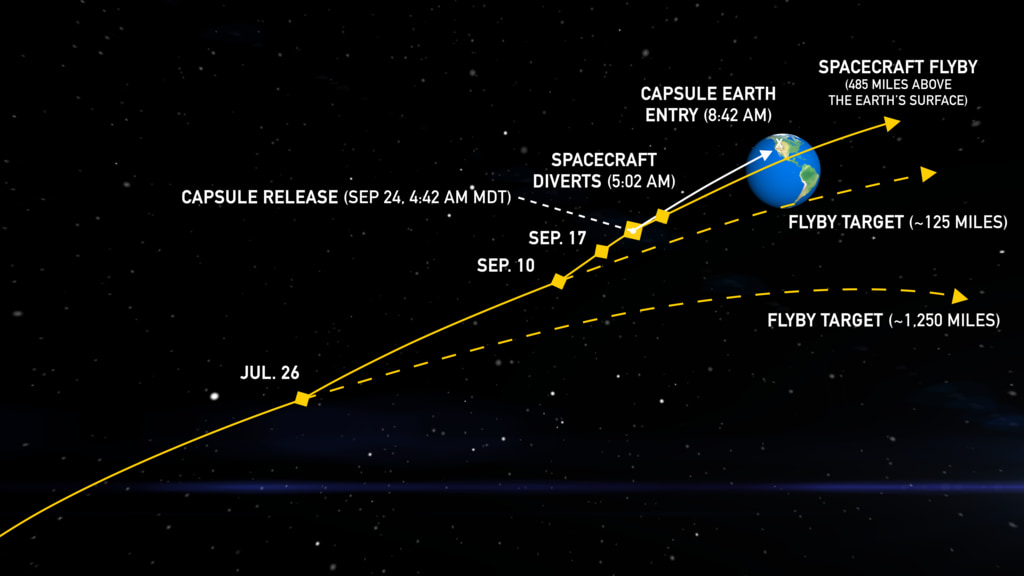
Currently, OSIRIS-REx is located at a distance of 7 million km from our planet. On September 24, OSIRIS-REx will drop a capsule with samples of asteroid matter, after which it will enter the earth’s atmosphere and land on the territory of the Utah Test and Training Range.
The tiny spacecraft launched back in 2016 and reached the asteroid Bennu in 2021.
One main reason for this mission is to find out what Bennu is made of. After the asteroid spewed out tiny “micromoons,” OSIRIS-REx successfully collected a tiny soil sample. By “tiny,” I mean less than 50 to 60 grams. And it couldn’t actually land, since the asteroid is too small to have enough gravity to support the spacecraft.
Now we have less than two weeks to find out what’s in the soil — assuming the capsule is retrieved without incident. And then OSIRIS-REx will head back out to visit yet another asteroid (Apophis) in 2029.
Yes, that famous “planet-killer” the media screamed about a few years ago as “the most dangerous asteroid in the world.” (uh. “in the world”?) It will “only” approach within 38,000 km in April 2029, but could possibly collide in 2036.
Way back in 2015, my good friend Rami Z Cohen came to me with an idea for a story. He had written two or three scenes about a group of asteroid hunters who stumbled upon something bizarre. The idea of mining asteroids was news at the time (and still is, although probably too expensive right now and not a worthwhile investment until we actually get some people in space who need metals without relying on NASA/ESA/JAXA/ISRO/etc).
So Rami and I began to email ideas back and forth for a few weeks, then we started to flesh out his characters and plot. I wrote a synopsis and outline and we hashed out the background.






 M Thomas Apple Author Page