Thanks to all who asked for a copy of Bringer of Light in the recent Goodreads giveaway!
Congratulations if you were a winner, and if you were not chosen by the system, take heart: there will be another giveaway in the near future. Thank you for your interest in my science fiction! I hope you enjoy reading it as much as I enjoy writing it!
If you could permanently ban a word from general usage, which one would it be? Why?
I would not ban any words from any language, ever. I am not a Language Nazi.
People should learn that words have power, words hurt, and words heal. People should learn when to say or write what to whom, when and where. Banning language does not prevent people from using language, and in fact simply adds to language power.
Only Nazis ban language. Think for yourself. Grow up!
It is wise to have decisions of great moment monitored by generalists. Experts and specialists lead you quickly into chaos. They are a source of useless nit-picking, the ferocious quibble over a comma….The expert looks backward; he looks into the narrow standards of his own speciality. The generalist looks outward; he looks for living principle, knowing full well that such principles change, that they develop.
The moment we’ve all been waiting for is nearly here!
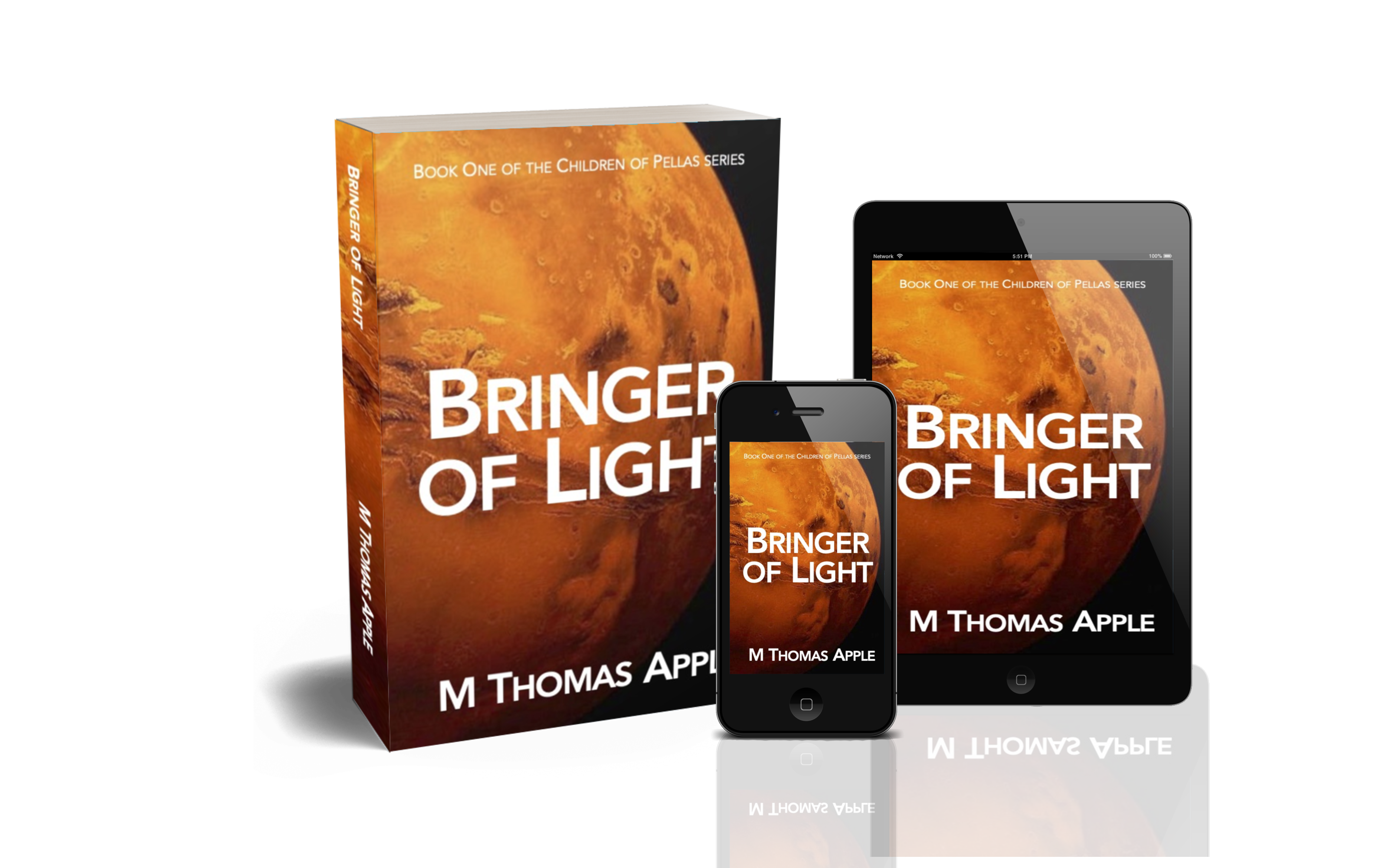
Bringer of Light is finally set to be released on March 15, 2024! (Click the link to see a book synopsis and two brief excerpts; Smashwords also has an excerpt from the beginning chapters.)
Stop by Draft2Digital to see links to your favorite bookstore online!
UPDATE: I have some difficulty convincing D2D to distribute to Amazon. Therefore, I have decided to publish Bringer of Light directly on Amazon. Stop by here to order for Kindle (released March 15th). Paperback and hard cover are also in the works.
Write (duh). I mean, this is obvious, right? (why does WP have an AI function now? I blog. Why would I want NOT to blog? Or use AI to blog? I don’t get it)
Read (duh). OK, read sci-fi and fantasy. And history. Especially ancient history.
Cook (seriously — I started doing this when I had to be separated from my family in 2018 and I found that it helps me calm down, eat healthier, and actually enjoy experimenting a little bit)
Play guitar (need more time for this — I find it more enjoyable to play bass but playing my faux-Gibson is more enjoyable bc I can actually play a whole tune lol)
Go on long, long walks by myself around the hills and mountains near my house so that I don’t feel so guilty about the Irish coffee waiting for me when I get back…
Wondering now if I should write the “five things I absolutely hate to have to do but generally have no say in the matter” or if I should wait and see if there is such a prompt…
I finally managed to get 1st edition copies of the famed Star Trek Readers, published in the late ’60s and early ’70s. My mother had copies when I was a kid, and they were among the first fictional stories I ever read.
The content varies slightly from the broadcast episodes, which apparently drew the ire of fans at the time. In defense of the British writer James Blish, he had not seen the episodes at the time of writing and was relying entirely on the scripts. As he himself wrote as an “Afterword” that appears (naturally) in the middle of the Reader II book, adapting script to prose is just as hard as adapting prose to scripts. Some scenes were skipped and dialogue boiled down to help the flow of the narrative, and fans were often upset to discover their favorite lines didn’t appear in the books.
The confusing part is the arrangement of each Reader into “books.” For example, Reader I (which has no label “I,” actually) consists of “Star Trek 2” (called “Book I”), “Star Trek 3” (Book II), and “Star Trek 8” (Book III). That reflects the original paperback publications by Bantam, but just makes things difficult. As a kid, I had no idea which episodes came before which. Not that it mattered! This was the first show I saw “in living color” — in the “TV room” of my grandparents’ house (we had a small black and white TV at home in the mid to late ’70s, so I never saw “The Incredible Hulk” (Bill Bixby and Lou Ferrigno) in color.)
All told, 59 of the original 79 ST: TOS episodes were adapted by Blish. Of the twenty not appearing in the Readers, “Mudd’s Women” and “What Are Little Girls Made of?” are odd exclusions. “Shore Leave” (the most childish of the first season episodes) is also not there. But there are still plenty to satisfy.
Two episodes were renamed by Blish for some reason; “The Man Trap” — the first episode broadcast but the third episode made — was renamed “The Unreal McCoy” (which gives away the plot), and “Charlie X” was renamed “Charlie’s Law.” The original pilot, “The Cage,” appears under the name “The Menagerie” as it was later broadcast (in two parts as part of the court martial of Spock, in which Star Trek characters watch Star Trek, but the novelized version omits the court martial framework — the “Afterword” comments that this script was covered in handwritten rewrites, making it difficult to work with.)
Most satisfying of all is the snarky dedication of Reader II — “To Harlan Ellison who was right all the time.”
Way back in 2015, my good friend Rami Z Cohen came to me with an idea for a story. He had written two or three scenes about a group of asteroid hunters who stumbled upon something bizarre. The idea of mining asteroids was news at the time (and still is, although probably too expensive right now and not a worthwhile investment until we actually get some people in space who need metals without relying on NASA/ESA/JAXA/ISRO/etc).
So Rami and I began to email ideas back and forth for a few weeks, then we started to flesh out his characters and plot. I wrote a synopsis and outline and we hashed out the background.