We compared current scientific theories of what makes humans conscious to compile a list of “indicator properties” that could then be applied to AI systems.
We don’t think systems that possess the indicator properties are definitely conscious, but the more indicators, the more seriously we should take claims of AI consciousness.
Last year, an engineer for Google who was working on what was then called “LaMDA” (later released as “Bard”) claimed that the software had achieved consciousness. He claimed it was like a small child and he could “talk” with it.
He was fired.
Bard, ChatGPT, Baidu, and so forth are advanced chatbots built on what’s called “Large Language Models” (LLM) and can generate text in an instant.
But the programs are not AI, strictly speaking. They have no sentience.
Both Russian and Ukrainian forces are integrating traditional weapons with AI, satellite imaging and communications, as well as smart and loitering munitions, according to a May report from the Special Competitive Studies Project, a non-partisan U.S. panel of experts. The battlefield is now a patchwork of deep trenches and bunkers where troops have been “forced to go underground or huddle in cellars to survive,” the report said.
I found it interesting that many people online were commenting about Iain M Bank’s take on AI (for an in-depth analysis of his Culture series check this out on Blood Knife) and how he “predicted” all this.
Uh. You know, I’m not sure whether Banks wrote much about integrating traditional weapons with AI (since I haven’t read his series). But I do know that PK Dick wrote a short story called “Second Variety” about trench warfare and AI robots making more versions of themselves and taking over the world.
I must explore alone. I will redefine the quality of being alone for generations to come. The word “alone” will no longer suffice — “aloneness,” the feeling human isolation; “alonetivity,” the alienation from society; “subjectivitis,” the alienation from the objective word; “individualreality,” the division from the former self.
Sometimes I wish I could put my thoughts directly onto paper. I think all the time, about everything…I see pictures in my head, pictures of my past — exact details of what I saw and experienced. Déjà-vu often occurs to me. It’s strange, that feeling of already having been someplace. Sometimes I can tell what’s going to happen in a matter of minutes. I can’t stand things like that — they send chills up my spine.
The lecture about Irish folk songs [note: at the time, I was in the Gaeltacht, west of Galway, learning Irish language] last night, two nights ago, whichever (time has no meaning in this place), was wrong. Why do we write, the léachtóir asked; to communicate; the poet wants to communicate.
No.
That is not why I write. Sometimes I write for fun, to play at words, to play with feelings. Sometimes I try to work out my problems myself in writing (I can’t). Sometimes I write just to relieve tension. Sometimes I write because I have to, because if I don’t get these words out of me and onto paper they’ll rip their way out.
All artificial intelligence, all robots and Chatbots and everything else electronically-programmed by a human being, will inevitably have human bias.
Even women prefer women’s voices to men’s when it comes to customer service.
On the other hand, women are also historically relegated to work with lower pay, lower status, kept out of positions of power — subject to the “male gaze.”
Now, we have AI that can be treated as sex objects. Even “married.”
So it is all “sinister,” as BBC asks?
Creepy, maybe. Sad, perhaps. Entirely predictable, definitely.
As we continue to lead more and more isolated individual lives, cut off from human contact and left unable to socialize, the rise of the “AI companion” seems inevitable…
ESA image. Gateway is planned to be much smaller and more cramped than ISS (about 1/6 the size).
NASA and its international partners see Gateway as a key platform to support the agency’s Artemis moon program and to build the technology required for future deep-space missions. Although the first elements of the small space station are expected to launch before the Artemis 3 mission lifts off in 2025 or 2026, NASA previously said that those astronauts will not use Gateway to “make that mission have a higher probability of success.”
While it’s a good idea to see some planning for this, I think maybe NASA should focus on getting Artemis 1 to work properly before they go on about Artemis 3 and 4.
Taking advantage of Gateway’s orbit far away from Earth’s protective magnetic field, three instruments will study risks due to radiation from the sun and from cosmic rays. Scientists hope this knowledge can help inform future long-term missions to the moon and Mars.
Since Gateway will orbit the Moon and not the Earth, the biggest problem will be preventing astronauts (and instruments!) from getting fried by solar radiation. Scientists need to come up with materials to shield people on Gateway and the Moon, or else we’re going nowhere…
One main reason for landing at the Moon’s South Pole is that the presence of water would help us build permanent settlements…
This region on the moon is an attractive place for humans to build a lasting presence due to the fact that water ice is located underfoot. Future moon-dwellers can potentially tap into that water for consumption, or even to create rocket propellant, instead of depending on water shipped from Earth.
Another reason has now been found…iron, manganese, aluminum, titanium…and “surprisingly” sulfur. Why should they be surprised? It’s already been established that the Moon has ice, and sulfur forms every time hydrocarbon and sulfates combine. Plus sulfur obviously results from volcanic activity, and it’s likely the Moon was volcanic when it first formed. And sulfur is also produced through nuclear fusion – i.e., the Sun.
So what can we do with this knowledge?
Having a more complete chemical composition of the lunar south pole area means future travelers to — and possible inhabitants of — the region can also plan for what else they don’t need to bring from Earth. In particular, some scientists have suggested moon-dwellers could use sulfur in bits of infrastructure such as building materials, solar cells and batteries.
Hmmm…I think more studies are needed first…define “bits,” for example.
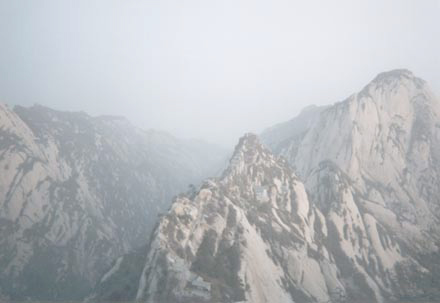
My legs, especially my left calf, still ache from Hua Shang. That experience alone justifies my whole trip. I walked 6 km starting at about 1pm. Stopping only once for maybe 15-20 minutes for a Sprite and a flashlight, I reached the North Peak (Bei Feng) at a little after 5. I really should have continued to the South Peak (the highest at 2160m), but at just before a particularly treacherous climb, a stranger offered to take my picture. He did this twice later; he then asked me where I was going, so because I told him North Peak, he led me to the North Peak Hotel. I signed into an expensive room, thinking a locked door proof against bag theft — but unnecessarily, as there were no other guests at all! I got a TV, a washbasin (no running water) and access to outdoor lavatories (Must have been the “private bath” the guidebook lied about). Public toilets basically meant an open outhouse shitting down the rock face — so much for sacred mountain vibes.
I slept and, waking at 4 am, set off to climb the Blue Dragon. Only then did I know why one traditionally climbed the mountain at night: to conquer fear. Once I began, I could not return. Grasping the iron-link chain with one hand and flashlight with the other, all I could see were tiny, steep steps underfoot and clear stars overhead. Most stairs were about 60º, but several inclined more, and at least one near the beginning of the Blue Dragon was almost vertical, certainly 80º. At the very end, just before the sunrise viewing point, was the actual peak (2100m). From atop an enormous boulder crowned with pine trees and a lone camp light came the voices of two crazy park workers, exhorting all to brave the true East Peak. A guide at the bottom told me to be careful before I attempted to climb the rock. But as I realized the steps were actually more than 90º, and that my pack was pulling me backward as I yanked myself up on the chains, I gave up and went down again after about 10 feet.
When I returned after watching daybreak, I looked down at the Dragon and could only marvel at my audacity; I had come alone at night, scared half out of my wits, with heavy packpack and asthma and glasses and only 1 free hand, and I had climbed steps narrower than the width of my foot. With sheer rock cliffs on both sides and only a single metal chain between me and a quickly plummeting death. I did it. I have nothing left to fear.




 M Thomas Apple Author Page