“Three things are needed for beauty: wholeness, harmony, radiance.” (as translated by “Stephen,” i.e., James Joyce.)
Or more simply integrity, consonance, clarity.
Note that the original is a bit longer, in St. Thomas Aquinas’ Summa Theologica:
Ad pulchritudinem tria requiruntur: Primo quidem integritas sive perfectio: quae enim diminuta sunt, hoc ipso turpia sunt. Et debita proportio sive consonantia. Et iterum claritas.
Sometimes I wish I could put my thoughts directly onto paper. I think all the time, about everything…I see pictures in my head, pictures of my past — exact details of what I saw and experienced. Déjà-vu often occurs to me. It’s strange, that feeling of already having been someplace. Sometimes I can tell what’s going to happen in a matter of minutes. I can’t stand things like that — they send chills up my spine.
It’s easy to see why fractals have been used to explain the complexity of human consciousness. Because they’re infinitely intricate, allowing complexity to emerge from simple repeated patterns, they could be the structures that support the mysterious depths of our minds.
But if this is the case, it could only be happening on the quantum level, with tiny particles moving in fractal patterns within the brain’s neurons. That’s why Penrose and Hameroff’s proposal is called a theory of “quantum consciousness”.
Quantum computers can only operate at extreme low temperatures (-272C, or -460F, which is basically colder than even the average temperature of outer space, so cold that we made up a new temperature scale called Kelvin to measure it — and no, the “Kelvin timeline” of Star Trek was not named after the temperature but after J J Abram’s grandfather).
So anyway, how is it possible that human consciousness can be considered “quantum” if we need (quite obviously) a much higher temperature to survive? (Making us controlled by classical physics and not quantum physics.)
Our brains are composed of cells called neurons, and their combined activity is believed to generate consciousness. Each neuron contains microtubules, which transport substances to different parts of the cell. The Penrose-Hameroff theory of quantum consciousness argues that microtubules are structured in a fractal pattern which would enable quantum processes to occur.
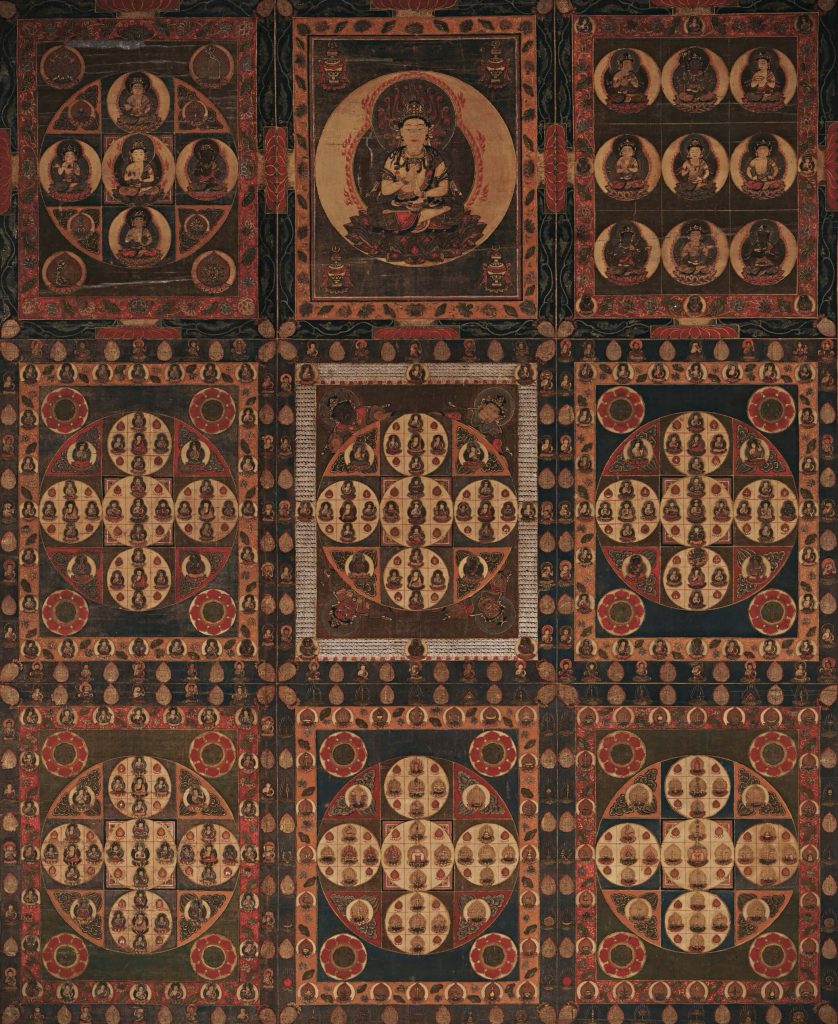
Scientists have measured electron wave functions (their quantum state) by injecting photons into two types of fractal structures, one triangular and one square-shaped (like the Sierpinski carpet pictured above). The next step would be to take quantum measurements from the brain’s microtubules.
Hmm. I think I’ve seen a shape similar to the Sierinski carpet somewhere before…
Way back in 2015, my good friend Rami Z Cohen came to me with an idea for a story. He had written two or three scenes about a group of asteroid hunters who stumbled upon something bizarre. The idea of mining asteroids was news at the time (and still is, although probably too expensive right now and not a worthwhile investment until we actually get some people in space who need metals without relying on NASA/ESA/JAXA/ISRO/etc).
So Rami and I began to email ideas back and forth for a few weeks, then we started to flesh out his characters and plot. I wrote a synopsis and outline and we hashed out the background.
The short story accused of violating the national security law, “Our Time,” is set in a dystopian 2050. It tells of an authoritarian future in which vast swaths of Hong Kong history have been erased from both the city’s structures and the public consciousness, and all aspects of life are subsumed under the Chinese Communist Party.
I’m not sure this is science fiction. Seems more like reality.
Every political entity wants power. When people resist being controlled, and they use a dialect or another form of the “official” language, those in charge try to eliminate the language of resistance.
When people write about a dystopian future in which they have no right to their own language, customs, ways of thinking and behaving, and political representation — and those in charge respond by banning the fiction — it really only shows the reality. And the reality is this:
Those in charge have small, frail, male egos that need constant stroking. Poor frail eggshell minds.
Language is power, because language is identity. Those in charge are always afraid of losing control over all three. And whenever they respond this way, they always get exactly the opposite of what they want.
The lecture about Irish folk songs [note: at the time, I was in the Gaeltacht, west of Galway, learning Irish language] last night, two nights ago, whichever (time has no meaning in this place), was wrong. Why do we write, the léachtóir asked; to communicate; the poet wants to communicate.
No.
That is not why I write. Sometimes I write for fun, to play at words, to play with feelings. Sometimes I try to work out my problems myself in writing (I can’t). Sometimes I write just to relieve tension. Sometimes I write because I have to, because if I don’t get these words out of me and onto paper they’ll rip their way out.
All artificial intelligence, all robots and Chatbots and everything else electronically-programmed by a human being, will inevitably have human bias.
Even women prefer women’s voices to men’s when it comes to customer service.
On the other hand, women are also historically relegated to work with lower pay, lower status, kept out of positions of power — subject to the “male gaze.”
Now, we have AI that can be treated as sex objects. Even “married.”
So it is all “sinister,” as BBC asks?
Creepy, maybe. Sad, perhaps. Entirely predictable, definitely.
As we continue to lead more and more isolated individual lives, cut off from human contact and left unable to socialize, the rise of the “AI companion” seems inevitable…
Today I talked to virtually no one for the first time in quite a while. It’s almost like meditation. Reminds me of what L said when we were out drinking Friday night (as usual). She and G were talking about scuba diving, about how being underwater hearing only your own breath and hardly being able to see anything unless it’s right in front of you gives you a feeling of being alone in the universe, a feeling of vulnerability and isolation, of insignificance. I commented, “That’s just like meditation.” No reaction.
I don’t need to go scuba diving in the Philippines to experience such a feeling.
ESA image. Gateway is planned to be much smaller and more cramped than ISS (about 1/6 the size).
NASA and its international partners see Gateway as a key platform to support the agency’s Artemis moon program and to build the technology required for future deep-space missions. Although the first elements of the small space station are expected to launch before the Artemis 3 mission lifts off in 2025 or 2026, NASA previously said that those astronauts will not use Gateway to “make that mission have a higher probability of success.”
While it’s a good idea to see some planning for this, I think maybe NASA should focus on getting Artemis 1 to work properly before they go on about Artemis 3 and 4.
Taking advantage of Gateway’s orbit far away from Earth’s protective magnetic field, three instruments will study risks due to radiation from the sun and from cosmic rays. Scientists hope this knowledge can help inform future long-term missions to the moon and Mars.
Since Gateway will orbit the Moon and not the Earth, the biggest problem will be preventing astronauts (and instruments!) from getting fried by solar radiation. Scientists need to come up with materials to shield people on Gateway and the Moon, or else we’re going nowhere…




 M Thomas Apple Author Page