How do significant life events or the passage of time influence your perspective on life?
I would say “yes.”
How?
Failure influences my perspective on life.
Successes influence my perspective on life.
Deaths influence my perspective on life.
Births influence my perspective on life.
Travel influences my perspective on life.
I would list the above five as “significant events” in life. But “the passage of time” is a little more vague.
Four years doesn’t seem like a long time to me now, but it sure did when I was 18.
Even six years doesn’t seem all that long now. But to my daughter who graduates from elementary school this March, six years is half her life.
My perspective on this question is that it’s the people in my life that have changed my perspective.
Even my daughter gets this. She wants to visit Australia, Canada, Singapore, and the US again because, as she put it, “a little piece of me is still there.”
I have arachnophobia in the first place and can’t even stand those little spiders that jump all around.
I came in the house once after working in the garden and realized a spider had gotten stuck in my hair (probably from weeding under the tomato plants).
Write (duh). I mean, this is obvious, right? (why does WP have an AI function now? I blog. Why would I want NOT to blog? Or use AI to blog? I don’t get it)
Read (duh). OK, read sci-fi and fantasy. And history. Especially ancient history.
Cook (seriously — I started doing this when I had to be separated from my family in 2018 and I found that it helps me calm down, eat healthier, and actually enjoy experimenting a little bit)
Play guitar (need more time for this — I find it more enjoyable to play bass but playing my faux-Gibson is more enjoyable bc I can actually play a whole tune lol)
Go on long, long walks by myself around the hills and mountains near my house so that I don’t feel so guilty about the Irish coffee waiting for me when I get back…
Wondering now if I should write the “five things I absolutely hate to have to do but generally have no say in the matter” or if I should wait and see if there is such a prompt…
All the answers, like the questions, are in here. Life has no meaning, I give it meaning and by doing so, seek to define it. But Life cannot be trapped; it is not an animal or emotion so easily caged, sated, confused, or led. It has a Will all its own, and Its Will merely Is. No thinking, no deliberation or pontification. No grandeur, no sweeping generalizations.
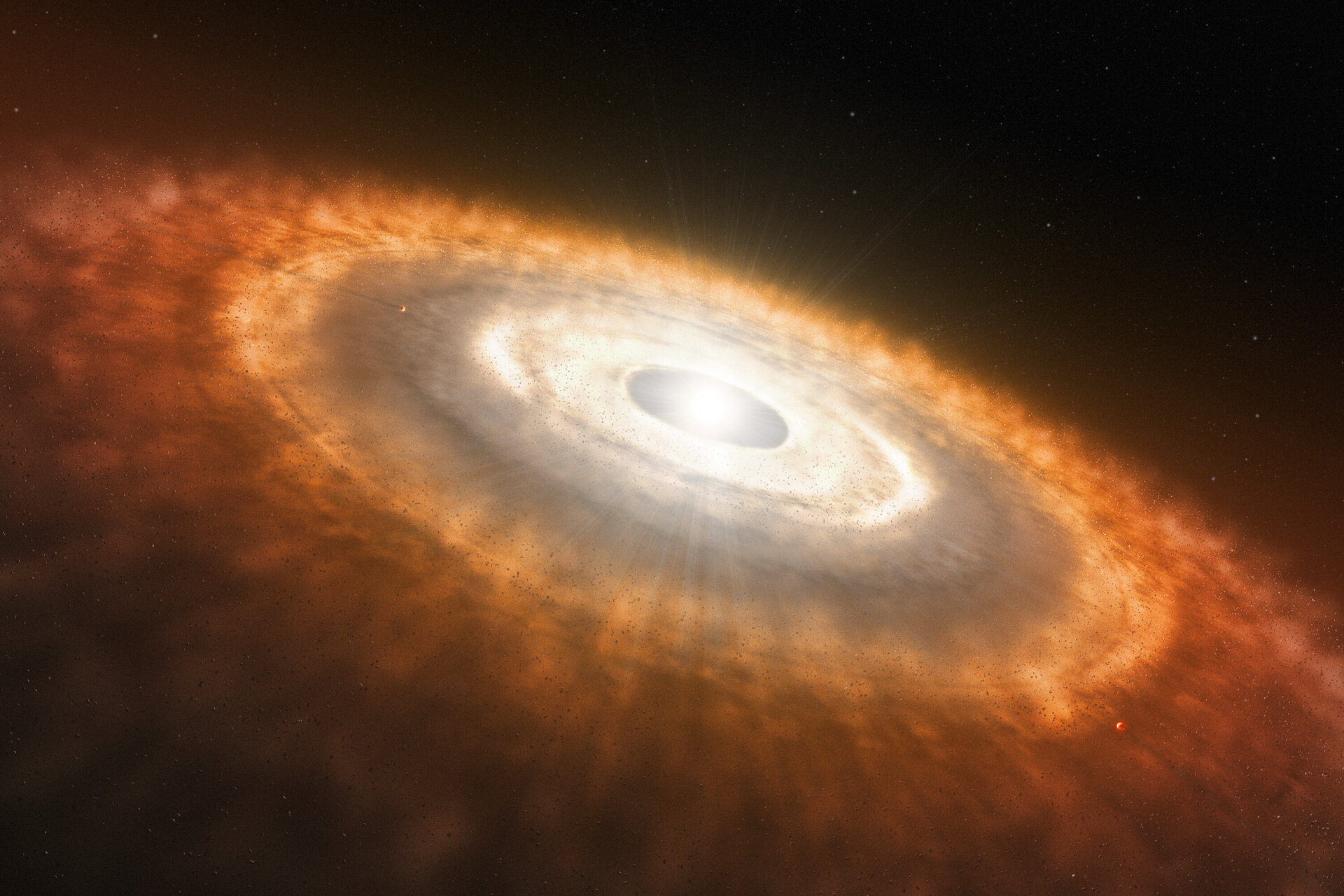
This is an artist’s impression of a young star surrounded by a protoplanetary disc in which planets are forming. An international team of astronomers have used the NASA/ESA/CSA James Webb Space Telescope to provide the first observation of water and other molecules in the inner, rocky-planet-forming regions of a disc in one of the most extreme environments in our galaxy. These results suggest that the conditions for rocky-planet formation, typically found in the discs of low-mass star-forming regions, can also occur in massive-star-forming regions and possibly a broader range of environments.
Because of its location near several massive stars in NGC6357, scientists expect XUE 1 to have been constantly exposed to a high ultraviolet radiation field throughout its life. However, in this extreme environment the team still detected a range of molecules that are the building blocks of rocky planets.
We compared current scientific theories of what makes humans conscious to compile a list of “indicator properties” that could then be applied to AI systems.
We don’t think systems that possess the indicator properties are definitely conscious, but the more indicators, the more seriously we should take claims of AI consciousness.
Last year, an engineer for Google who was working on what was then called “LaMDA” (later released as “Bard”) claimed that the software had achieved consciousness. He claimed it was like a small child and he could “talk” with it.
He was fired.
Bard, ChatGPT, Baidu, and so forth are advanced chatbots built on what’s called “Large Language Models” (LLM) and can generate text in an instant.
But the programs are not AI, strictly speaking. They have no sentience.
It’s easy to see why fractals have been used to explain the complexity of human consciousness. Because they’re infinitely intricate, allowing complexity to emerge from simple repeated patterns, they could be the structures that support the mysterious depths of our minds.
But if this is the case, it could only be happening on the quantum level, with tiny particles moving in fractal patterns within the brain’s neurons. That’s why Penrose and Hameroff’s proposal is called a theory of “quantum consciousness”.
Quantum computers can only operate at extreme low temperatures (-272C, or -460F, which is basically colder than even the average temperature of outer space, so cold that we made up a new temperature scale called Kelvin to measure it — and no, the “Kelvin timeline” of Star Trek was not named after the temperature but after J J Abram’s grandfather).
So anyway, how is it possible that human consciousness can be considered “quantum” if we need (quite obviously) a much higher temperature to survive? (Making us controlled by classical physics and not quantum physics.)
Our brains are composed of cells called neurons, and their combined activity is believed to generate consciousness. Each neuron contains microtubules, which transport substances to different parts of the cell. The Penrose-Hameroff theory of quantum consciousness argues that microtubules are structured in a fractal pattern which would enable quantum processes to occur.
Scientists have measured electron wave functions (their quantum state) by injecting photons into two types of fractal structures, one triangular and one square-shaped (like the Sierpinski carpet pictured above). The next step would be to take quantum measurements from the brain’s microtubules.
Hmm. I think I’ve seen a shape similar to the Sierinski carpet somewhere before…
The lecture about Irish folk songs [note: at the time, I was in the Gaeltacht, west of Galway, learning Irish language] last night, two nights ago, whichever (time has no meaning in this place), was wrong. Why do we write, the léachtóir asked; to communicate; the poet wants to communicate.
No.
That is not why I write. Sometimes I write for fun, to play at words, to play with feelings. Sometimes I try to work out my problems myself in writing (I can’t). Sometimes I write just to relieve tension. Sometimes I write because I have to, because if I don’t get these words out of me and onto paper they’ll rip their way out.
All artificial intelligence, all robots and Chatbots and everything else electronically-programmed by a human being, will inevitably have human bias.
Even women prefer women’s voices to men’s when it comes to customer service.
On the other hand, women are also historically relegated to work with lower pay, lower status, kept out of positions of power — subject to the “male gaze.”
Now, we have AI that can be treated as sex objects. Even “married.”
So it is all “sinister,” as BBC asks?
Creepy, maybe. Sad, perhaps. Entirely predictable, definitely.
As we continue to lead more and more isolated individual lives, cut off from human contact and left unable to socialize, the rise of the “AI companion” seems inevitable…









 M Thomas Apple Author Page