Show me a completely smooth operation and I’ll show you someone who’s covering mistakes. Real boats rock.
Frank Herbert, Chapterhouse: Dune
Today’s quote
March 2, 2024

March 2, 2024
Show me a completely smooth operation and I’ll show you someone who’s covering mistakes. Real boats rock.
Frank Herbert, Chapterhouse: Dune
March 1, 2024
Do you believe in fate/destiny?

Every choice closes off one path and opens another…
February 25, 2024

Astronomers have found three previously unknown moons in our solar system — two additional moons circling Neptune and one around Uranus.
https://www.nbcnews.com/science/space/astronomers-spot-new-tiny-moons-neptune-uranus-rcna140285
One takes nearly 27 years to circle Neptune.
The “new” moon of Uranus is only 8 kilometers (5 miles) in diameter.
And there are likely many more yet to be discovered.
February 22, 2024
What bores you?
What doesn’t?
OK, I guess I’ll play along…
February 14, 2024

A study published this weekend in the journal Monthly Notices of the Royal Astronomical Societyproposes that the oldest star in the Milky Way is a faint white dwarf that is about 10.7 billion years old and shining roughly 90 light years away from Earth.
https://www.popsci.com/science/the-milky-ways-oldest-star-is-a-white-hot-pyre-of-dead-planets/?fbclid=IwAR3smMe_OryfOHbM03X9HZIz9CcFu85LCsmGiNe5vaBh-7678xtPO4VOuxY
The Milky Way is old. Like, really, really old. One of the oldest galaxies.
This is probably what will eventually happen to our solar system. That’s right, everything will turn to rubble and get sucked into the dying Sun.
So, given all that, there’s only one thing for it…

February 13, 2024
“I’ll take ‘Barely Surviving’ for $100, Alec.”
February 12, 2024

Mimas, the smallest and innermost of Saturn‘s major moons, is believed to generate the right amount of heat to support a subsurface ocean of liquid water
https://www.space.com/saturn-moon-mimas-stealth-ocean-world
Unfortunately the “stealth ocean” is only a few million years old, not nearly enough to harbor life.
But it demonstrates the fact that water may in fact be common in space, opening the possibility of finding life on celestial bodies with older (much older) water sources.
(FYI: Mimas orbits Saturn once every 22 hours, and is affected by tidal forces from Saturn that appear to have melted part of its icy surface.)
January 20, 2024

A Japanese robot has successfully touched down on the Moon but problems with its solar power system mean the mission may live for just a few hours.
The Smart Lander for Investigating Moon (Slim) put itself gently on the lunar surface near an equatorial crater.
https://www.bbc.com/news/science-environment-68035314
Or SLIM, if you want to actually write acronyms properly (snark).
Also, it’s JAXA, not Jaxa. And NASA and ESA, not Nasa and Esa. But I digress.
Anyways, kudos but too bad yet another space mission failed. At this point I’m wondering how on Earth NASA managed to land people on the Moon so successfully in the 1960s and 1970s without killing half of them in the process. We can barely manage to get a tiny robot rover the size of a marble to land (see the link above for the picture of the “hopper” and “shape shifting” ball…curious about the “shape shifting” bit…)
December 20, 2023
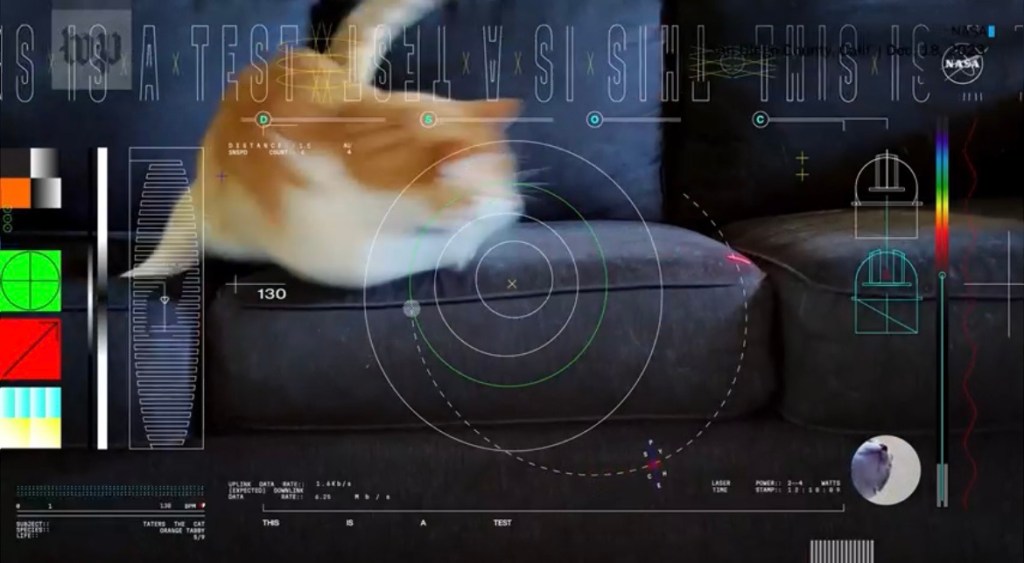
Aiming the laser at the spacecraft so the transceiver knows where to point back is the most difficult part, Wright said. And because Earth and the spacecraft are both moving, the lasers must point to where the destination will be in a few minutes.
https://www.washingtonpost.com/technology/2023/12/19/nasa-laser-video-streaming-space-mars-cat/
“The beam’s so narrow, it can’t just point to Earth. It needs to know exactly where on Earth,” Wright said. “Trying to hit a dime from a mile away while you’re moving at 17,000 miles an hour — that’s the challenge.”
So NASA has been working on this idea for a while now. The invisible laser beam that carried this video file came from the Psyche probe, on its way to the asteroid belt between Mars and Jupiter.
Psyche is 19 million miles away right now. The laser beam took 108 seconds to reach Earth.
Mars and Earth are on average 140 million miles apart and can be up to 250 million miles apart depending on the timing of their respective orbits.
I don’t think lasers are the answer here. A good start, maybe, but you can do the math. Having to wait between 10 to 20 minutes, or more, for a one-way transmission (double that for an exchange of messages) would not be ideal for a human settlement in an emergency.
Star Trek style instant interstellar communication is still just scifi. Unless there’s still something out there we haven’t found yet, even quantum communication will take time…
But at least NASA has finally realized that non-science people like cat videos.
🐈 🐈⬛
December 20, 2023
Sorry, everyone. It’s been a very stressful and exhausting stretch this month.
Family issues, health issues, work issues…
I need a serious break.
Writing Fanfiction in the worlds of Tolkien and Beyond!
Learning more about our place in the universe...
Best Tech Gadgets Advise
Marvel Comics Reviews, Previews and News
Writing blogs is miracle I am a writer blogger and my site mission is to give information on maximum information to audiences
Reflections of an inquiring retiree ...
Simple ideas to make every room feel stylish and welcoming
Rock & Metal Reviews That Hit Hard
Short stories | Reflections | Poetry
Read. Reflect. Grow


 M Thomas Apple Author Page