The comet has a core of dust, gas and ice surrounded by a bright cloud of gas known as a coma. Sunlight and solar radiation can heat the comet’s core, sometimes causing violent outbursts like the ones observed in July and Oct.
Herman said the comet’s temporary horns are thought to originate from these icy eruptions. The comet’s structure may be shaping how the spewed clouds of gas and ice appear from Earth, creating the appearance of horns to ground-based telescopes.
There is a difference between being alone and feeling alone; being isolated and feeling isolated; being rejected and feeling rejected. Reality and emotive perception have no relation, except that which the mind projects. Eliminate the projection, and the reality allows itself to become revealed.
Only I can permit this reality to become revealed; only I can perceive, how can another remove this perception from me, if I cannot myself? No one can rely on me, if I do not rely on myself. No one can be helped by me, if I do not help myself.
No one can help me not feel alone, if I cannot do it myself. Being alone is a function of reality and circumstance; feeling alone is a function of myself, not dependent upon external stimuli. This feeling is one I must remove myself. I cannot be two, if I cannot be one.
We compared current scientific theories of what makes humans conscious to compile a list of “indicator properties” that could then be applied to AI systems.
We don’t think systems that possess the indicator properties are definitely conscious, but the more indicators, the more seriously we should take claims of AI consciousness.
Last year, an engineer for Google who was working on what was then called “LaMDA” (later released as “Bard”) claimed that the software had achieved consciousness. He claimed it was like a small child and he could “talk” with it.
He was fired.
Bard, ChatGPT, Baidu, and so forth are advanced chatbots built on what’s called “Large Language Models” (LLM) and can generate text in an instant.
But the programs are not AI, strictly speaking. They have no sentience.
Carbon accounted for almost five percent of the sample’s total weight, and was present in both organic and mineral form, while the water was locked inside the crystal structure of clay minerals, he said.
Scientists believe the reason Earth has oceans, lakes and rivers is because it was hit with water-carrying asteroids 4 to 4.5 billion years ago, making it a habitable planet.
We have ample evidence now that all water on Earth was brought during the “Late Heavy Bombardment” period (4~4.5 billion years ago). Imagine how many rocks it took to get enough water (estimates anywhere between 20 and 200 million years of asteroid after asteroid slamming into the Earth).
And the only reason life exists on Earth is that there is enough iron and nickel in the Earth’s core to generate a magnetic field to prevent solar radiation from ripping off the atmosphere. Which is likely what happened to Mars.
(Alright, alright, technically electrical currents running through the liquid iron outer core as well as in the crust and ionosphere also contribute to the magnetic field. Go check out this horribly complicated explanation if you like.)
Note that this is the third time to get asteroid dust to examine. JAXA has managed to do this twice now. But Hayabusa-2 only got about 5 grams. The OSIRIS-REx project got about 250 grams (1/2 lb). Lots more = lots more to save for future researchers who will have developed even more sophisticated analysis methods.
Now lets get some PEOPLE on those things and start mining and living in space, already!
Both Russian and Ukrainian forces are integrating traditional weapons with AI, satellite imaging and communications, as well as smart and loitering munitions, according to a May report from the Special Competitive Studies Project, a non-partisan U.S. panel of experts. The battlefield is now a patchwork of deep trenches and bunkers where troops have been “forced to go underground or huddle in cellars to survive,” the report said.
I found it interesting that many people online were commenting about Iain M Bank’s take on AI (for an in-depth analysis of his Culture series check this out on Blood Knife) and how he “predicted” all this.
Uh. You know, I’m not sure whether Banks wrote much about integrating traditional weapons with AI (since I haven’t read his series). But I do know that PK Dick wrote a short story called “Second Variety” about trench warfare and AI robots making more versions of themselves and taking over the world.
[Note to self – it’s probably not a coincidence that so many of my better diary entries were written in August. I obviously have more time to think and write at that time of year!]
What strange turns my life has taken. Never would I have in a million years expected to be here, now, in this apartment, typing on an extended keyboard into a Japanese computer, in a Japanese city, listening to the same Cure tape I was listening to back in 1996. Has it actually been 8 years?
Ten years ago I was playing role playing games and drinking in Robbins lounge, getting ready to pack everything I owned into a moving van to move to Ann Arbor. A city I didn’t know, with no money for deposit or rent, or a job. Without a clue. Totally hopeless. Instead of exploring the city, I stayed in my bedroom and played games or typed. What was I thinking? I can’t even get in touch with the few people I met there. Even the ones I knew at ND are either gone back where they came from or no longer answer my emails.
I can still picture them all in my mind. I can still see the rooms I lived in, all the way back home. Even the freshman dorm room which no longer exists, since they tore the building down. How can that be?
It must be this which makes us human; the ability to take the visual and turn it into mental. The capacity to make emotional connections between the world outside and the world inside. The belief that there are two worlds. This makes us human, and at the same time it makes us separate. It is a false belief, that we are not of the outside. Yet there is no returning. Once we start, we can never stop. Even changing languages doesn’t help. We merely start over again from a new perspective, still outside the outside.
I must explore alone. I will redefine the quality of being alone for generations to come. The word “alone” will no longer suffice — “aloneness,” the feeling human isolation; “alonetivity,” the alienation from society; “subjectivitis,” the alienation from the objective word; “individualreality,” the division from the former self.
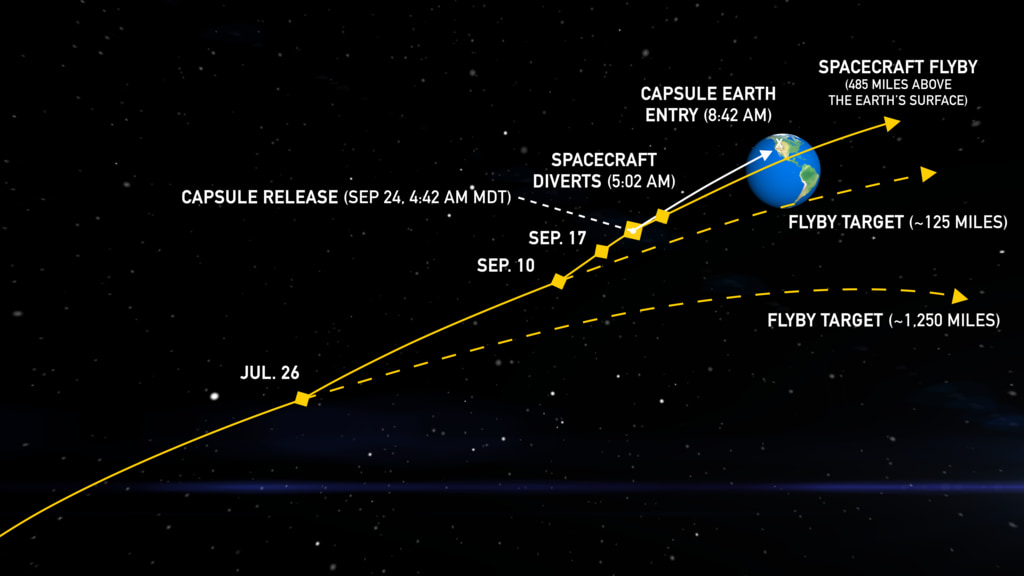
Currently, OSIRIS-REx is located at a distance of 7 million km from our planet. On September 24, OSIRIS-REx will drop a capsule with samples of asteroid matter, after which it will enter the earth’s atmosphere and land on the territory of the Utah Test and Training Range.
The tiny spacecraft launched back in 2016 and reached the asteroid Bennu in 2021.
One main reason for this mission is to find out what Bennu is made of. After the asteroid spewed out tiny “micromoons,” OSIRIS-REx successfully collected a tiny soil sample. By “tiny,” I mean less than 50 to 60 grams. And it couldn’t actually land, since the asteroid is too small to have enough gravity to support the spacecraft.
Now we have less than two weeks to find out what’s in the soil — assuming the capsule is retrieved without incident. And then OSIRIS-REx will head back out to visit yet another asteroid (Apophis) in 2029.
Yes, that famous “planet-killer” the media screamed about a few years ago as “the most dangerous asteroid in the world.” (uh. “in the world”?) It will “only” approach within 38,000 km in April 2029, but could possibly collide in 2036.
A story must be more than merely a story. It must be an examination, of the human heart, of the mind, of the spirit. Of experience and existence. A simple recapitulation of one’s personal past or the delusional suffering of a dysfunctional suburban American family have no merit. Overcoming the reality we believe we live in, debunking fiction and elevating the truth, that is worthwhile.





 M Thomas Apple Author Page